
|
受注:045-509-1970 |
技術サポート:tech@selleck.co.jp 平日9:00〜18:00 1営業日以内にご連絡を差し上げます |
化学情報
|
Synonyms | N/A | Storage (From the date of receipt) |
3 years -20°C powder 1 years -80°C in solvent |
|||
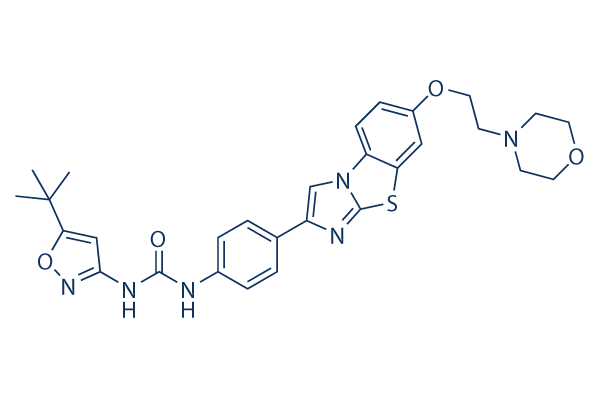
| 化学式 | C29H32N6O4S |
||||||
| 分子量 | 560.67 | CAS No. | 950769-58-1 | ||||
| Solubility (25°C)* | 体外 | DMSO | 33 mg/mL (58.85 mM) | ||||
| Water | Insoluble | ||||||
| Ethanol | Insoluble | ||||||
| 体内 (毎回新しく調製した物を用意してください) |
|
||||||
|
* <1 mg/ml means slightly soluble or insoluble. * Please note that Selleck tests the solubility of all compounds in-house, and the actual solubility may differ slightly from published values. This is normal and is due to slight batch-to-batch variations. |
|||||||
溶剤液(一定の濃度)を調合する
生物活性
| 製品説明 | Quizartinib (AC220) is a second-generation FLT3 inhibitor for Flt3(ITD/WT) with IC50 of 1.1 nM/4.2 nM in MV4-11 and RS4;11 cells, respectively, 10-fold more selective for Flt3 than KIT, PDGFRα, PDGFRβ, RET, and CSF-1R. Quizartinib (AC220) induces apoptosis of tumor cells. Phase 3. |
|---|---|
| in vitro | AC220, a unique, potent and selective inhibitor of FLT3, has high affinity for FLT3 with a Kd value of 1.6 nM. This compound inhibits the autophosphorylation of FLT3 in the human leukemia cell lines MV4-11 which harbor a homozygous FLT3-ITD mutation and is FLT3 dependent, and RS4;11 which expresses wild-type FLT3 with IC50 values of 1.1 nM and 4.2 nM, respectively. It is the most potent cellular FLT3-ITD inhibitor, leading to the most significant inhibition of MV4-11 cell proliferation with IC50 of 0.56 nM compared to all other FLT3 inhibitors whose IC50 values range from 0.87 nM to 64 nM. This chemical has no inhibitory activity against the proliferation of A375 cells which harbor an activating mutation in BRAF and are not FLT3 dependent, indicating a large window between FLT3 inhibition and general cytotoxic effects. [1] |
| in vivo | Oral administration of AC220 (10 mg/kg) induces time-dependent inhibition of FLT3 autophosphorylation in the FLT3-ITD–dependent MV4-11 tumor xenograft mouse model; the inhibition being 90% at 2 hours and 40% at 24 hours. This compound significantly extends survival in a mouse model of FLT3-ITD AML with doses as low as 1 mg/kg given orally once a day. Treatment with this chemical at 10 mg/kg for 28 days results in rapid and complete regression of tumors in all mice with no tumor regrowth during the 60-day posttreatment period. It displays more significant efficacy compared to sunitinib treatment which causes tumors to shrink slowly and resume growth immediately upon discontinuation of treatment in all but one of the mice. [1] |
| 特徴 | The most potent cellular FLT3-ITD inhibitor. |
プロトコル(参考用のみ)
| キナーゼアッセイ | Inhibition of FLT3 autophosphorylation | |
|---|---|---|
| To measure inhibition of FLT3 autophosphorylation, MV4-11 or RS4;11 cells are cultured in low serum media (0.5% FBS) overnight and seeded at a density of 400 000 cells per well in a 96-well plate the following day. The cells are incubated with different concentrations of this compound for 2 hours at 37 °C. To induce FLT3 autophosphorylation in RS4;11 cells, 100 ng/mL FLT3 ligand is added for 15 minutes after the 2-hour incubation with this chemical. Cell lysates are prepared and incubated in 96-well plates precoated with a total FLT3 capture antibody. The coated plates are incubated with either a biotinylated antibody against FLT3 to detect total FLT3 or an antibody against phosphotyrosines to detect FLT3 autophosphorylation. In both cases, a SULFO-tagged streptavidin secondary antibody is used for electrochemiluminescence detection on the Meso Scale Discovery platform. The concentration of this compound that inhibits FLT3-ITD or TLT3-WT autophosphorylation by 50% represents IC50 value | ||
| 細胞アッセイ | 細胞株 | MV4-11 and RS4;11 cells |
| 濃度 | Dissolved in DMSO, final concentration ~20 μM | |
| 反応時間 | 72 hours | |
| 実験の流れ | Cells are cultured overnight in low serum media (0.5% FBS), seeded in a 96-well plate at 40 000 cells per well and exposed to this compound for 72 hours at 37 °C. Cell viability is measured using the Cell Titer-Blue Cell Viability Assa | |
| 動物実験 | 動物モデル | Female NU/NU or severe combined immunodeficient mice implanted with MV4-11 cells |
| 投薬量 | ~10 mg/kg | |
| 投与方法 | Oral gavage | |
参考
|
カスタマーフィードバック
-
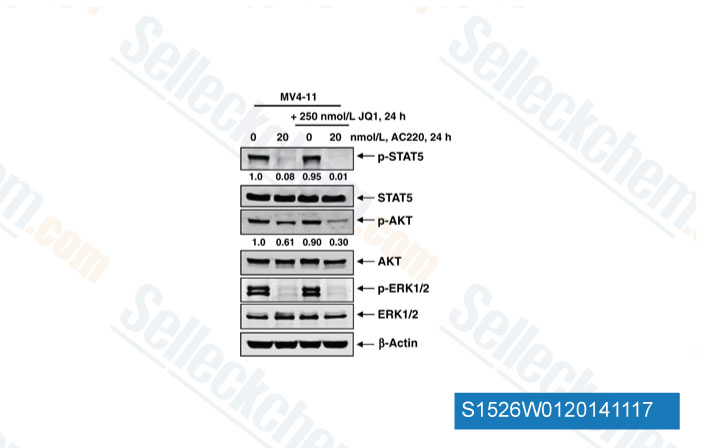
Data from [Data independently produced by Mol Cancer Ther, 2014, 13(10), 2315-27]
-
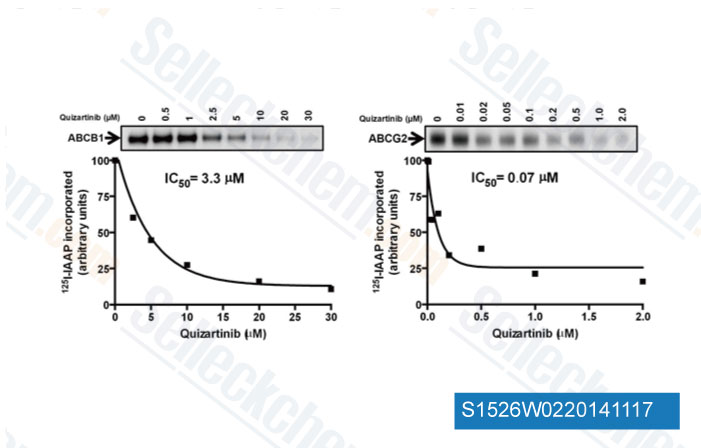
Data from [Data independently produced by PLoS One, 2013, 8(8), e71266]
-
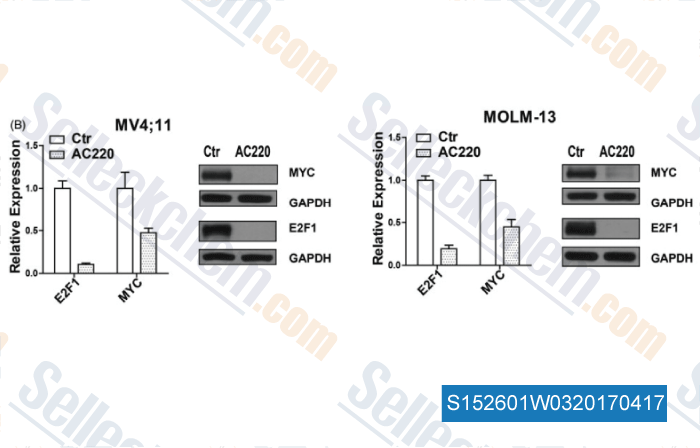
, , Leuk Lymphoma, 2017, 58(10):2426-2438
Selleckの高級品が、幾つかの出版された研究調査結果(以下を含む)で使われた:
| High mtDNA content identifies oxidative phosphorylation-driven acute myeloid leukemias and represents a therapeutic vulnerability [ Signal Transduct Target Ther, 2025, 10(1):222] | PubMed: 40653487 |
| ADH5/ALDH2 dehydrogenases and DNA polymerase theta protect normal and malignant hematopoietic cells from formaldehyde challenge: therapeutic implications [ Leukemia, 2025, 39(9):2152-2162] | PubMed: 40640557 |
| Dual targeting of CDK6 and LSD1 is synergistic and overcomes differentiation blockade in AML [ EMBO Mol Med, 2025, 10.1038/s44321-025-00296-2] | PubMed: 40883610 |
| Chaperone-mediated autophagy regulates the metastatic state of mesenchymal tumors [ EMBO Mol Med, 2025, 17(4):747-774] | PubMed: 40055574 |
| FLT3 inhibitors induce p53 instability, driven by STAT5/MDM2/p53 competitive interactions in acute myeloid leukemia [ Cancer Lett, 2025, 611:217446] | PubMed: 39756787 |
| Inhibition of NLRP3 enhances pro-apoptotic effects of FLT3 inhibition in AML [ Cell Commun Signal, 2025, 23(1):53] | PubMed: 39875995 |
| FLT3-ITD promotes immune checkpoint CD80 via ROS elevation in acute myeloid leukemia [ Front Immunol, 2025, 16:1577313] | PubMed: 40746567 |
| Conventional type 1 dendritic cells in the lymph nodes aggravate neuroinflammation after spinal cord injury by promoting CD8+ T cell expansion [ Mol Med, 2025, 31(1):37] | PubMed: 39901071 |
| Anti-Tumor Effects of Gilteritinib on FLT3 Mutations: Insights into Resistance Mechanisms in Ba/F3 Cell Models [ Onco Targets Ther, 2025, 18:489-501] | PubMed: 40196870 |
| Multi-selective RAS(ON) Inhibition Targets Oncogenic RAS Mutations and Overcomes RAS/MAPK-Mediated Resistance to FLT3 and BCL2 Inhibitors in Acute Myeloid Leukemia [ bioRxiv, 2025, 2025.06.10.658786] | PubMed: 40661530 |
長期の保管のために-20°Cの下で製品を保ってください。
人間や獣医の診断であるか治療的な使用のためにでない。
各々の製品のための特定の保管と取扱い情報は、製品データシートの上で示されます。大部分のSelleck製品は、推薦された状況の下で安定です。製品は、推薦された保管温度と異なる温度で、時々出荷されます。長期の保管のために必要とされてそれと異なる温度で、多くの製品は、短期もので安定です。品質を維持するが、夜通しの積荷のために最も経済的な貯蔵状況を用いてあなたの送料を保存する状況の下に、製品が出荷されることを、我々は確実とします。製品の受領と同時に、製品データシートの上で貯蔵推薦に従ってください。