
|
受注:045-509-1970 |
技術サポート:tech@selleck.co.jp 平日9:00〜18:00 1営業日以内にご連絡を差し上げます |
生物学的記述
| Specificity | Phospho-PERK (Thr980) Antibody [E9N5] detects endogenous levels of total PERK protein only when it is phosphorylated at Thr980. |
|---|---|
| Background | Phospho-PERK (Thr980) designates the activated form of protein kinase–like endoplasmic reticulum kinase (PERK/EIF2AK3) in which the conserved threonine residue within the activation loop of the cytoplasmic kinase domain is autophosphorylated, marking engagement of the PERK arm of the unfolded protein response and coupling ER stress to translational control and downstream signaling. PERK is a type I ER transmembrane serine/threonine kinase with a luminal stress-sensing domain that binds the chaperone BiP under basal conditions and a cytosolic kinase region that dimerizes and oligomerizes upon BiP release and accumulation of misfolded proteins, creating a platform for activation-loop phosphorylation at Thr980 and related residues. Autophosphorylation at Thr980 stabilizes the active conformation of the kinase domain and enables efficient phosphorylation of eIF2α on Ser51, which reduces global cap-dependent translation while permitting selective translation of stress-responsive mRNAs, including ATF4, thereby decreasing ER protein load and initiating transcriptional programs for amino acid metabolism, antioxidant defense, and apoptosis regulators. Thr980 phosphorylation is therefore widely used as a biochemical surrogate for PERK activity, and phospho-specific antibodies raised against a phosphopeptide encompassing this residue detect increased P‑Thr980 upon treatment with ER stressors such as tunicamycin or thapsigargin in multiple cell types. PERK signaling contributes to G1 growth arrest through loss of cyclin D1 and promotes adaptation or cell death depending on stress intensity and duration, and defects in PERK (including loss-of-function mutations in EIF2AK3) underlie Wolcott–Rallison syndrome, emphasizing the importance of regulated PERK activation in β cell survival and systemic homeostasis. |
使用情報
| Application | WB | Dilution |
|
||
|---|---|---|---|---|---|
| Reactivity | Rat | ||||
| Source | Rabbit Monoclonal Antibody | MW | 125 kDa | ||
| Storage Buffer | PBS, pH 7.2+50% Glycerol+0.05% BSA+0.01% NaN3 | Storage (from the date of receipt) |
-20°C (avoid freeze-thaw cycles), 2 years | ||
References
|
Application Data
WB
Validated by Selleck
-
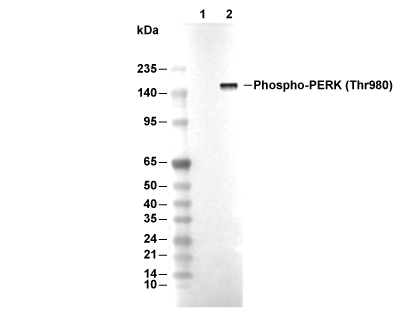 Lane 1: AR42J, Lane 2: AR42J (thapsigargin (Tg), 1 μM, 20 min)