
|
受注:045-509-1970 |
技術サポート:tech@selleck.co.jp 平日9:00〜18:00 1営業日以内にご連絡を差し上げます |
化学情報

|
Synonyms | AXL1717 | Storage (From the date of receipt) |
3 years -20°C powder 1 years -80°C in solvent |
|||||||
| 化学式 | C22H22O8 |
||||||||||
| 分子量 | 414.41 | CAS No. | 477-47-4 | ||||||||
| Solubility (25°C)* | 体外 | DMSO (warmed with 50ºC water bath) | 82 mg/mL (197.87 mM) | ||||||||
| Water | Insoluble | ||||||||||
| Ethanol | Insoluble | ||||||||||
| 体内 (毎回新しく調製した物を用意してください) |
|
||||||||||
|
* <1 mg/ml means slightly soluble or insoluble. * Please note that Selleck tests the solubility of all compounds in-house, and the actual solubility may differ slightly from published values. This is normal and is due to slight batch-to-batch variations. |
|||||||||||
溶剤液(一定の濃度)を調合する
生物活性
| 製品説明 | Picropodophyllin (PPP, AXL1717) is a IGF-1R inhibitor with IC50 of 1 nM. It displays selectivity for IGF-1R and does not coinhibit tyrosine phosphorylation the IR, or of a selected panel of receptors less related to IGF-IR(FGF-R, PDGF-R, OR EGF-R). Picropodophyllin (PPP) induces apoptosis with antineoplastic activity. |
|---|---|
| in vitro | In intact cells, Picropodophyllin (PPP) efficiently inhibits IGF-1-stimulated IGF-1R, Akt (Ser 473) and Erk1/2 phosphorylation. It specifically inhibits cell growth, and induces apoptosis in cultured IGF-1R-positive tumor cells. [1] This compound synergistically sensitizes HMCL, primary human MM and murine 5T33MM cells to ABT-737 and ABT-199 by further decreasing cell viability and enhancing apoptosis. [3] It also synergistically suppresses the proliferation and motility of hepatocellular carcinoma cells. [4] |
| in vivo | In SCID mice xenografted with human ES-1, BE, and PC3, Picropodophyllin (PPP) (20 mg/kg/12 h, i.p.) causes complete tumor regression. [1] In the 5T33MM mouse model, it also shows a marked antitumor activity and causes a significant increase in survival. [2] |
プロトコル(参考用のみ)
| キナーゼアッセイ | In vitro tyrosine kinase assays. | |
|---|---|---|
| Assay of IGF-1R-catalyzed substrate phosphorylation of pTG, using a 96-well plate tyrosine kinase assay kit, is performed. We use recombinant epidermal growth factor receptor, immunoprecipitated IR from HEPG2, immunoprecipitated IGF-1R from P6 cells, and IGF-1R immunodepleted supernatant from P6 (representing “non-IGF-1R tyrosine kinases”). After 30-min treatment of the receptors with Picropodophyllin (PPP) in the kinase buffer [50 mM HEPES buffer (pH 7.4), 20 mM MgCl2, 0.1 MnCl2, and 0.2 Na3VO4], the kinase reaction is activated by addition of ATP. The phosphorylated polymer substrate is probed with a phosphotyrosine-specific monoclonal antibody conjugated to horseradish peroxidase, clone PT-66. Color is developed with horseradish peroxidase chromogenic substrate O-phenylenediamine dihydrochloride and quantitated by spectrophotometry (ELISA reader). IGF-1R tyrosine autophosphorylation is analyzed by a sandwich ELISA assay. Briefly, 96-well plates are coated overnight at 4°C with 1 μg/well of an antibody to IGF-1R β-subunit. The plates are blocked with 1% BSA in PBS Tween for 1 h, and then 80 μg/well of total protein lysate from the P6 cell line is added. As a negative control we use total protein lysate from the R- cell line. This compound is added in tyrosine kinase buffer without ATP at room temperature for 30 min before kinase activation with ATP. Kinase assay is performed using the Sigma kit (see above). After spectrophotometry the IC50 values of inhibitors are determined using the REGRESSION function of Statistica program. | ||
| 細胞アッセイ | 細胞株 | Melanoma cells (FM 55, SK-MEL-28, SK-MEL-5, C8161, DFB, DFW and AA), sarcoma cells (RD-ES), breast carcinoma cells (MCF 7), prostate carcinoma cells (PC3), hepatoma cells (HepG2) and embryonic mouse fibroblasts (P6 and R-) |
| 濃度 | ~15 μM | |
| 反応時間 | 48 hours | |
| 実験の流れ | All of the standards and experiments for Picropodophyllin (PPP) are performed in triplicates using the Cell proliferation kit II, which is based on colorimetric change of the yellow tetrazolium salt 2,3-bis[2-methoxy-4-nitro-5-sulfophenyl]-2H-tetrazolium-5-carboxanilide inner salt in orange formazan dye by the respiratory chain of viable cell. |
|
| 動物実験 | 動物モデル | SCID mice bearing ES-1, BE, or PC3 xenografts that express IGF-1R, or R- v-src (IGF-1R negative) and P12 (overexpressing IGF-1 and IGF-1R) |
| 投薬量 | 20 mg/kg/12 h | |
| 投与方法 | i.p. | |
参考
|
カスタマーフィードバック
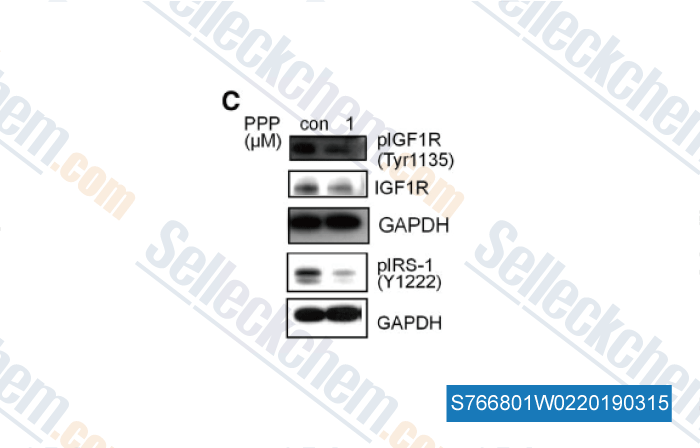
-
Data from [Data independently produced by , , Blood, 2013, 122(9):1621-33]
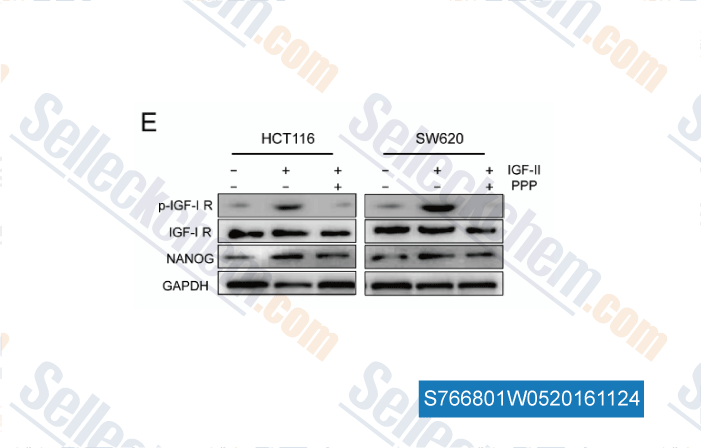
-
Data from [Data independently produced by , , Stem Cells, 2016, 34(4):820-31.]
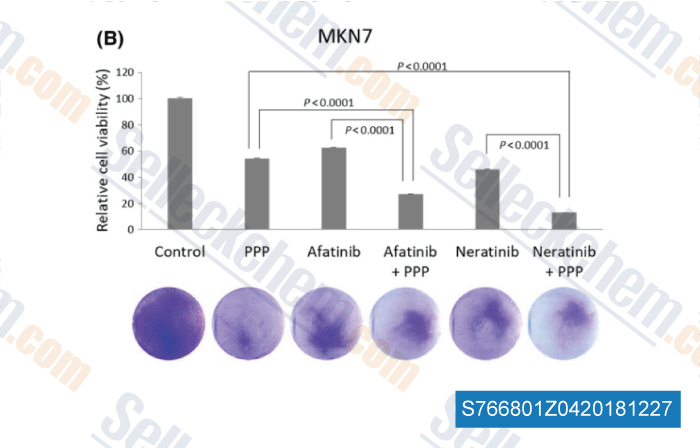
-
Data from [Data independently produced by , , Cancer Sci, 2018, 109(4):1166-1176]
Selleckの高級品が、幾つかの出版された研究調査結果(以下を含む)で使われた:
| Disrupting AGR2/IGF1 paracrine and reciprocal signaling for pancreatic cancer therapy [ Cell Rep Med, 2025, 6(2):101927] | PubMed: 39914384 |
| Viral insulin/IGF-like peptides inhibit IGF-1 receptor signaling to enhance viral replication [ Cell Rep, 2025, 44(8):116149] | PubMed: 40829596 |
| Picropodophyllin, an IGF‑1 receptor inhibitor, enhances oxaliplatin efficacy in chemoresistant colorectal cancer HCT116 cells by reducing metastatic potential [ Oncol Lett, 2025, 29(5):220] | PubMed: 40103601 |
| Nutrient-regulated dynamics of chondroprogenitors in the postnatal murine growth plate [ Bone Res, 2023, 11(1):20] | PubMed: 37080994 |
| Nutrient-regulated dynamics of chondroprogenitors in the postnatal murine growth plate [ Bone Res, 2023, 11(1):20] | PubMed: 37080994 |
| Synergy of 5-aminolevulinate supplement and CX3CR1 suppression promotes liver regeneration via elevated IGF-1 signaling [ Cell Rep, 2023, 42(8):112984] | PubMed: 37578861 |
| Scalable generation of sensory neurons from human pluripotent stem cells [ Stem Cell Reports, 2023, 18(4):1030-1047] | PubMed: 37044067 |
| IGF1R Inhibition Enhances the Therapeutic Effects of Gq/11 Inhibition in Metastatic Uveal Melanoma Progression [ Mol Cancer Ther, 2023, 22(1):63-74] | PubMed: 36223548 |
| Inhibition of the epigenetically activated miR-483-5p/IGF-2 pathway results in rapid loss of meningioma tumor cell viability [ J Neurooncol, 2023, 162(1):109-118.] | PubMed: 36809604 |
| Effect of insulin-like growth factor system on luteinising angiogenesis [ Reprod Fertil, 2023, 4(2)e220057 RAF-22-0057] | PubMed: 37052337 |
長期の保管のために-20°Cの下で製品を保ってください。
人間や獣医の診断であるか治療的な使用のためにでない。
各々の製品のための特定の保管と取扱い情報は、製品データシートの上で示されます。大部分のSelleck製品は、推薦された状況の下で安定です。製品は、推薦された保管温度と異なる温度で、時々出荷されます。長期の保管のために必要とされてそれと異なる温度で、多くの製品は、短期もので安定です。品質を維持するが、夜通しの積荷のために最も経済的な貯蔵状況を用いてあなたの送料を保存する状況の下に、製品が出荷されることを、我々は確実とします。製品の受領と同時に、製品データシートの上で貯蔵推薦に従ってください。