
|
受注:045-509-1970 |
技術サポート:tech@selleck.co.jp 平日9:00〜18:00 1営業日以内にご連絡を差し上げます |
化学情報
|
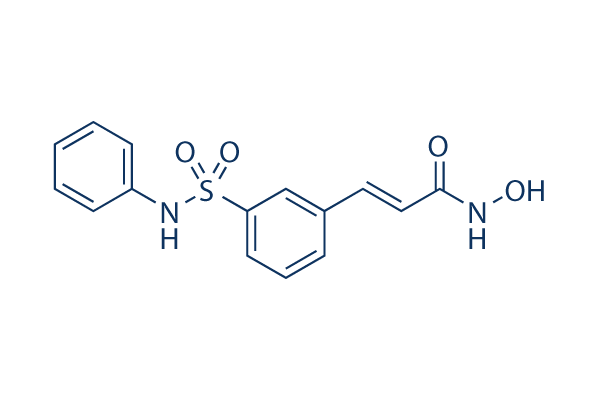
Synonyms | PXD101,NSC726630, PX-105684 | Storage (From the date of receipt) |
3 years -20°C powder 1 years -80°C in solvent |
|||
| 化学式 | C15H14N2O4S |
||||||
| 分子量 | 318.35 | CAS No. | 866323-14-0 | ||||
| Solubility (25°C)* | 体外 | DMSO | 63 mg/mL (197.89 mM) | ||||
| Ethanol | 51 mg/mL (160.2 mM) | ||||||
| Water | Insoluble | ||||||
| 体内 (毎回新しく調製した物を用意してください) |
|
||||||
|
* <1 mg/ml means slightly soluble or insoluble. * Please note that Selleck tests the solubility of all compounds in-house, and the actual solubility may differ slightly from published values. This is normal and is due to slight batch-to-batch variations. |
|||||||
溶剤液(一定の濃度)を調合する
生物活性
| 製品説明 | Belinostat is a novel HDAC inhibitor with IC50 of 27 nM in a cell-free assay, with activity demonstrated in cisplatin-resistant tumors. Belinostat (PXD101) induces autophagy. |
|---|---|
| in vitro | Belinostat inhibits the growth of tumor cells (A2780, HCT116, HT29, WIL, CALU-3, MCF7, PC3 and HS852) with IC50 from 0.2-0.66 μM. PD101 shows low activity in A2780/cp70 and 2780AD cells, which are cisplatin and doxorubicin-resistant derivatives of A2780 cells. This compound could induce apoptosis through PARP cleavage and acetylation of histones H3/H4. [1] It inhibits bladder cancer cell growth, especially in 5637 cells, which shows accumulation of G0-G1 phase, decrease in S phase and increase in G2-M phase. [2] The growth inhibitory activity of this chemical on cell lines is not strongly influenced by the multidrug-resistant phenotype, whereas the activity of docetaxel is clearly affected. It could enhance the growth inhibitory activity of docetaxel or carboplatin in OVCAR-3 and A2780 cells. This compound also shows enhanced tubulin acetylation in ovarian cancer cell lines. [3] A recent study shows that it activates protein kinase A in a TGF-β signaling-dependent mechanism and decreases survivin mRNA. [4] |
| in vivo | Belinostat indicates significant tumor growth delay in A2780 and A2780/cp70 xenograft at a dose of 10mg/kg with no effects on the body weight. [1] This compound also induces p21WAF1, HDAC core and cell communication genes in mouse bladder tumors. [2] Its monotherapy induces dose-proportional antitumor effects with TGI of 47% at a dose of 100mg/kg in A2780 xenograft. The combination of this chemical (100 mg/kg) with carboplatin (40 mg/kg) could delay tumor growth from 18.6 days to 22.5 days. [3] Combining with bortezomib, it results in great tumor inhibition and gastrointestinal toxicity in mice with bortezomib-resistant UMSCC-11A xenograft. [5] |
| 特徴 | Lead compound of Topotarget. |
プロトコル(参考用のみ)
| キナーゼアッセイ | Histone Deacetylase Activity | |
|---|---|---|
| Subconfluent cultures are harvested and washed twice in ice cold PBS and pelleted by centrifugation at 200 × g for 5 min. The cell pellet is resuspended in two volumes of lysis buffer [60 mM Tris buffer (pH 7.4) containing 30% glycerol and 450 mM NaCl] and lysed by three freeze (dry ice) thaw (30 °C water bath) cycles. Cell debris is removed by centrifugation at 1.2 × 10⁴ g for 5 min, and the supernatant is stored at −80 °C. Histone H4 peptide (sequence SGRGKGGKGLGKGGAKRHRK corresponding to the 20 NH2-terminal residues) is acetylated by a recombinant protein containing the hypoxanthine-aminopterin-thymidine domain of p300, using [3H]acetyl CoA as a source of acetate. H4 peptide (100 μg) is mixed with hypoxanthine-aminopterin-thymidine buffer (50 mM Tris HCl pH 8.0, 5% glycerol, 50 mM KCl, and 0.1 mM EDTA), 1 mM DTT, 1 mM 4-(2-aminoethyl) benzenesulfonylfluoride, 1 × complete protease inhibitors, 50 μL of purified p300, and 1.85 m [3H]acetyl CoA (4.50Ci/mmol) in a final volume of 300 μL and incubated at 30 °C for 45 min. The p300 protein is removed by incubation with 20 μL of 50% Ni-agaroase beads for 1 hour at 4 °C and centrifugation. The supernatant is applied to a 2 mL Sephadex G15 column, and the flow through is collected. One milliliter of distilled H2O is gently applied, and three drop fractions are collected; this is repeated until 4–5 mL of distilled H2O has been added, and ∼40 fractions are collected. Three microliters of each fraction are diluted in 2 mL of scintillation fluid and counted in a scintillation counter to identify the fractions containing the labeled peptide. These fractions are pooled, and 1 μL of the combined sample is measured to assess the radioactivity in every peptide batch (3-7×10³ cpm/μL). For activity assays, the reaction is carried out in a total volume of 150 μL of buffer [60 mM Tris (pH 7.4) containing 30% glycerol] containing 2 μL of cell extract and, where used, 2 μL of this compound. The reaction is started by the addition of 2 μL of [3H] labeled substrate (acetylated histone H4 peptide corresponding to the 20 NH2-terminal residues). Samples are incubated at 37 °C for 45 min, and the reaction stopped by the addition of HCl and acetic acid (0.72 and 0.12 M final concentrations, respectively). Released [3H]acetate is extracted into 750 μL of ethyl acetate, and samples are centrifuged at 1.2× 10⁴ g for 5 min. The upper phase (600 μL) is transferred to 3 mL of scintillation fluid and counted. | ||
| 細胞アッセイ | 細胞株 | A2780, A2780/cp70, 2780AD, HCT116, HT29, WIL, CALU-3, MCF7, PC3 and HS852 |
| 濃度 | 0.016 - 10 μM | |
| 反応時間 | 24 hours | |
| 実験の流れ | Tumor cell lines are seeded in 5 mL of medium at a density of 8 × 10⁴ cells/25 cm2 flask and incubated for 48 hours. Cells are exposed to Belinostat (0.016 to 10 μM) for 24 hours. The medium is removed, and 1 mL of trypsin/EDTA is added to each flask. Once the cells have detached, 1 mL of medium is added, the cells are resuspended, and those from the control untreated flask are counted. Cells are diluted and plated into 6-cm Petri dishes (three per flask) at a density of 0.5-2× 10³ cells/dish depending on the cell line. Cells from the drug-treated flasks are diluted and plated as for the control flasks. Dishes are incubated for 10–15 days at 37 °C. Cells are washed with PBS, fixed in methanol, and stained with crystal violet, and colonies that contained ≥50 cells counted. Sensitivity is expressed as the IC50 defined as the concentration of this compound required to reduce the number of colonies to 50% of that of the control untreated cells. | |
| 動物実験 | 動物モデル | A2780, A2780/cp70 and HCT116 cells are injected s.c. into the right flank of CD1 nu/nu mice. |
| 投薬量 | ≤40 mg/kg | |
| 投与方法 | Administered via i.p. | |
参考
|
カスタマーフィードバック
-
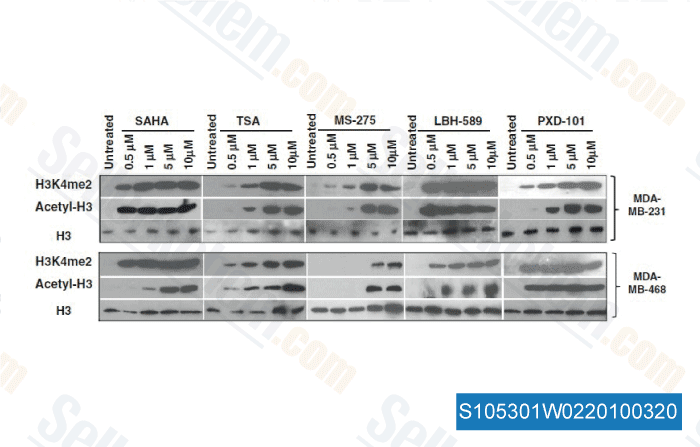
Data from [Breast Cancer Res Treat , 2012, 131, 777-789]
-
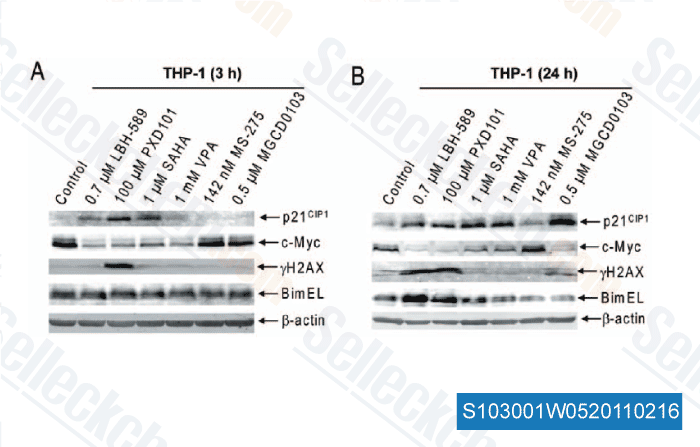
Data from [PLoS One, 2011, 6, e17138]
-
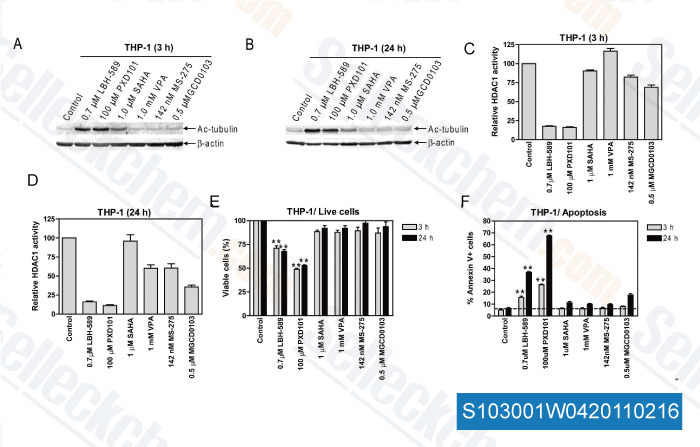
Data from [PLoS One, 2011, 6, e17138]
Selleckの高級品が、幾つかの出版された研究調査結果(以下を含む)で使われた:
| A patient-derived T cell lymphoma biorepository uncovers pathogenetic mechanisms and host-related therapeutic vulnerabilities [ Cell Rep Med, 2025, S2666-3791(25)00102-8] | PubMed: 40147445 |
| Deacetylation of TALDO1 by HDAC6 promotes glycolysis and nasopharyngeal carcinoma progression through a moonlighting function [ Cell Death Dis, 2025, 16(1):743] | PubMed: 41120289 |
| The anticancer effect of the HDAC inhibitor belinostat is enhanced by inhibitors of Bcl-xL or Mcl-1 in ovarian cancer [ Mol Oncol, 2025, 10.1002/1878-0261.70050] | PubMed: 40483575 |
| The anticancer effect of the HDAC inhibitor belinostat is enhanced by inhibitors of Bcl-xL or Mcl-1 in ovarian cancer [ Mol Oncol, 2025, 10.1002/1878-0261.70050] | PubMed: 40483575 |
| Targeting the akt/mtor signaling pathway by maprotiline leads to tumor suppression in T-cell lymphoma [ Ann Hematol, 2025, 10.1007/s00277-025-06571-z] | PubMed: 40892074 |
| Role of the NuRD complex and altered proteostasis in cancer cell quiescence [ bioRxiv, 2025, 2025.02.10.637435] | PubMed: 39990343 |
| Orthogonal proteogenomic analysis identifies the druggable PA2G4-MYC axis in 3q26 AML [ Nat Commun, 2024, 15(1):4739] | PubMed: 38834613 |
| Interferon-induced factor 16 is essential in metastatic melanoma to maintain STING levels and the immune responses upon IFN-γ response pathway activation [ J Immunother Cancer, 2024, 12(10)e009590] | PubMed: 39424359 |
| Chronic hypoxia stabilizes 3βHSD1 via autophagy suppression [ Cell Rep, 2024, 43(1):113575] | PubMed: 38181788 |
| PXD101 inhibits malignant progression and radioresistance of glioblastoma by upregulating GADD45A [ J Transl Med, 2024, 22(1):1047] | PubMed: 39568000 |
長期の保管のために-20°Cの下で製品を保ってください。
人間や獣医の診断であるか治療的な使用のためにでない。
各々の製品のための特定の保管と取扱い情報は、製品データシートの上で示されます。大部分のSelleck製品は、推薦された状況の下で安定です。製品は、推薦された保管温度と異なる温度で、時々出荷されます。長期の保管のために必要とされてそれと異なる温度で、多くの製品は、短期もので安定です。品質を維持するが、夜通しの積荷のために最も経済的な貯蔵状況を用いてあなたの送料を保存する状況の下に、製品が出荷されることを、我々は確実とします。製品の受領と同時に、製品データシートの上で貯蔵推薦に従ってください。