
|
受注:045-509-1970 |
技術サポート:tech@selleck.co.jp 平日9:00〜18:00 1営業日以内にご連絡を差し上げます |
化学情報
|
Synonyms | RG7422, GNE 390 | Storage (From the date of receipt) |
3 years -20°C powder 1 years -80°C in solvent |
|||
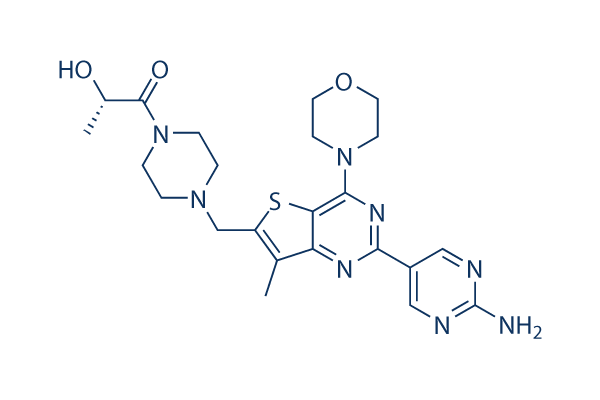
| 化学式 | C23H30N8O3S |
||||||
| 分子量 | 498.6 | CAS No. | 1032754-93-0 | ||||
| Solubility (25°C)* | 体外 | DMSO | 20 mg/mL (40.11 mM) | ||||
| Water | Insoluble | ||||||
| Ethanol | Insoluble | ||||||
| 体内 (毎回新しく調製した物を用意してください) |
|
||||||
|
* <1 mg/ml means slightly soluble or insoluble. * Please note that Selleck tests the solubility of all compounds in-house, and the actual solubility may differ slightly from published values. This is normal and is due to slight batch-to-batch variations. |
|||||||
溶剤液(一定の濃度)を調合する
生物活性
| 製品説明 | Apitolisib (GDC-0980, RG7422, GNE 390) is a potent, class I PI3K inhibitor for PI3Kα/β/δ/γ with IC50 of 5 nM/27 nM/7 nM/14 nM in cell-free assays, respectively. Also a mTOR inhibitor with Ki of 17 nM in a cell-free assay, and highly selective versus other PIKK family kinases. Apitolisib activates autophagy and apoptosis simultaneously in pancreatic cancer cells. Phase 2. |
|---|---|
| in vitro | Apitolisib (GDC-0980) shows potent and selective inhibitory activities against class I PI3K and mTOR kinase versus a large panel of kinases, with Ki of 17 nM for mTOR and IC50 of 5 nM, 27 nM, 7 nM, and 14 nM for PI3Kα, β, δ, and γ, respectively. [1] In vitro, this compound significantly inhibits cell proliferation in PC3 and MCF7 cells with IC50 of 307 nM and 255 nM, respectively. [1] A recent study shows that it reduces cancer cell viability by inhibiting cell-cycle procession and inducing apoptosis with most potency in prostate (IC50 < 200 nM 50%, <500 nM 100%), breast (IC50 <200 nM 37%, <500 nM 78%) and NSCLC lines (IC50 <200 nM 29%, <500 nM 88%) and less potency in pancreatic (IC50 <200 nM 13%, <500 nM 67%) and melanoma cell lines (IC50 <200 nM 0%, <500 nM 33%). [2] |
| in vivo | Apitolisib (GDC-0980) exhibits significant antitumor activity at a dose of 1 mg/kg by causing tumor growth delay in both PC-3 and MCF-7 neo/HER2 xenograft models. Furthermore, this compound results in tumor stasis or regressions at the maximum tolerated dose of 7.5 mg/kg. [1] In mice, intravenous administration at 1 mg/kg leads to low clearance (Clp: 9.2 mL/min/kg, Vss: 1.7 L/kg). While, oral administration at 5 mg/kg in 80% PEG400 and at 50 mg/kg as a crystalline suspension in 0.5% methylcellulose/0.2% Tween-80 also results in favorable pharmacokinetic parameters. [1] |
| 特徴 | A potent, selective, and orally available inhibitor of PI3Kα, β, δ, γ and mTOR. |
プロトコル(参考用のみ)
| キナーゼアッセイ | Enzymatic activity | |
|---|---|---|
| Apitolisib (GDC-0980) is evaluated through enzymatic activity assays for Class I PI3K isoforms using a fluorescence polarization method that monitors the formation of 3,4,5-inositoltriphosphate, which competes with fluorescently labeled PIP3 for binding to the GRP-1 pleckstrin homology domain protein. An increase in phosphatidyl inositide-3-phosphate product results in a decrease in fluorescence polarization signal as the labeled fluorophore is displaced from the GRP-1 protein binding site. Class I PI3K isoforms are expressed and purified as heterodimeric recombinant proteins. PI3K isoforms are assayed under initial rate conditions in the presence of 10 mM Tris (pH 7.5), 25 μM ATP, 9.75 μM PIP2, 5% glycerol, 4 mM MgCl2, 50 mM NaCl, 0.05% (v/v) Chaps, 1 mM dithiothreitol, 2% (v/v) DMSO at the following concentrations for each isoform: PI3Kα,β at 60 ng/mL; PI3Kγ at 8 ng/mL; PI3Kδ at 45 ng/mL. After assay for 30 minutes at 25°C, reactions are terminated with a final concentration of 9 mM EDTA, 4.5 nM TAMRA-PIP3, and 4.2 μg/mL GRP-1 detector protein before reading fluorescence polarization on an Envision plate reader. IC50s are calculated from the fit of the dose−response curves to a 4-parameter equation. Human recombinant mTOR(1360−2549) is expressed and purified from insect cells and assayed using a Lanthascreen fluorescence resonance energy transfer format in which phosphorylation of recombinant green fluorescent protein (GFP)-4-EBP1 is detected using a terbium-labeled antibody to phospho-threonine 37/46 of 4-EBP1. Reactions are initiated with ATP and conducted in the presence of 50 mM Hepes (pH 7.5), 0.25 nM mTOR, 400 nM GFP-4E-BP1, 8 μM ATP, 0.01% (v/v) Tween 20, 10 mM MnCl2, 1 mM EGTA, 1 mM dithiothreitol, and 1% (v/v) DMSO. Assays are conducted under initial rate conditions at room temperature for 30 minutes before terminating the reaction and detecting product in the presence of 2 nM Tb-anti-p4E-BP1 antibody and 10 mM EDTA. Dose−response curves are fit to an equation for competitive tight-binding inhibition and apparent Ki' s are calculated using the determined Km for ATP of 6.1 μM. | ||
| 細胞アッセイ | 細胞株 | PC3 and MCF7.1 |
| 濃度 | 0 to 10 μM | |
| 反応時間 | 72 hours or 96 hours | |
| 実験の流れ | Antiproliferative cellular assays are conducted using PC3 and MCF7.1 human tumor cell lines. MCF7.1 is an in vivo selected line and originally derived from the parental human MCF7 breast cancer cell line. Cell lines are cultured in RPMI supplemented with 10% fetal bovine serum, 100 units/mL penicillin, and 100 μg/mL streptomycin, 10 mM HEPES, and 2 mM glutamine at 3°C under 5% CO2. MCF7.1 cells or PC3 cells are seeded in 384-well plates in media at 1000 cells/well or 3000 cells/well, respectively, and incubated overnight prior to the addition of Apitolisib (GDC-0980) to a final DMSO concentration of 0.5% v/v. MCF7.1 cells and PC3 cells are incubated for 3 days and 4 days, respectively, prior to the addition of CellTiter-Glo reagen and reading of luminescence using an Analyst plate reader. For antiproliferative assays, a cytostatic agent such as aphidicolin and a cytotoxic agent such as staurosporine are included as controls. Dose−response curves are fit to a 4-parameter equation and relative IC50s are calculated using Assay Explorer software. | |
| 動物実験 | 動物モデル | PC3 and MCF7.1 cells are injected s.c. into the right hind flank of athymic nu/nu (nude) mice. |
| 投薬量 | ≤7.5 mg/kg | |
| 投与方法 | Administered via p.o. | |
参考
|
カスタマーフィードバック

-
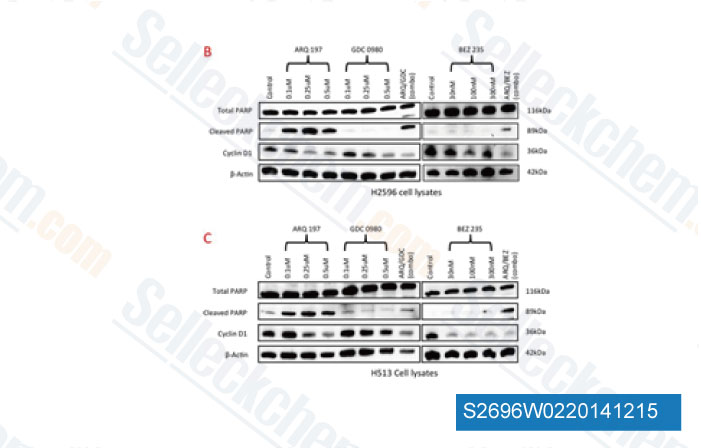
Data from [Data independently produced by Breast Cancer Res, 2014, 16(4), 406]
-
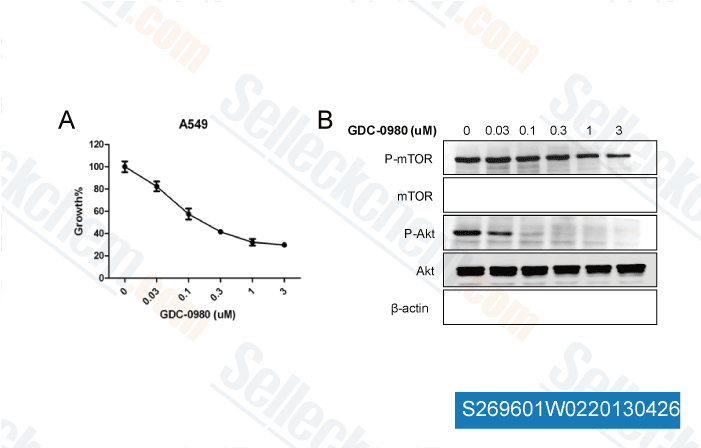
Data from [Data independently produced by PLoS One, 2014, 9(9), e105919]
-
, , Dr.Wang Wei from NanFang Hospital
Selleckの高級品が、幾つかの出版された研究調査結果(以下を含む)で使われた:
| Depleting the action of EZH2 through PI3K-mTOR inhibition to overcome metastasis and immunotherapy resistance in triple-negative breast cancer [ Mol Cancer Ther, 2025, 10.1158/1535-7163.MCT-24-0693] | PubMed: 40497697 |
| Establishment, characterization, and biobanking of 36 pancreatic cancer organoids: prediction of metastasis in resectable pancreatic cancer [ Cell Oncol (Dordr), 2024, 10.1007/s13402-024-00939-5] | PubMed: 38619751 |
| Dual targeting of the androgen receptor and PI3K/AKT/mTOR pathways in prostate cancer models improves antitumor efficacy and promotes cell apoptosis [ Mol Oncol, 2024, 10.1002/1878-0261.13577] | PubMed: 38225213 |
| Ferroptosis heterogeneity in triple-negative breast cancer reveals an innovative immunotherapy combination strategy [ Cell Metab, 2022, S1550-4131-2200411-9] | PubMed: 36257316 |
| Distinctive molecular features of regenerative stem cells in the damaged male germline [ Nat Commun, 2022, 13(1):2500] | PubMed: 35523793 |
| Overexpression of S100A9 in obesity impairs macrophage differentiation via TLR4-NFkB-signaling worsening inflammation and wound healing [ Theranostics, 2022, 12(4):1659-1682] | PubMed: 35198063 |
| Cancer genes disfavoring T cell immunity identified via integrated systems approach [ Cell Rep, 2022, 40(5):111153] | PubMed: 35926468 |
| Therapeutic Targeting of Stromal-Tumor HGF-MET Signaling in an Organotypic Triple-Negative Breast Tumor Model [ Mol Cancer Res, 2022, 20(7):1166-1177] | PubMed: 35348758 |
| Identification of New Vulnerabilities in Conjunctival Melanoma Using Image-Based High Content Drug Screening [ Cancers (Basel), 2022, 14(6)1575] | PubMed: 35326726 |
| Culture and multiomic analysis of lung cancer patient-derived pleural effusions revealed distinct druggable molecular types [ Sci Rep, 2022, 12(1):6345] | PubMed: 35428753 |
長期の保管のために-20°Cの下で製品を保ってください。
人間や獣医の診断であるか治療的な使用のためにでない。
各々の製品のための特定の保管と取扱い情報は、製品データシートの上で示されます。大部分のSelleck製品は、推薦された状況の下で安定です。製品は、推薦された保管温度と異なる温度で、時々出荷されます。長期の保管のために必要とされてそれと異なる温度で、多くの製品は、短期もので安定です。品質を維持するが、夜通しの積荷のために最も経済的な貯蔵状況を用いてあなたの送料を保存する状況の下に、製品が出荷されることを、我々は確実とします。製品の受領と同時に、製品データシートの上で貯蔵推薦に従ってください。