
|
受注:045-509-1970 |
技術サポート:tech@selleck.co.jp 平日9:00〜18:00 1営業日以内にご連絡を差し上げます |
化学情報
|
Synonyms | N/A | Storage (From the date of receipt) |
3 years -20°C powder 1 years -80°C in solvent |
|||||||
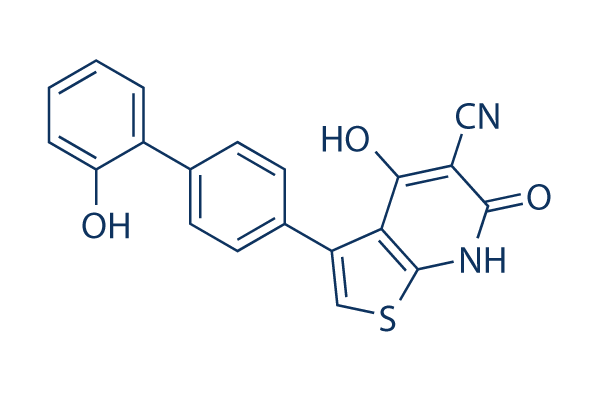
| 化学式 | C20H12N2O3S |
||||||||||
| 分子量 | 360.39 | CAS No. | 844499-71-4 | ||||||||
| Solubility (25°C)* | 体外 | DMSO | 72 mg/mL (199.78 mM) | ||||||||
| Water | Insoluble | ||||||||||
| Ethanol | Insoluble | ||||||||||
| 体内 (毎回新しく調製した物を用意してください) |
|
||||||||||
|
* <1 mg/ml means slightly soluble or insoluble. * Please note that Selleck tests the solubility of all compounds in-house, and the actual solubility may differ slightly from published values. This is normal and is due to slight batch-to-batch variations. |
|||||||||||
溶剤液(一定の濃度)を調合する
生物活性
| 製品説明 | A-769662は、強力で可逆的なAMPK活性化剤であり、細胞フリーアッセイでのEC50は0.8 µMで、GPPase/FBPase活性にはほとんど影響を与えません。 |
|---|---|
| in vitro | A-769662 stimulates partially purified rat liver AMPK with EC50 with 0.8 μM. This compound activates AMPK purified from multiple tissues and species in a dose-responsive manner with modest variations in observed EC50s. EC50s determined for this chemical using partially purified AMPK extracts from rat heart, rat muscle, or human embryonic kidney cells (HEKs) are 2.2 mM, 1.9 mM, or 1.1 mM, respectively. A 4 hours treatment of primary rat hepatocytes with this compound dose-dependently increases ACC phosphorylation, which correlated inhibition of fatty acid synthesis with IC50 of 3.2 μM. It also inhibits fatty acid sythesis in mouse hepatocytes with IC50 with 3.6 μM This compound activates AMPK both allosterically and by inhibiting dephosphorylation of AMPK on Thr-172, similar to the effects of AMP. It inhibits proteasomal function by an AMPK-independent mechanism. This chemical affects the in vitro activity of purified 26S proteasomes but not the in vitro activity of purified 20S proteasomes. It has toxic effects on MEF cells. A recent research shows this compound inhibited cell proliferation and DNA synthesis. |
| in vivo | Short-term treatment of normal Sprague Dawley rats with A-769662 decreases liver malonyl CoA levels and the respiratory exchange ratio, VCO2/VO2, indicating an increased rate of whole-body fatty acid oxidation. Treatment of ob/ob mice with 30 mg/kg b.i.d. of this compound decreases hepatic expression of PEPCK, G6Pase, and FAS, lowers plasma glucose by 40%, reduced body weight gain and significantly decreases both plasma and liver triglyceride levels. |
プロトコル(参考用のみ)
| キナーゼアッセイ | 96-well AMPK assay | |
|---|---|---|
| AMPK activity is measured by monitoring phosphorylation of the SAMS peptide substrate (20 μM in standard assays and 100 μM in additivity assays) following a previously described protocol (Anderson et al., 2004). To determine whether A-769662-induced AMPK activation occurs in a reversible manner, AMP or this compound are preincubated with rat liver AMPK for 10 minutes at 20 times standard assay concentrations prior to dilution and measurement of AMPK activity. | ||
| 細胞アッセイ | 細胞株 | MEF cells |
| 濃度 | 300 μM | |
| 反応時間 | 24 hours | |
| 実験の流れ | Cell viability of MEF cells treated or not with A-769662 is performed as follows: cells are harvested by trypsinization and incubated with 0.5 mg/mL RNase and 50 μg/mL propidium iodine at room temperature in the dark; cell viability is analyzed by flow cytometry using a FACScanto flow cytometer, using an excitation laser at 488 nm and a propidium iodine fluorescence detection at 600 nm. To determine the proportion of cells in each phase of the cell cycle, cells are harvested by trypsinization, collected by centrifugation, washed in PBS and fixed overnight in 80% ethanol at -20 °C. Subsequently, these fixed cells are centrifuged to remove the fixative and incubated for 20 minutes in the dark at room temperature in PBS containing 0.5 mg/mL RNase and 50 μg/mL propidium iodine. Flow cytometry analysis is performed as above. The proportion of cells in G1, S, and G2 is determined using the MODFIT program. Cell culture pictures are taken at the indicated times using a camera coupled to an inverted microscope with a 20 × objective. |
|
| 動物実験 | 動物モデル | Sprague Dawley rats |
| 投薬量 | 30 mg/kg | |
| 投与方法 | Administered via i.p. | |
参考
|
カスタマーフィードバック
-
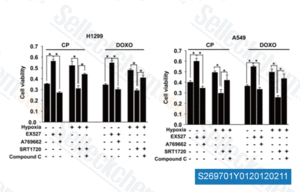
Data from [Cancer Res, 2014, 74(1), 298-308]
-
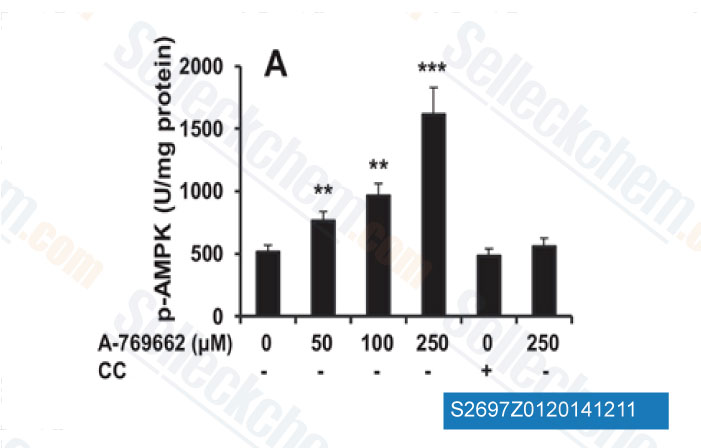
Data from [Data independently produced by Pharmacol Res, 2014, 81, 34-43]
-
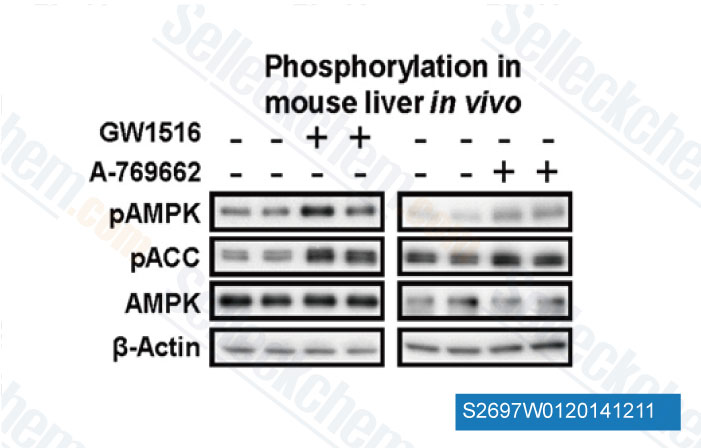
Data from [Data independently produced by J Lipid Res, 2014, 55(7), 1254-1266]
Selleckの高級品が、幾つかの出版された研究調査結果(以下を含む)で使われた:
| Propionibacterium acnes evades microbicidal phagocytosis by inhibiting the mitochondrial biogenesis of nucleus pulposus cells [ FEBS J, 2025, 10.1111/febs.70247] | PubMed: 40891515 |
| AMPK-YAP signaling pathway-mediated mitochondrial dynamics and mitophagy participate in the protective effect of silibinin on HaCaT cells under high glucose conditions [ Arch Biochem Biophys, 2025, 769:110433] | PubMed: 40268264 |
| Nuclear PD-L1 compartmentalization suppresses tumorigenesis and overcomes immunocheckpoint therapy resistance in mice via histone macroH2A1 [ J Clin Invest, 2024, 134(22)e181314] | PubMed: 39545415 |
| Maternal adiponectin restores cholinergic vasodilation in resistance vessels from adult offspring exposed to maternal obesity in utero [ bioRxiv, 2024, 2024.09.21.612123] | PubMed: 39345365 |
| Hypoxanthine phosphoribosyl transferase 1 metabolizes temozolomide to activate AMPK for driving chemoresistance of glioblastomas [ Nat Commun, 2023, 14(1):5913] | PubMed: 37737247 |
| Pathogenesis-related protein 1 suppresses oomycete pathogen by targeting against AMPK kinase complex [ J Adv Res, 2023, 43:13-26] | PubMed: 36585103 |
| A subset of VEGFR-TKIs activates AMPK in LKB1-mutant lung cancer [ Cancer Sci, 2023, 114(4):1651-1662] | PubMed: 36459496 |
| Loss of Lactate/Proton Monocarboxylate Transporter 4 Induces Ferroptosis via the AMPK/ACC Pathway and Inhibition of Autophagy on Human Bladder Cancer 5637 Cell Line [ J Oncol, 2023, 2023:2830306] | PubMed: 36718218 |
| Discovery of a natural small-molecule AMP-activated kinase activator that alleviates nonalcoholic steatohepatitis [ Mar Life Sci Technol, 2023, 5(2):196-210] | PubMed: 37275542 |
| Identification of purine biosynthesis as an NADH-sensing pathway to mediate energy stress [ Nat Commun, 2022, 13(1):7031] | PubMed: 36396642 |
長期の保管のために-20°Cの下で製品を保ってください。
人間や獣医の診断であるか治療的な使用のためにでない。
各々の製品のための特定の保管と取扱い情報は、製品データシートの上で示されます。大部分のSelleck製品は、推薦された状況の下で安定です。製品は、推薦された保管温度と異なる温度で、時々出荷されます。長期の保管のために必要とされてそれと異なる温度で、多くの製品は、短期もので安定です。品質を維持するが、夜通しの積荷のために最も経済的な貯蔵状況を用いてあなたの送料を保存する状況の下に、製品が出荷されることを、我々は確実とします。製品の受領と同時に、製品データシートの上で貯蔵推薦に従ってください。