
|
受注:045-509-1970 |
技術サポート:tech@selleck.co.jp 平日9:00〜18:00 1営業日以内にご連絡を差し上げます |
生物学的記述
| Specificity | Acetyl-Histone H4 (Lys12) Antibody [D15E14] detects endogenous levels of total Histone H4 protein only when it is Acetylated at Lys12. |
|---|---|
| Background | Acetyl-Histone H4 (Lys12) is a key posttranslational modification on the N-terminal tail of histone H4 that marks newly synthesized H4 for preferential deposition onto daughter DNA strands during replication-coupled nucleosome assembly, mediated by the histone chaperone RbAp46/CAF-1. The enzyme HAT1 acetylates Lys12 within its active site after initial acetylation of Lys5, resulting in a di-acetyl mark that neutralizes the positive charge at position 12, loosening interactions between the H4 tail and DNA or H2A/H2B dimers, and facilitating transfer of the H4 tetramer. This acetylation functions as a transient "read" signal for bromodomain readers such as BRD2, BRD3, and BRD4, whose tandem domains clamp the H4 tail, with K12ac engaged in a hydrophobic pocket via conserved residues and water-mediated hydrogen bonds. These interactions recruit transcriptional coactivators, including pTEFb/CDK9 for RNA Pol II pause release and SWI/SNF for nucleosome remodeling, at active gene enhancers and promoters. K12ac also promotes synergy with H3K56ac through RbAp46 binding, supporting S-phase progression and DNA damage response, while deacetylation by HDAC1/3 within Sin3/NuRD complexes or by SIRT2 resets the mark after deposition. Elevated K12ac levels are associated with replication stress vulnerability, active euchromatin domains during neurogenesis and myogenesis, and oncogenic states such as MYC-amplified neuroblastoma, where BRD4 retention sustains proliferation. Hyperacetylation of K12 in aging and senescence drives the senescence-associated secretory phenotype via NF-κB enhancers, while hypoacetylation is linked to DNA repair defects in Cockayne syndrome through impaired TFIIH/CSB function. |
使用情報
| Application | WB, IHC, IF, FCM | Dilution |
|
||||||||
|---|---|---|---|---|---|---|---|---|---|---|---|
| Reactivity | Mouse, Rat, Human | ||||||||||
| Source | Rabbit Monoclonal Antibody | MW | 11 kDa | ||||||||
| Storage Buffer | PBS, pH 7.2+50% Glycerol+0.05% BSA+0.01% NaN3 | Storage (from the date of receipt) |
-20°C (avoid freeze-thaw cycles), 2 years | ||||||||
References
|
Application Data
WB
Validated by Selleck
-
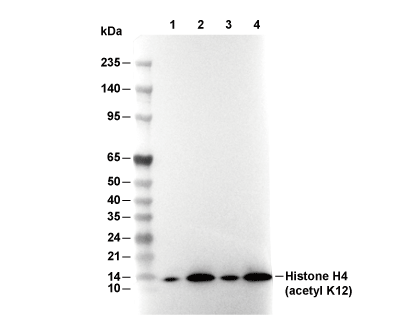 Lane 1: HeLa, Lane 2: HeLa (Trichostatin A, 500 ng/ml, 4 h), Lane 3: NIH/3T3, Lane 4: NIH/3T3 (Trichostatin A, 500 ng/ml, 4 h)