
|
受注:045-509-1970 |
技術サポート:tech@selleck.co.jp 平日9:00〜18:00 1営業日以内にご連絡を差し上げます |
生物学的記述
| Specificity | ACSL1 Antibody [D13B22] detects endogenous levels of total ACSL1 protein. |
|---|---|
| Background | Acyl-CoA synthetase long-chain family member 1 (ACSL1) is a pivotal enzyme in lipid metabolism, responsible for activating long-chain fatty acids (C12–C20) by catalyzing their conversion into fatty acyl-CoA thioesters in an ATP- and CoA-dependent reaction. This activation is essential for channeling fatty acids into downstream metabolic pathways, including mitochondrial β-oxidation for energy production, complex lipid synthesis (such as triglycerides and phospholipids), and lipid signaling, thereby maintaining cellular energy homeostasis and lipid balance. ACSL1 is an amino-acid protein with a large N-terminal catalytic domain and a smaller C-terminal domain; its architecture includes a conserved AMP-binding region with characteristic motifs (A3, A5, A8, A10), a fatty acid-binding pocket, and Walker A/B-like motifs that facilitate its two-step “ping-pong” mechanism, first forming an acyl-AMP intermediate, then transferring the acyl group to CoA. ACSL1 localizes to the endoplasmic reticulum, mitochondria, and peroxisomes, where it interacts with carnitine palmitoyltransferase 1 (CPT1) to direct acyl-CoAs toward β-oxidation or with lipid droplets to promote triglyceride synthesis, thus partitioning specific fatty acids (oleate or palmitate) into metabolic fates according to cellular energy needs. Its expression is transcriptionally regulated by PPARα and SREBP-1c in response to nutrient and hormonal cues, supporting metabolic flexibility in tissues such as liver, heart, and adipose tissue. Dysregulation of ACSL1, through overexpression or genetic variation, contributes to hepatic steatosis, ER stress, and the development of insulin resistance and atherosclerosis, while knockdown or loss-of-function models reveal its critical role in obesity, cardiovascular disease, and cancer lipid metabolism. |
使用情報
| Application | WB, IHC | Dilution |
|
||||
|---|---|---|---|---|---|---|---|
| Reactivity | Human | ||||||
| Source | Rabbit Monoclonal Antibody | MW | 78 kDa | ||||
| Storage Buffer | PBS, pH 7.2+50% Glycerol+0.05% BSA+0.01% NaN3 | Storage (from the date of receipt) |
-20°C (avoid freeze-thaw cycles), 2 years | ||||
References
|
Application Data
WB
Validated by Selleck
-
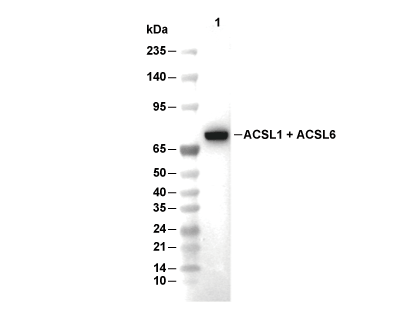 Lane 1: Raji