
|
受注:045-509-1970 |
技術サポート:tech@selleck.co.jp 平日9:00〜18:00 1営業日以内にご連絡を差し上げます |
生物学的記述
| Specificity | AFP Antibody [M19A22] detects endogenous levels of total AFP protein. |
|---|---|
| Background | Alpha-fetoprotein (AFP), also known as alpha-1-fetoprotein, is a fetal-specific glycoprotein and oncofetal biomarker belonging to the albumin gene family. It is primarily synthesized in the embryonic yolk sac, fetal liver, and gastrointestinal tract during development, with expression silenced in adults except for low hepatic levels. Reactivation of AFP occurs in hepatocellular carcinoma (HCC), germ cell tumors, and nonseminomatous testicular cancers, making it a key marker for diagnosis and monitoring. AFP is a single polypeptide chain folded into three conserved domains (I, II, III) that form a V-shaped molecule stabilized by 15-16 disulfide bridges. It contains four fatty acid-binding pockets (subdomains IIA, IIA/IIB, IIIA, IIIB) with key ligand-orienting residues (Lys242, Lys246, Arg233, Tyr435), a metal-ion binding site in Domain IA (His22, His264, His268, Asp280), N-glycosylation at Asn251 (the fucosylated AFP-L3 isoform is clinically relevant for aggressive HCC), and C-terminal motifs for protein-receptor interactions. AFP serves biological roles in fetal plasma transport of bilirubin, fatty acids, and metals, maintenance of osmotic pressure, and modulation of immune tolerance by suppressing maternal T, NK, and dendritic cell responses through estrogen and growth factor binding. It also regulates liver cell proliferation and differentiation. AFP promotes tumor growth by activating PI3K/Akt/mTOR and cAMP/PKA pathways, inhibits apoptosis via caspase-3 binding, drives angiogenesis and metastasis through Wnt/β-catenin signaling, enables immune evasion, and is regulated by p53 and β-catenin mutations in HCC. |
使用情報
| Application | WB, IP, IHC, IF, FCM | Dilution |
|
||||||||||
|---|---|---|---|---|---|---|---|---|---|---|---|---|---|
| Reactivity | Human | ||||||||||||
| Source | Rabbit Monoclonal Antibody | MW | 68 kDa | ||||||||||
| Storage Buffer | PBS, pH 7.2+50% Glycerol+0.05% BSA+0.01% NaN3 | Storage (from the date of receipt) |
-20°C (avoid freeze-thaw cycles), 2 years | ||||||||||
References
|
Application Data
WB
Validated by Selleck
-
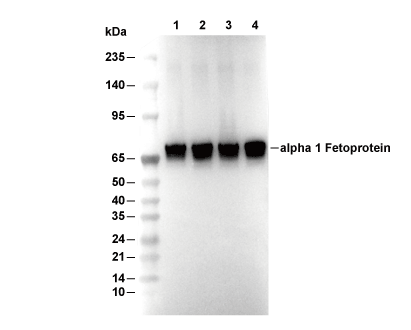 Lane 1: Huh7, Lane 2: HepG2, Lane 3: Human fetal liver, Lane 4: Human plasma