
|
受注:045-509-1970 |
技術サポート:tech@selleck.co.jp 平日9:00〜18:00 1営業日以内にご連絡を差し上げます |
生物学的記述
| Specificity | Apolipoprotein E Antibody [B14G10] detects endogenous levels of total Apolipoprotein E protein. |
|---|---|
| Background | Apolipoprotein E (ApoE) is a glycoprotein produced predominantly by hepatocytes and astrocytes, essential for systemic and central nervous system lipid homeostasis. Circulating as three major isoforms, ApoE2, ApoE3, and ApoE4, which differ at residues Cys112 and Arg158, ApoE mediates receptor-dependent uptake, redistribution, and clearance of cholesterol-rich lipoproteins (HDL, VLDL, chylomicron remnants) throughout the body and brain. Lipid-free ApoE adopts a two-domain organization: an N-terminal receptor-binding domain (residues 1–191, forming a four-α-helix bundle with key motifs for LDL receptor family binding) and a C-terminal domain (residues 210–299) comprising amphipathic helices that mediate lipid association, joined by a flexible hinge. Upon lipidation, ApoE undergoes a conformational “domain unlocking,” exposing binding sites and stabilizing discoidal HDL-like particles. Lipidated ApoE directs lipoproteins to receptors such as LDLR, LRP1, CD36, and HSPGs, facilitating endocytosis, lysosomal lipolysis, cholesterol efflux, and esterification pathways critical for membrane repair, steroidogenesis, and neuronal health. In the brain, astrocyte-derived ApoE3 supports amyloid-β (Aβ) oligomerization and clearance via LRP1, and promotes synaptic plasticity through PI3K/Akt signaling. In contrast, the ApoE4 isoform’s structural instability impairs lipidation, enhances Aβ42 aggregation and seeding, increases neuroinflammation through TLR4/NF-κB activation, and disrupts tau phosphorylation and neurotrophic signaling, conferring a dramatically higher risk for Alzheimer’s disease, atherosclerosis, and neurodegeneration. ApoE2, conversely, enhances receptor binding and clearance, offering cardiovascular protection. |
使用情報
| Application | WB, IP, IHC, IF, FCM | Dilution |
|
||||||||||
|---|---|---|---|---|---|---|---|---|---|---|---|---|---|
| Reactivity | Human | ||||||||||||
| Source | Rabbit Monoclonal Antibody | MW | 36 kDa | ||||||||||
| Storage Buffer | PBS, pH 7.2+50% Glycerol+0.05% BSA+0.01% NaN3 | Storage (from the date of receipt) |
-20°C (avoid freeze-thaw cycles), 2 years | ||||||||||
References
|
Application Data
WB
Validated by Selleck
-
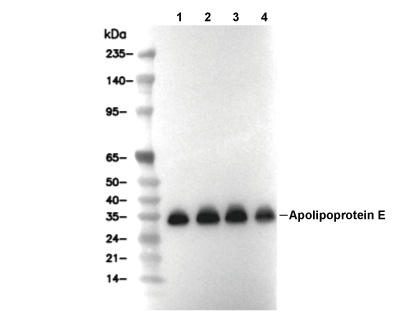 Lane 1: Human liver, Lane 2: Human cerebellum, Lane 3: HepG2, Lane 4: Human serum