
|
受注:045-509-1970 |
技術サポート:tech@selleck.co.jp 平日9:00〜18:00 1営業日以内にご連絡を差し上げます |
生物学的記述
| Specificity | Atg9A Antibody [L22J4] detects endogenous levels of total Atg9A protein. |
|---|---|
| Background | Atg9A, a multi-spanning transmembrane protein of the autophagy-related (ATG) family and the mammalian ortholog of yeast Atg9, serves as the sole known integral membrane ATG protein essential for autophagosome biogenesis across diverse cellular contexts. It features six transmembrane domains forming a palmitoylated lipid transport scaffold that cycles dynamically between the trans-Golgi network (TGN), endosomes, omegasomes, and phagophores without stable incorporation into mature autophagosomes. Upon autophagy induction via mTORC1 inhibition or ULK1 activation, Atg9A traffics through AP1/AP4 adaptors and RUSC2 to deliver nascent phagophore membranes, partnering with ATG2A-ATG18 to expand PI3P-enriched platforms while its C-terminal tail recruits IQGAP1 and ESCRT-III component CHMP2A to seal phagophore openings, completing autophagosome enclosure through constriction and membrane scission independent of canonical LC3 lipidation. This positions Atg9A as a central hub in the ULK1-ATG9-ATG2-WIPI2-PI3KC3 axis, where phosphorylation by AMPK/ULK1 at S761 fine-tunes vesicular export and fission, enabling lipid scramblase activity that flips phospholipids for curvature generation and selective cargo engulfment during starvation, ER stress, or pathogen invasion. It drives neuronal clearance of protein aggregates, immune synapse formation in T cells, and metabolic adaptation in muscle, making it invaluable for researchers probing membrane dynamics via super-resolution tracking or dissecting non-canonical autophagy in organoids. Loss-of-function mutations impair neurodevelopment and lysosomal storage, contributing to neurodegeneration and myopathy. |
使用情報
| Application | WB, IP | Dilution |
|
||||
|---|---|---|---|---|---|---|---|
| Reactivity | Human, Mouse, Rat, Monkey | ||||||
| Source | Rabbit Monoclonal Antibody | MW | 100-110 kDa | ||||
| Storage Buffer | PBS, pH 7.2+50% Glycerol+0.05% BSA+0.01% NaN3 | Storage (from the date of receipt) |
-20°C (avoid freeze-thaw cycles), 2 years | ||||
References
|
Application Data
WB
Validated by Selleck
-
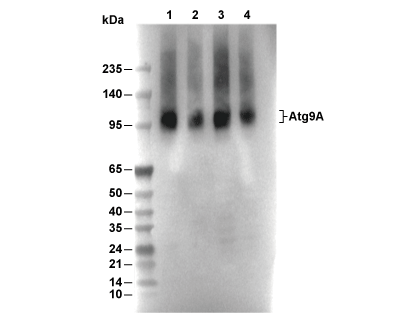 Lane 1: DU145, Lane 2: Neuro-2a, Lane 3: H-4-II-E, Lane 4: MCF7