
|
受注:045-509-1970 |
技術サポート:tech@selleck.co.jp 平日9:00〜18:00 1営業日以内にご連絡を差し上げます |
生物学的記述
| Specificity | ATP6V1B2 Antibody [K16G16] detects endogenous levels of total ATP6V1B2 protein. |
|---|---|
| Background | ATP6V1B2 serves as the B2 isoform of the V1 sector in vacuolar H+-ATPase (V-ATPase) complexes, which function as ATP-driven proton pumps to acidify intracellular compartments like lysosomes and endosomes, as well as certain plasma membranes. It forms part of the peripheral V1 domain's catalytic hexamer alongside A subunits, featuring nucleotide-binding sites that drive rotational ATP hydrolysis to power proton translocation through the membrane-embedded V0 sector. ATP6V1B2-containing V-ATPases interact directly with the Ragulator-Rag GTPase complex on lysosomal surfaces, sensing amino acid availability to trigger mTORC1 recruitment and activation; upon leucine or arginine stimulation, V-ATPase proton pumping generates a localized acidic microenvironment that stabilizes RagA/B in GTP-bound states, facilitating mTORC1 docking via Raptor and subsequent phosphorylation of S6K1/4EBP1 to promote anabolic translation while inhibiting catabolism. This proton gradient also couples lysosomal biogenesis with nutrient signaling, where ATP6V1B2 mutations impair acidification, disrupt autophagic flux, and paradoxically sustain mTORC1 activity by altering v-ATPase disassembly-reassembly dynamics. ATP6V1B2 maintains cellular homeostasis in nutrient-fluctuating environments by coordinating lysosomal degradation with growth decisions, making it ideal for researchers studying amino acid sensing or macropinocytosis, where v-ATPase inhibition reveals mTORC1 dependency. Dysregulation through somatic mutations activates autophagy while preserving mTORC1, contributing to B-cell lymphoma survival under leucine scarcity, whereas variants causing distal renal tubular acidosis demonstrate impaired acid-base homeostasis. |
使用情報
| Application | WB | Dilution |
|
||
|---|---|---|---|---|---|
| Reactivity | Human, Mouse, Rat, Monkey | ||||
| Source | Rabbit Monoclonal Antibody | MW | 55 kDa | ||
| Storage Buffer | PBS, pH 7.2+50% Glycerol+0.05% BSA+0.01% NaN3 | Storage (from the date of receipt) |
-20°C (avoid freeze-thaw cycles), 2 years | ||
References
|
Application Data
WB
Validated by Selleck
-
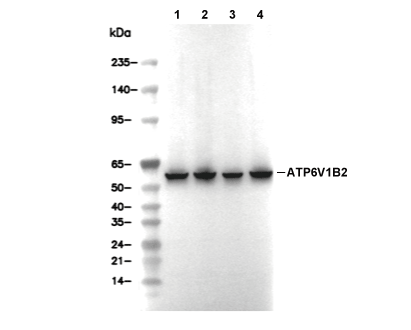 Lane 1: 293, Lane 2: ACHN, Lane 3: COS-7, Lane 4: vero