
|
受注:045-509-1970 |
技術サポート:tech@selleck.co.jp 平日9:00〜18:00 1営業日以内にご連絡を差し上げます |
生物学的記述
| Specificity | BCKDHA Antibody [K21P5] detects endogenous levels of total BCKDHA protein. |
|---|---|
| Background | BCKDHA encodes the alpha subunit of the E1 component of the mitochondrial branched‑chain α‑keto acid dehydrogenase complex, a multienzyme assembly that catalyzes the first committed and rate‑limiting step of branched‑chain amino acid catabolism and links valine, leucine, and isoleucine turnover to energy production and metabolic homeostasis. The E1α subunit associates with the beta subunit BCKDHB to form a heterotetrameric decarboxylase that provides the thiamine pyrophosphate‑dependent active sites required for oxidative decarboxylation of branched‑chain α‑keto acids, positioning BCKDHA as the structural and catalytic core that recognizes transaminated BCAA derivatives. Within the intact complex, E1α participates in substrate binding and cofactor coordination that generate an acyl‑enzyme intermediate, which is then transferred to the lipoyl moiety of the E2 transacylase component, connecting the decarboxylation reaction to subsequent acyl‑CoA formation and entry of BCAA‑derived carbon into downstream oxidative pathways. This enzymatic step sets the flux through the BCAA catabolic pathway and influences levels of circulating and tissue BCAAs and their corresponding α‑keto acids, which act as metabolic signals and contribute to the regulation of energy balance, nutrient signaling, and anabolic processes. E1α function is embedded in a regulatory network in which the whole BCKD complex is modulated by a dedicated kinase and phosphatase system that controls phosphorylation status and catalytic activity, allowing adaptation of BCAA oxidation to nutritional and hormonal cues. High BCKDHA activity promotes efficient clearance of BCAAs and their keto acids and supports production of acetyl‑CoA and succinyl‑CoA equivalents that feed the tricarboxylic acid cycle, whereas impaired E1α function reduces BCKD flux and leads to accumulation of BCAAs and their keto acids in body fluids and tissues. Loss‑of‑function mutations in BCKDHA underlie a subset of maple syrup urine disease, where deficient E1 activity within the BCKD complex is associated with markedly elevated branched‑chain amino acids and α‑keto acids, neurotoxicity, and characteristic metabolic crises that reflect failure of this oxidative decarboxylation step. |
使用情報
| Application | WB, IP, IHC | Dilution |
|
||||||
|---|---|---|---|---|---|---|---|---|---|
| Reactivity | Human | ||||||||
| Source | Rabbit Monoclonal Antibody | MW | 49 kDa | ||||||
| Storage Buffer | PBS, pH 7.2+50% Glycerol+0.05% BSA+0.01% NaN3 | Storage (from the date of receipt) |
-20°C (avoid freeze-thaw cycles), 2 years | ||||||
References
|
Application Data
WB
Validated by Selleck
-
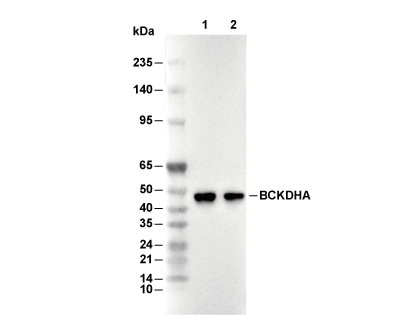 Lane 1: 293T, Lane 2: Hela