
|
受注:045-509-1970 |
技術サポート:tech@selleck.co.jp 平日9:00〜18:00 1営業日以内にご連絡を差し上げます |
生物学的記述
| Specificity | Bub1 Antibody [D12M3] detects endogenous levels of total Bub1 protein. |
|---|---|
| Background | Bub1 is a conserved mitotic serine/threonine kinase that localizes to kinetochores and functions as a core spindle assembly checkpoint (SAC) component, linking unattached or improperly attached kinetochores to inhibition of the anaphase‑promoting complex/cyclosome (APC/C) through the mitotic checkpoint complex and thereby preventing anaphase onset until all chromosomes achieve correct bipolar attachment. The N‑terminal region contains a Bub3‑binding GLEBS motif and KNL1‑interacting elements that target Bub1 to MELT‑phosphorylated KNL1 at the outer kinetochore, where it forms a scaffold for recruitment and stable localization of other SAC proteins including Mad1–Mad2, BubR1, Cdc20, and CENP‑E; the C‑terminal domain harbors the active kinase fold that phosphorylates histone H2A on Thr120 to generate a binding site for Shugoshin–PP2A complexes at centromeres. These activities position Bub1 at the interface between kinetochore–microtubule attachment status and both checkpoint signaling and sister chromatid cohesion, because Bub1‑dependent H2A‑Thr120 phosphorylation and consequent Shugoshin recruitment contribute to centromeric protection of cohesin in early mitosis and meiosis, while its SAC scaffold role supports generation of a diffusible APC/C^Cdc20^ inhibitor that maintains securin and cyclin B until proper attachment is satisfied. Bub1 also contributes to the establishment of chromosome congression and biorientation: its kinetochore pool influences the balance of kinetochore forces and correction of erroneous attachments, and additional kinetochore‑independent pools can support chromosome alignment, indicating that Bub1 exerts both local structural and broader regulatory effects on segregation. Kinase activity is essential for proper chromosome alignment and H2A‑Thr120 phosphorylation but plays a more limited role in SAC signaling per se, which additionally depends on a conserved central motif required for checkpoint function and on interactions with Bub3 and KNL1; mutation of these regions uncouples alignment and checkpoint outputs and several cancer‑associated BUB1 variants impair segregation fidelity without fully abolishing SAC activity. Bub1 is also implicated in DNA damage response crosstalk, where its kinetochore presence and checkpoint signaling capacity interface with genotoxic stress pathways to maintain genome stability, and germline or somatic alterations that reduce Bub1 function associate with aneuploidy, embryonic lethality in model organisms, and increased tumorigenic potential, while Bub1 overexpression in human cancers correlates with chromosomal instability and therapy response. |
使用情報
| Application | WB, IP, IF, FCM | Dilution |
|
||||||||
|---|---|---|---|---|---|---|---|---|---|---|---|
| Reactivity | Human | ||||||||||
| Source | Rabbit Monoclonal Antibody | MW | 122 kDa | ||||||||
| Storage Buffer | PBS, pH 7.2+50% Glycerol+0.05% BSA+0.01% NaN3 | Storage (from the date of receipt) |
-20°C (avoid freeze-thaw cycles), 2 years | ||||||||
References
|
Application Data
WB
Validated by Selleck
-
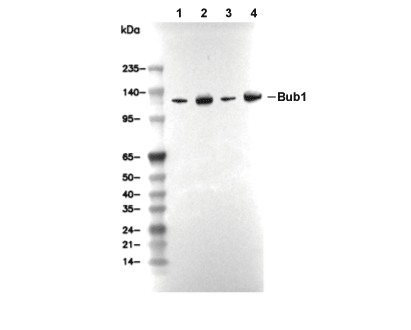 Lane 1: 293T, Lane 2: 293T (Nocodazole, 100 ng/mL, 18 h), Lane 3: Hela, Lane 4: Hela (Nocodazole, 100 ng/mL, 18 h)