
|
受注:045-509-1970 |
技術サポート:tech@selleck.co.jp 平日9:00〜18:00 1営業日以内にご連絡を差し上げます |
生物学的記述
| Specificity | Chd1 Antibody [E24E7] detects endogenous levels of total Chd1 protein. |
|---|---|
| Background | Chromodomain‑helicase‑DNA‑binding protein 1 (CHD1) is a member of the CHD family of ATP‑dependent chromatin remodelers that couples histone-modification readout to nucleosome restructuring and transcriptional control in euchromatin‑rich regions. CHD1 contains two N‑terminal chromodomains that bind methylated histone H3 at lysine 4 (H3K4me), a central SWI/SNF CTG‑related ATPase module that hydrolyzes ATP to slide, reposition, or evict nucleosomes, and a C‑terminal DNA‑binding region that contributes to DNA‑surface engagement and target‑site selection, enabling CHD1 to maintain open, transcriptionally permissive chromatin at active gene promoters and enhancers. CHD1 binds H3K4‑marked euchromatic loci, promotes nucleosome‑free region formation at promoters, sustains high transcriptional output, and supports the robust activation of lineage‑specific programs during osteoblast differentiation and early embryogenesis, while also coordinating cohesin‑mediated loop boundaries and chromatin topology that influence long‑range enhancer–promoter interactions. CHD1 participates in early damage signaling and chromatin remodeling at break sites, and its ATPase activity helps preserve appropriate histone‑modification landscapes and transcriptional coherence, whereas loss of full‑length CHD1, or of its C‑terminal intrinsically disordered region, impairs condensate‑like assembly of the remodeler with histone‑modifying complexes and non‑coding RNAs, leading to dysregulated gene expression and genome‑instability‑associated tumorigenesis. CHD1 inactivation is recurrent in prostate and other epithelial cancers, where it often co‑occurs with PTEN loss and alters tumor‑microenvironment immune signaling and epigenetic enzyme activity, but germline CHD1 mutations are also associated with neurodevelopmental and intellectual‑disability syndromes. |
使用情報
| Application | WB, IF, FCM, ChIP | Dilution |
|
||||||||
|---|---|---|---|---|---|---|---|---|---|---|---|
| Reactivity | Human | ||||||||||
| Source | Rabbit Monoclonal Antibody | MW | 196 kDa | ||||||||
| Storage Buffer | PBS, pH 7.2+50% Glycerol+0.05% BSA+0.01% NaN3 | Storage (from the date of receipt) |
-20°C (avoid freeze-thaw cycles), 2 years | ||||||||
References
|
Application Data
WB
Validated by Selleck
-
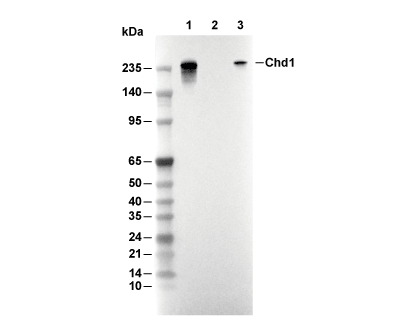 Lane 1: HEK-293T, Lane 2: HEK-293T (KO CHD1), Lane 3: K562