
|
受注:045-509-1970 |
技術サポート:tech@selleck.co.jp 平日9:00〜18:00 1営業日以内にご連絡を差し上げます |
生物学的記述
| Specificity | CRBN Antibody [P23M10] detects endogenous levels of total CRBN protein. |
|---|---|
| Background | CRBN, or cereblon, functions as a substrate receptor within the CRL4 E3 ubiquitin ligase complex, critically directing targeted proteolysis to regulate key cellular pathways, including energy sensing and immune modulation. It contains a conserved thalidomide-binding pocket that undergoes conformational shifts upon small-molecule engagement, facilitating neosubstrate docking to the DDB1-Cullin4-Roc1 core. CRBN binds the α-subunit of AMPK to suppress its activation under energy-replete conditions, thereby disinhibiting mTORC1 signaling to drive cap-dependent translation and ribosomal biogenesis; pathogenic truncations like R419X abolish this interaction, unleashing constitutive AMPK phosphorylation at T172, which hyperactivates TSC2 to curtail mTOR activity, Rheb GTP loading, and S6K1/4EBP1 phosphorylation essential for synaptic protein synthesis. CRBN mediates the pleiotropic effects of immunomodulatory drugs (IMiDs) by inducing high-affinity binding to transcription factors IKZF1/3 (Ikaros/Aiolos), recruiting them for CRL4-mediated K48-linked polyubiquitination and proteasomal destruction, which downregulates IRF4/MYC axes to halt myeloma cell proliferation while paradoxically enhancing IL-2/TNF-α secretion in T cells via glutamine synthetase relief. This positions CRBN as a metabolic gatekeeper in neurons, where it sustains hippocampal long-term potentiation and spatial memory consolidation through balanced AMPK-mTOR flux, and as an immunomodulatory hub in B-cell malignancies, enabling synthetic lethality with IMiDs in CRBN-proficient contexts. CRBN governs adipocyte differentiation and neuronal development by fine-tuning lipid metabolism and ion channel turnover, with tissue-specific expression guiding its selection for brain-penetrant PROTACs or metabolic screens. Dysregulation via genetic loss or low expression drives intellectual disability phenotypes with memory impairment and confers IMiD resistance in multiple myeloma, where CRBN levels below detection thresholds predict negligible progression-free survival benefit. |
使用情報
| Application | WB, IP, IHC, IF, FCM | Dilution |
|
||||||||||
|---|---|---|---|---|---|---|---|---|---|---|---|---|---|
| Reactivity | Human, Mouse, Rat | ||||||||||||
| Source | Rabbit Monoclonal Antibody | MW | 55 kDa | ||||||||||
| Storage Buffer | PBS, pH 7.2+50% Glycerol+0.05% BSA+0.01% NaN3 | Storage (from the date of receipt) |
-20°C (avoid freeze-thaw cycles), 2 years | ||||||||||
References
|
Application Data
WB
Validated by Selleck
-
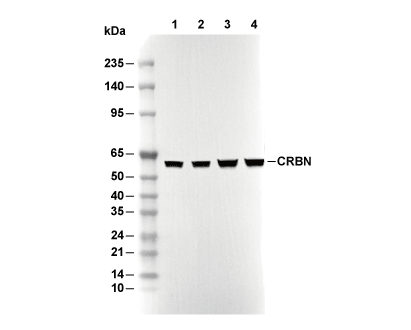 Lane 1: PC-3, Lane 2: U266B1, Lane 3: AML12, Lane 4: MTLn3