
|
受注:045-509-1970 |
技術サポート:tech@selleck.co.jp 平日9:00〜18:00 1営業日以内にご連絡を差し上げます |
生物学的記述
| Specificity | Cre Recombinase Antibody [D11J17] detects transfected and transgenic levels of total Cre recombinase protein. |
|---|---|
| Background | Cre recombinase functions as a type IB topoisomerase from bacteriophage P1 that maintains the viral genome as a low-copy plasmid through conservative site-specific recombination at loxP sites. The protein adopts a V-shaped monomeric architecture comprising an N-terminal DNA-binding domain with helix-turn-helix motifs that recognize the 13-base-pair inverted repeats flanking an 8-base-pair asymmetric spacer, connected via a flexible linker to a C-terminal catalytic domain housing the tyrosine nucleophile and conserved RHR triad essential for phosphodiester bond hydrolysis. Recombination initiates with two Cre monomers binding each loxP half-site to bend DNA sharply by 90 degrees, forming a synaptic tetramer through intermolecular four-helix bundle interfaces that align cleavage sites in trans for Holliday junction formation. The catalytic tyrosine attacks the scissile phosphate between the spacer and repeat, generating a 3'-phosphotyrosine covalent intermediate while the complementary strand remains intact, followed by strand exchange through rotation of the non-cleaved duplex around the Holliday junction axis to resolve the first half-reaction. Isomerization repositions active sites for second-strand cleavage and religation, yielding excised circular products from direct repeats or inversion from head-to-head loxP orientations, with spacer compatibility ensuring strand selectivity and preventing non-allelic recombination. Reaction efficiency remains high without host factors, though magnesium ions stabilize the transition state and tetramer stability governs recombination directionality. Accessory factors like Cre helper proteins modulate synapse formation in vivo. Ubiquitous nuclear localization upon eukaryotic expression enables tissue-specific gene activation or knockout via promoter-driven variants, with self-excising cassettes minimizing insertional mutagenesis. Dysregulated persistent recombination underlies off-target integrations in germline models, while temperature-sensitive mutants facilitate temporal control for lineage tracing. |
使用情報
| Application | WB, IHC, IF, FCM | Dilution |
|
||||||||
|---|---|---|---|---|---|---|---|---|---|---|---|
| Reactivity | All Species Expected | ||||||||||
| Source | Rabbit Monoclonal Antibody | MW | 37 kDa | ||||||||
| Storage Buffer | PBS, pH 7.2+50% Glycerol+0.05% BSA+0.01% NaN3 | Storage (from the date of receipt) |
-20°C (avoid freeze-thaw cycles), 2 years | ||||||||
References
|
Application Data
WB
Validated by Selleck
-
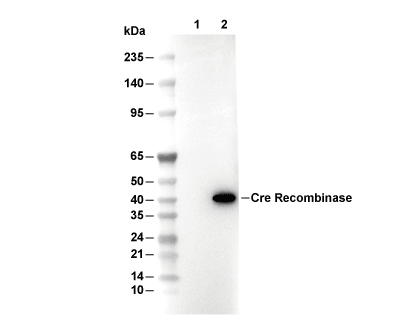 Lane 1: 293T (mock-transfected), Lane 2: 293T (transfected with Cre recombinase)