
|
受注:045-509-1970 |
技術サポート:tech@selleck.co.jp 平日9:00〜18:00 1営業日以内にご連絡を差し上げます |
生物学的記述
| Specificity | CXCL13 Antibody (Mouse mAb) [E8F3] detects endogenous levels of total CXCL13 protein. |
|---|---|
| Background | CXCL13, also known as B‑cell‑attracting chemokine‑1 (BCA‑1) or B‑lymphocyte chemoattractant (BLC), is a CXC chemokine that drives B‑cell recruitment, positioning, and activation within secondary lymphoid organs and ectopic lymphoid structures, and it functions as the principal ligand for the G‑protein‑coupled receptor CXCR5 to organize lymphoid architecture and coordinate humoral immune responses. The chemokine adopts the conserved CXC fold with an N‑terminal activation region, a three‑stranded β‑sheet, and a C‑terminal α‑helix, and it forms gradients on follicular dendritic cells and stromal organizers that attract CXCR5‑expressing B cells and follicular helper T cells into B‑cell zones where germinal center reactions and antibody affinity maturation occur. CXCL13 binding to CXCR5 triggers Gαi‑dependent signaling, leading to activation of PI3K, MAPK, and small GTPases, with downstream engagement of Akt and Rac that reorganize the actin cytoskeleton and direct polarized migration along CXCL13 gradients, while CXCR5 also recruits β‑arrestin to modulate receptor trafficking and signal duration, integrating migration with survival and activation cues that support B‑cell homeostasis and differentiation. The CXCL13/CXCR5 axis acts as a lymphoid organizer by recruiting CXCR5‑positive B cells and T follicular helper cells to mesenchymal lymphoid tissue organizer cells, where it promotes the formation of tertiary lymphoid structures in non‑lymphoid tissues during chronic inflammation, infection, or autoimmunity, and CXCL13 expression by peripheral helper T cells and macrophages in disease settings drives ectopic lymphoid neogenesis and pathologic B‑cell accumulation. In cancer, the CXCL13/CXCR5 axis shapes the tumor microenvironment by recruiting B cells, regulatory B cells, and T follicular helper cells into tumor‑associated tertiary lymphoid structures, where its activity can promote pro‑neoplastic immune suppression by attracting suppressive lymphocytes while simultaneously enabling anti‑tumor immunity through organized germinal center‑like responses and high‑affinity antibody production, and CXCL13 also drives tumor cell proliferation, invasion, and angiogenesis through PI3K/AKT and NF‑κB signaling in malignant cells. In autoimmune diseases, ectopic CXCL13 expression in inflamed tissues correlates with CXCR5‑dependent B‑cell infiltration, formation of tertiary lymphoid structures, autoantibody production, and chronic inflammation in rheumatoid arthritis, multiple sclerosis, systemic lupus erythematosus, Sjögren's syndrome, myasthenia gravis, and inflammatory bowel disease, positioning CXCL13 as a biomarker and therapeutic target in these conditions. CXCL13 is also induced by environmental carcinogens such as tobacco smoke and benzo(a)pyrene in lung epithelial cells, where it contributes to lung carcinogenesis and colorectal cancer, and CXCL13 knockout in mice reduces these carcinogen‑driven malignancies, linking CXCL13 to both immune‑mediated tumor control and tumor promotion in a context‑dependent manner. |
使用情報
| Application | WB | Dilution |
|
||
|---|---|---|---|---|---|
| Reactivity | Human | ||||
| Source | Mouse Monoclonal Antibody | MW | 13 kDa | ||
| Storage Buffer | PBS, pH 7.2+50% Glycerol+0.05% BSA+0.01% NaN3 | Storage (from the date of receipt) |
-20°C (avoid freeze-thaw cycles), 2 years | ||
| WB |
Experimental Protocol:
Sample preparation
1. Tissue: Lyse the tissue sample by adding an appropriate volume of ice-cold RIPA/NP-40 Lysis Buffer (containing Protease Inhibitor Cocktail),and homogenize the tissue at a low temperature or lyse it by sonication on ice, then incubate on ice for 30 minutes. 2. Adherent cell: Aspirate the culture medium and wash the cells with ice-cold PBS twice. Lyse the cells by adding an appropriate volume of RIPA/NP-40 Lysis Buffer (containing Protease Inhibitor Cocktail) , sonicate to lyse the cells, and incubate on ice for 30 minutes. 3. Suspension cell: Transfer the culture medium to a pre-cooled centrifuge tube. Centrifuge and aspirate the supernatant. Wash the cells with ice-cold PBS twice. Lyse the cells by adding an appropriate volume of RIPA/NP-40 Lysis Buffer (containing Protease Inhibitor Cocktail) , sonicate to lyse the cells, and incubate on ice for 30 minutes. 4. Place the lysate into a pre-cooled microcentrifuge tube. Centrifuge at 4°C for 15 min. Collect the supernatant;
5. Remove a small volume of lysate to determine the protein concentration;
6. Combine the lysate with protein loading buffer. Boil 20 µL sample under 95-100°C for 5 min. Centrifuge for 5 min after cool down on ice.
Electrophoretic separation
1. According to the concentration of extracted protein, load appropriate amount of protein sample and marker onto SDS-PAGE gels for electrophoresis. Recommended separating gel (lower gel) concentration: 20%. Reference Table for Selecting SDS-PAGE Separation Gel Concentrations 2. Power up 80V for 30 minutes. Then the power supply is adjusted (110 V~150 V), the Marker is observed, and the electrophoresis can be stopped when the indicator band of the predyed protein Marker where the protein is located is properly separated. (Note that the current should not be too large when electrophoresis, too large current (more than 150 mA) will cause the temperature to rise, affecting the result of running glue. If high currents cannot be avoided, an ice bath can be used to cool the bath.)
Transfer membrane
1. Take out the converter, soak the clip and consumables in the pre-cooled converter;
2. Activate PVDF membrane with methanol for 1 min and rinse with transfer buffer;
3. Install it in the order of "black edge of clip - sponge - filter paper - filter paper - glue -PVDF membrane - filter paper - filter paper - sponge - white edge of clip"; 4. The protein was electrotransferred to PVDF membrane. ( 0.22 µm PVDF membrane is recommended )) Reference Table for Selecting PVDF Membrane Pore Size Specifications Recommended conditions for wet transfer: 200 mA, 60 min. ( Note that the transfer conditions can be adjusted according to the protein size. For high-molecular-weight proteins, a higher current and longer transfer time are recommended. However, ensure that the transfer tank remains at a low temperature to prevent gel melting.)
Block
1. After electrotransfer, wash the film with TBST at room temperature for 5 minutes;
2. Incubate the film in the blocking solution for 1 hour at room temperature;
3. Wash the film with TBST for 3 times, 5 minutes each time.
Antibody incubation
1. Use 5% skim milk powder to prepare the primary antibody working liquid (recommended dilution ratio for primary antibody 1:500), gently shake and incubate with the film at 4°C overnight; 2. Wash the film with TBST 3 times, 5 minutes each time;
3. Add the secondary antibody to the blocking solution and incubate with the film gently at room temperature for 1 hour;
4. After incubation, wash the film with TBST 3 times for 5 minutes each time.
Antibody staining
1. Add the prepared ECL luminescent substrate (or select other color developing substrate according to the second antibody) and mix evenly;
2. Incubate with the film for 1 minute, remove excess substrate (keep the film moist), wrap with plastic film, and expose in the imaging system.
|
References
|
Application Data
WB
Validated by Selleck
-
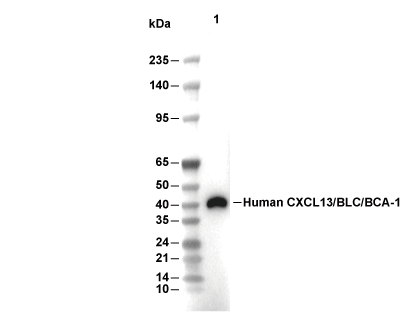 Lane 1: Recombinant (hFc) Human CXCL13 Protein