
|
受注:045-509-1970 |
技術サポート:tech@selleck.co.jp 平日9:00〜18:00 1営業日以内にご連絡を差し上げます |
生物学的記述
| Specificity | Cytochrome b Antibody [F15F24] detects endogenous levels of total Cytochrome b protein. |
|---|---|
| Background | Cytochrome b stands as the mitochondrially encoded core subunit of complex III, known as ubiquinol-cytochrome c reductase, within the oxidative phosphorylation system. This integral inner membrane protein spans the membrane with multiple transmembrane helices and harbors two heme groups that define the Qo and Qi ubiquinol binding sites central to its catalytic function. Complex III operates as a dimer where cytochrome b facilitates electron bifurcation during the Q-cycle: at the Qo site on the intermembrane space side, ubiquinol undergoes oxidation, releasing two protons while one electron transfers via the Rieske iron-sulfur protein and cytochrome c1 to cytochrome c, and the second electron moves through the low-potential heme bL to the high-potential heme bH at the Qi site on the matrix side. There, a second ubiquinol molecule accepts the electron to form ubiquinol, taking up two matrix protons, which collectively translocates four protons per cycle to establish the proton-motive force essential for ATP synthesis. This mechanism positions cytochrome b at a key nexus for electron flux and proton gradient generation, with residues near Qo and Qi sites influencing inhibitor binding, such as atovaquone at Qo and clomipramine at Qi, while proton pathways involving conserved residues like those equivalent to Gly137 and Tyr132 support efficient translocation. Cytochrome b sustains respiratory chain homeostasis, modulates reactive oxygen species output at complex III, and coordinates with nuclear-encoded subunits for dimer assembly, rendering it vital for energy-demanding tissues like the heart and muscle, where disruptions impair oxidative capacity. |
使用情報
| Application | WB, IP | Dilution |
|
||||
|---|---|---|---|---|---|---|---|
| Reactivity | Human, Mouse, Rat, Monkey | ||||||
| Source | Rabbit Monoclonal Antibody | MW | 26 kDa | ||||
| Storage Buffer | PBS, pH 7.2+50% Glycerol+0.05% BSA+0.01% NaN3 | Storage (from the date of receipt) |
-20°C (avoid freeze-thaw cycles), 2 years | ||||
References
|
Application Data
WB
Validated by Selleck
-
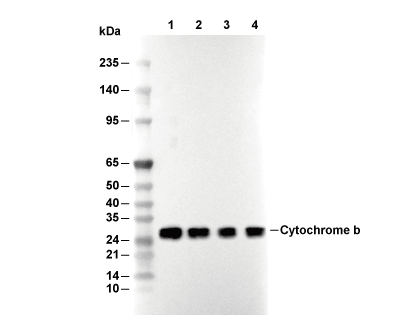 Lane 1: Hela, Lane 2: U2OS, Lane 3: C6, Lane 4: COS-7