
|
受注:045-509-1970 |
技術サポート:tech@selleck.co.jp 平日9:00〜18:00 1営業日以内にご連絡を差し上げます |
生物学的記述
| Specificity | ENPP2/ATX Antibody [J20P19] detects endogenous levels of total ENPP2/ATX protein. |
|---|---|
| Background | ENPP2, widely known as autotaxin (ATX), functions as a secreted ectonucleotide pyrophosphatase/phosphodiesterase that hydrolyzes lysophosphatidylcholine into bioactive lysophosphatidic acid (LPA), driving critical signaling in cell motility, vascular maturation, and tissue repair. ATX generates LPA gradients that engage LPAR1-6 G-protein-coupled receptors, activating Gαq/PLCβ for calcium release and RhoA/ROCK-mediated actomyosin contraction, alongside Gαi/PI3K/Akt for survival and Gα12/13/PKA for chemotaxis, while direct ATX-integrin αvβ3/α5β1 interactions localize LPA delivery at leading edges to amplify FAK/Src signaling for focal adhesion turnover. This fuels directional migration during embryonic angiogenesis, where ATX-LPA promotes endothelial sprouting and vessel stabilization, and orchestrates wound healing by recruiting fibroblasts and macrophages through autocrine LPA loops that sustain proliferation and ECM deposition. In muscle regeneration, ATX expression surges post-injury to license satellite cell fusion via LPA-WNT/β-catenin crosstalk, ensuring myofiber hypertrophy, while in immunity it shapes B cell trafficking and platelet activation for thrombus resolution. ATX deficiency phenocopies vascular defects and impairs lymphangiogenesis, making it essential for studying chemotactic gradients in vivo via plasma LPA profiling or neutralizing antibodies in migration chambers. Overproduction drives pancreatic cancer desmoplasia through CAF-derived LPA stimulating CTGF/TGF-β, while in pulmonary fibrosis ATX-LPA sustains myofibroblast differentiation and TIF1 deposition; both contexts reveal therapeutic vulnerability to ATX inhibitors that collapse LPA signaling without toxicity. |
使用情報
| Application | WB, IF, FCM | Dilution |
|
||||||
|---|---|---|---|---|---|---|---|---|---|
| Reactivity | Human, Mouse | ||||||||
| Source | Rabbit Monoclonal Antibody | MW | 98 kDa | ||||||
| Storage Buffer | PBS, pH 7.2+50% Glycerol+0.05% BSA+0.01% NaN3 | Storage (from the date of receipt) |
-20°C (avoid freeze-thaw cycles), 2 years | ||||||
References
|
Application Data
WB
Validated by Selleck
-
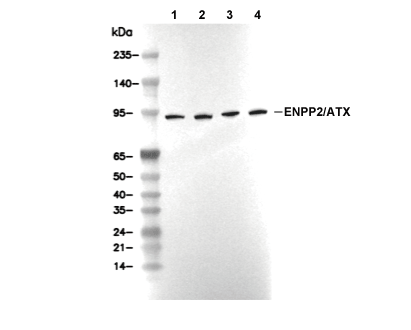 Lane 1: Hela, Lane 2: U-87 MG, Lane 3: A375, Lane 4: Mouse placenta