
|
受注:045-509-1970 |
技術サポート:tech@selleck.co.jp 平日9:00〜18:00 1営業日以内にご連絡を差し上げます |
生物学的記述
| Specificity | FLT3 Antibody [H6L24] detects endogenous levels of total FLT3 protein. |
|---|---|
| Background | FLT3 (FMS‑like tyrosine kinase 3, also called FLK2 or CD135) is a class III receptor tyrosine kinase in the c‑Kit/PDGFR family that is expressed on early hematopoietic stem and progenitor cells and functions as a key regulator of their survival, proliferation, and differentiation in response to its cognate cytokine FLT3 ligand. The receptor is a type I transmembrane glycoprotein with an extracellular region containing five immunoglobulin‑like domains that mediate FLT3 ligand binding and receptor dimerization, a single transmembrane helix, a juxtamembrane regulatory segment that restrains kinase activity in the absence of ligand, and a split cytoplasmic tyrosine kinase domain with multiple autophosphorylation sites that serve as docking sites for signaling effectors when the receptor is activated. FLT3 ligand, produced by bone marrow stromal cells and other stromal elements, binds monomeric FLT3 and promotes formation of a ternary complex in which a homodimeric FLT3L bridges two FLT3 molecules, bringing the intracellular kinase domains into proximity, triggering trans‑autophosphorylation within the activation loop and juxtamembrane tyrosines, and creating binding platforms for SH2‑containing adaptor and effector proteins. Activated FLT3 recruits and phosphorylates complexes containing Shc, Grb2, Gab1/2, SHP‑2, SHIP, and CrkL, which link the receptor to RAS–RAF–MEK–ERK signaling for mitogenic responses, to PI3K–AKT–mTOR pathways that promote cell survival and metabolic support, and to JNK and p38 MAPK modules that modulate stress responses, cytokine production, and differentiation outcomes in hematopoietic progenitors. These signaling networks act in synergy with other cytokine receptors such as c‑Kit, GM‑CSF receptor, and interleukin receptors to expand multipotent progenitors, support dendritic cell and NK cell development, and maintain stem and progenitor pools in bone marrow, thymus, and lymphoid organs, with FLT3 ligand alone showing modest proliferative activity but strong cooperative effects in combination with other growth factors. FLT3 expression is normally confined to early progenitors and is downregulated upon maturation, but high‑level expression persists in most acute myeloid leukemia blasts and in a substantial subset of acute lymphoblastic leukemias, providing a platform for oncogenic activation. Somatic FLT3 mutations, particularly internal tandem duplications in the juxtamembrane region and activating point mutations in the kinase domain, are among the most frequent lesions in AML, occurring in roughly one‑third of cases, and lead to ligand‑independent receptor dimerization or relief of juxtamembrane autoinhibition, chronic autophosphorylation, and constitutive activation of STAT5, PI3K–AKT, and RAS–ERK pathways that drive uncontrolled proliferation, survival, and impaired differentiation of myeloid progenitors. |
使用情報
| Application | WB, IP | Dilution |
|
||||
|---|---|---|---|---|---|---|---|
| Reactivity | Human, Mouse | ||||||
| Source | Rabbit Monoclonal Antibody | MW | 113 kDa | ||||
| Storage Buffer | PBS, pH 7.2+50% Glycerol+0.05% BSA+0.01% NaN3 | Storage (from the date of receipt) |
-20°C (avoid freeze-thaw cycles), 2 years | ||||
References
|
Application Data
WB
Validated by Selleck
-
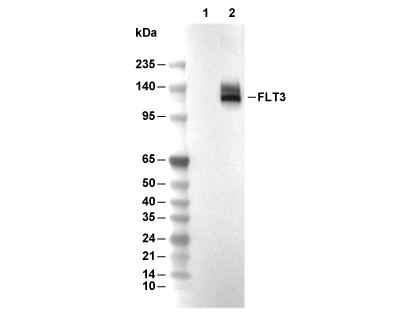 Lane 1: 293T, Lane 2: 293T (FLT3 transfected)