
|
受注:045-509-1970 |
技術サポート:tech@selleck.co.jp 平日9:00〜18:00 1営業日以内にご連絡を差し上げます |
生物学的記述
| Specificity | GRIM19 Antibody [J7L19] detects endogenous levels of total GRIM19 protein. |
|---|---|
| Background | GRIM19, also known as NDUFA13, serves as an integral nuclear-encoded subunit of mitochondrial complex I within the NADH:ubiquinone oxidoreductase assembly, essential for electron transfer from NADH to ubiquinone during oxidative phosphorylation and maintenance of mitochondrial membrane potential. The protein adopts a compact helical bundle structure anchored peripherally to the matrix arm of complex I, positioning its LYR motif to stabilize the Q-module and facilitate conformational coupling between FMN reduction and quinone binding pocket dynamics that drive proton pumping across the inner membrane. Upregulation by type I interferons and retinoic acid through IRF/STAT promoter elements recruits GRIM19 to antagonize STAT3 dimerization by direct binding to its phosphotyrosine tail, blocking nuclear translocation and transcriptional activation of survival genes like c-Myc and Bcl-xL while sensitizing cells to apoptosis via Bax oligomerization. GRIM19 coordinates iron-sulfur cluster relay from the N-module through conformational gating that prevents ROS leakage during reverse electron transport, intersecting with NLRP3 inflammasome regulation, where its depletion elevates mtROS to activate caspase-1 and gasdermin D pore formation, amplifying IL-1β/IL-33 secretion in macrophages and hepatocytes. Loss disrupts fetal hematopoietic stem cell differentiation and adult quiescence through SHP-1/TGF-β axis impairment, while in parietal cells, GRIM19 deficiency triggers ROS-NRF2-HO-1-NF-κB signaling to license NLRP3-dependent spasmolytic polypeptide-expressing metaplasia. Overexpression promotes brown adipose differentiation by shifting PPARγ coactivator-1α toward thermogenic programs, countering diet-induced obesity. |
使用情報
| Application | WB | Dilution |
|
||
|---|---|---|---|---|---|
| Reactivity | Human | ||||
| Source | Rabbit Monoclonal Antibody | MW | 16 kDa | ||
| Storage Buffer | PBS, pH 7.2+50% Glycerol+0.05% BSA+0.01% NaN3 | Storage (from the date of receipt) |
-20°C (avoid freeze-thaw cycles), 2 years | ||
References
|
Application Data
WB
Validated by Selleck
-
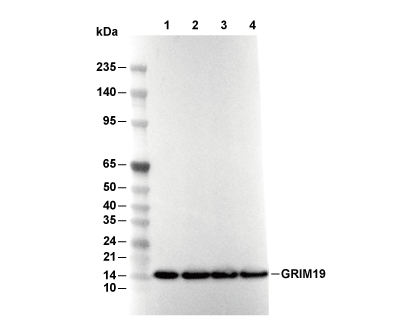 Lane 1: Daudi, Lane 2: TT, Lane 3: HepG2, Lane 4: VCaP