
|
受注:045-509-1970 |
技術サポート:tech@selleck.co.jp 平日9:00〜18:00 1営業日以内にご連絡を差し上げます |
化学情報
|
Synonyms | Storage (From the date of receipt) |
3 years -20°C powder 1 years -80°C in solvent |
|
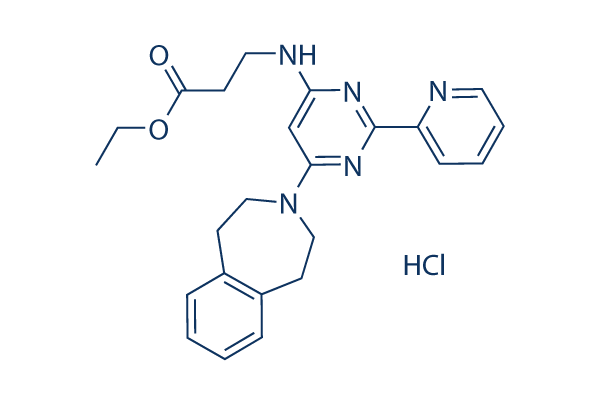
| 化学式 | C24H27N5O2.HCl |
|||
| 分子量 | 453.96 | CAS No. | 1797983-09-5 | |
| Solubility (25°C)* | 体外 | DMSO | 91 mg/mL (200.45 mM) | |
| Ethanol | 91 mg/mL (200.45 mM) | |||
| Water | 9.4 mg/mL (20.7 mM) | |||
|
* <1 mg/ml means slightly soluble or insoluble. * Please note that Selleck tests the solubility of all compounds in-house, and the actual solubility may differ slightly from published values. This is normal and is due to slight batch-to-batch variations. |
||||
溶剤液(一定の濃度)を調合する
生物活性
| 製品説明 | GSK J4 HClは、GSK J1の細胞透過性プロドラッグであり、H3K27 ヒストン脱メチル化酵素 JMJD3とUTXの最初の選択的阻害剤です。細胞フリーアッセイでは60 nMのIC50を示し、JMJファミリーの脱メチル化酵素パネルに対しては不活性です。 |
|---|---|
| in vitro | GSK J4 HCl is an ethyl ester derivative of the JMJD3 selective histone demethylase inhibitor GSK-J1 with an IC50 value greater than 50 μM in vitro. This compound is used to probe the consequences of demethylation of H3K27me3. In human primary macrophages, this chemical inhibits the lipopolysaccharide-induced production of cytokines, including pro-inflammatory tumour necrosis factor (TNF). In addition, it prevents the lipopolysaccharide-induced loss of H3K27me3 associated with the TNF transcription start sites and blocked the recruitment of RNA polymerase II. |
| in vivo | GSK-J4 hydrochloride is a potent dual inhibitor of H3K27me3/me2-demethylases JMJD3/KDM6B and UTX/KDM6A. It inhibits LPS-induced TNF-α production in human primary macrophages. This compound is a cell permeable prodrug of GSK-J1. |
プロトコル(参考用のみ)
| キナーゼアッセイ | Histone Demethylase AlphaScreen | |
|---|---|---|
| Inhibition of histone demethylases is assessed using the histone demethylase AlphaScreen assay (Amplified Luminescence Proximity Homogenous Assay). This assay uses a biotinylated peptide substrate and relies on detection of the product methyl mark using a specific antibody coupled to protein-A acceptor beads and a Steptavidin donor bead to capture the peptide. In brief, recombinant demethylase enzymes are incubated in the presence of Fe2+ in the form of Ferrous Ammonium Sulphate (FAS), -ketoglutarate (KG) and biotinylated peptide substrate. L-Ascorbic Acid is included to provide a reducing environment and prevent oxidation of Fe2+. After incubation with peptide substrate the presence of the product is detected using AlphaScreen technology. The demethylase AlphaScreen assays are performed in 384-well plate format using white proxiplates. All steps are carried out in assay buffer (50 mM HEPES pH 7.5, 0.1% (w/v) BSA and 0.01 % (v/v) Tween-20). FAS is dissolved fresh each day in 20 mM HCl to a concentration of 400 mM and diluted to 1.0 mM in deionized water. All other components are dissolved fresh each day in deionized water. For IC50 determinations 5 μL of assay buffer containing demethylase enzyme is transferred to wells of a 384-well proxiplate. Titrations of this compound (0.1 μL) are transferred to each well and the enzymes allowed to pre-incubate for 15 minutes with this chemical (final concentration of DMSO is 1%). The enzyme reaction is initiated by addition of 5 μL of a substrate mix consisting of α-KG, FAS, L-Ascorbic Acid and biotinylated peptide substrate and the reaction incubated for the indicated time at room temperature. The enzyme reaction is stopped after the indicated time by addinton of 5 μL of EDTA (7.5 mM final concentration in assay buffer). Streptavidin Donor beads (0.08 mg/ml) and Protein-A conjugated acceptor beads (0.08 mg/ml) are pre-incubated for 1 hour with an antibody to the product methyl mark and the presence of biotin-H3-product is detected by addition of 5 μL of the preincubated AlphaScreen beads (final concentrations of 0.02 mg/ml with respect to acceptor and donor beads). Detection is allowed to proceed for 1 hour at room temperature and the assay plates read in a BMG Labtech Pherastar FS plate reader. Data are normalized to the no enzyme control and the IC50 determined from the nonlinear regression curve fit using GraphPad Prism 5. | ||
| 細胞アッセイ | 細胞株 | Mouse podocytes |
| 濃度 | 5 μM | |
| 反応時間 | 48 h | |
| 実験の流れ | Cells were serum starved for 4 hours, followed by treatment with EPZ-6438 (10 μM) or this compound (5 μM) for 48 hours. |
|
| 動物実験 | 動物モデル | BALB/c mice |
| 投薬量 | 10 mg/kg | |
| 投与方法 | i.p. | |
参考
|
カスタマーフィードバック
-
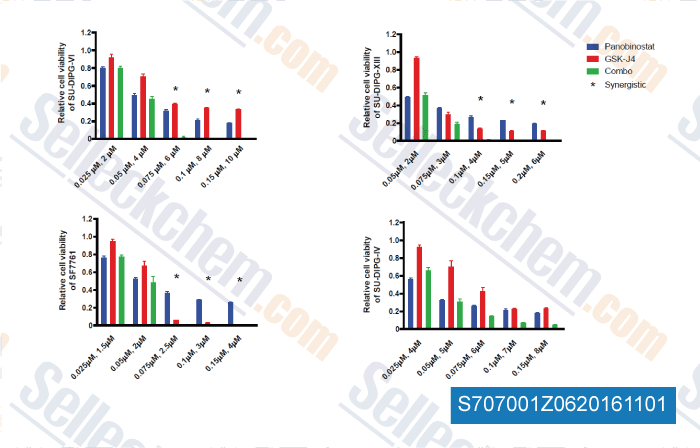
, , Nat Med, 2015, 21(6):555-9.
-
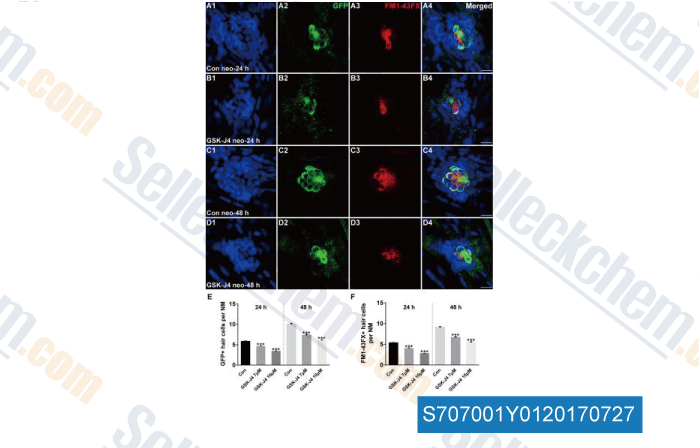
, , Front Mol Neurosci, 2017, doi: 10.3389/fnmol.2017.00051
-
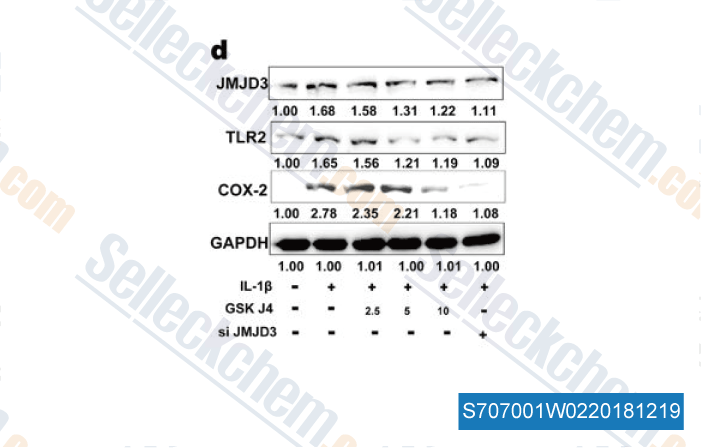
Data from [Data independently produced by , , Cell Mol Immunol, 2018, doi:10.1038/s41423-018-0037-8]
Selleckの高級品が、幾つかの出版された研究調査結果(以下を含む)で使われた:
| HIF-independent oxygen sensing via KDM6A regulates ferroptosis [ Mol Cell, 2025, 85(15):2973-2987.e6] | PubMed: 40712585 |
| Loss of Kmt2c or Kmt2d drives brain metastasis via KDM6A-dependent upregulation of MMP3 [ Nat Cell Biol, 2024, 26(7):1165-1175] | PubMed: 38926506 |
| Evi1 governs Kdm6b-mediated histone demethylation to regulate the Laptm4b-driven mTOR pathway in hematopoietic progenitor cells [ J Clin Invest, 2024, 134(24)e173403] | PubMed: 39680456 |
| Targeting lysine demethylase 6B ameliorates ASXL1 truncation-mediated myeloid malignancies in preclinical models [ J Clin Invest, 2024, 134(1)e163964] | PubMed: 37917239 |
| Refractory testicular germ cell tumors are highly sensitive to the targeting of polycomb pathway demethylases KDM6A and KDM6B [ Cell Commun Signal, 2024, 22(1):528] | PubMed: 39482699 |
| Dual targeting of histone deacetylases and MYC as potential treatment strategy for H3-K27M pediatric gliomas [ Elife, 2024, 13RP96257] | PubMed: 39093942 |
| Prenatal dexamethasone exposure reduces osteoprogenitor proliferation in mice via histone modifications at the Mkp-1 gene locus [ Commun Biol, 2024, 7(1):1589] | PubMed: 39609620 |
| Targeting histone demethylases JMJD3 and UTX: selenium as a potential therapeutic agent for cervical cancer [ Clin Epigenetics, 2024, 16(1):51] | PubMed: 38576048 |
| miRNA-27a-3p is involved in the plasticity of differentiated hepatocytes [ Gene, 2024, 913:148387] | PubMed: 38499211 |
| Refractory testicular germ cell tumors are highly sensitive to the targeting of polycomb pathway demethylases KDM6A and KDM6B [ Res Sq, 2024, rs.3.rs-4986186] | PubMed: 39483904 |
長期の保管のために-20°Cの下で製品を保ってください。
人間や獣医の診断であるか治療的な使用のためにでない。
各々の製品のための特定の保管と取扱い情報は、製品データシートの上で示されます。大部分のSelleck製品は、推薦された状況の下で安定です。製品は、推薦された保管温度と異なる温度で、時々出荷されます。長期の保管のために必要とされてそれと異なる温度で、多くの製品は、短期もので安定です。品質を維持するが、夜通しの積荷のために最も経済的な貯蔵状況を用いてあなたの送料を保存する状況の下に、製品が出荷されることを、我々は確実とします。製品の受領と同時に、製品データシートの上で貯蔵推薦に従ってください。