
|
受注:045-509-1970 |
技術サポート:tech@selleck.co.jp 平日9:00〜18:00 1営業日以内にご連絡を差し上げます |
化学情報
|
Synonyms | N/A | Storage (From the date of receipt) |
3 years -20°C powder 1 years -80°C in solvent |
|||||||||||
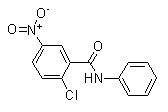
| 化学式 | C13H9ClN2O3 |
||||||||||||||
| 分子量 | 276.68 | CAS No. | 22978-25-2 | ||||||||||||
| Solubility (25°C)* | 体外 | DMSO | 55 mg/mL (198.78 mM) | ||||||||||||
| Water | Insoluble | ||||||||||||||
| Ethanol | Insoluble | ||||||||||||||
| 体内 (毎回新しく調製した物を用意してください) |
|
||||||||||||||
|
* <1 mg/ml means slightly soluble or insoluble. * Please note that Selleck tests the solubility of all compounds in-house, and the actual solubility may differ slightly from published values. This is normal and is due to slight batch-to-batch variations. |
|||||||||||||||
溶剤液(一定の濃度)を調合する
生物活性
| 製品説明 | GW9662 is a selective PPAR antagonist for PPARγ with IC50 of 3.3 nM in a cell-free assay, with at least 10- to 600-fold functional selectivity in cells with PPARγ versus PPARα and PPARδ. |
|---|---|
| in vitro | GW9662 binds to Cys(285) on PPARgamma which is conserved among all three PPARs. This compound acts as an antagonist of PPARgamma which is confirmed in an assay of adipocyte differentiation inhibition. [1] It prevents activation of PPARγ and inhibits growth of human mammary tumour cell lines (MCF7, MDA-MB-468, MDA-MB-231) with IC50 of 20 μM-30 μM, suggesting either the existence of PPARγ agonistic properties of this chemical or growth-inhibitory mechanisms independent of PPARγ. Co-treatment with this compound (10 μM) results in statistically lower viable cell numbers after 7 days in MDA-MB-231 cells. [2] PPARγ1 ligands could suppress RANKL-induced osteoclast formation in primary murine myeloid (BMs) and RAW264.7 cells. Importantly, suppression by these ligands is reversed in a concentration-dependent fashion with this chemical (2 μM). It (2 μM) blocks IL-4 suppression of osteoclast formation in BMs. This compound (1 μM) blocks RANKL activation of NF-κB in RAW264.7 cells. [3] GW9662 (10 μM) inhibits hormone- and agonist-induced adipogenesis of primary preadipocytes from patients with thyroid eye disease. [4] |
| in vivo | Pretreatment with LPS (1 mg/kg i.p.) significantly attenuates all markers of renal injury and dysfunction caused by ischemia/reperfusion (I/R) injury in rats. Most notably, this compound (1 mg/kg i.p.) abolishes the protective effects of LPS. [5] |
プロトコル(参考用のみ)
| キナーゼアッセイ | Binding assay | |
|---|---|---|
| The human PPARα, PPARγ, and PPARδ ligand binding domains (LBDs) are expressed in E. coli as polyhistidine-tagged fusion proteins. Receptors are immobilized on SPA beads by addition of the desired receptor (15 nM) to a slurry of streptavidin-modifed SPA beads (0.5 mg/mL) in assay buffer. The mixture is allowed to equilibrate for at least 1 hour at room temperature, and the beads are pelleted by centrifugation at 1×10³ g. The supernate is discarded, and the beads are resuspended in the original volume of fresh assay buffer with gentle mixing. The centrifugation/resuspension procedure is repeated, and the resulting slurry of receptor-coated beads is used immediately or stored at 4 ℃ for up to 1 week before use. [3H]GW2443 are used as radioligands for determination of competition binding to PPARα, PPARγ, and PPARδ, respectively. Unless otherwise indicated, the buffer used for all assays is 50 mM HEPES (pH 7), 50 mM NaCl, 5 mM CHAPS, 0.1 mg/mL BSA, and 10 mM DTT. For some experiments, the HEPES (pH 7) is replaced with 50 mM Tris (pH 8). | ||
| 細胞アッセイ | 細胞株 | MDA-MB-231 cells |
| 濃度 | 10 μM | |
| 反応時間 | 10 days | |
| 実験の流れ | MDA-MB-231 cells are seeded at a density of 1 × 10⁵ cells per 25 cm3 tissue culture flask. After 24 h (day 0), the growth medium is replaced with fresh medium containing GW9662 (10 μM) or both together. Control flasks receives 0.1% DMSO. Cells are harvested on days 0, 3, 5, 7, 10 for each treatment condition by trypsinisation, stained using trypan blue, and the total and viable number of cells per flask calculates using a haemocytometer. |
|
| 動物実験 | 動物モデル | male Wistar rats |
| 投薬量 | 1 mg/kg | |
| 投与方法 | intraperitoneal injection | |
参考
|
カスタマーフィードバック
-
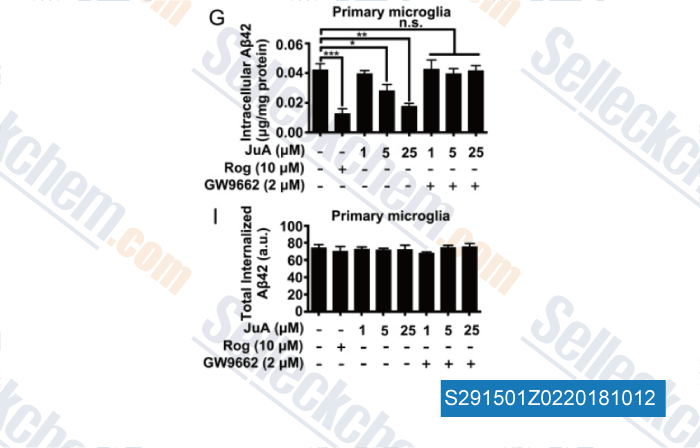
Data from [Data independently produced by , , Theranostics, 2018, 8(15):4262-4278]
-
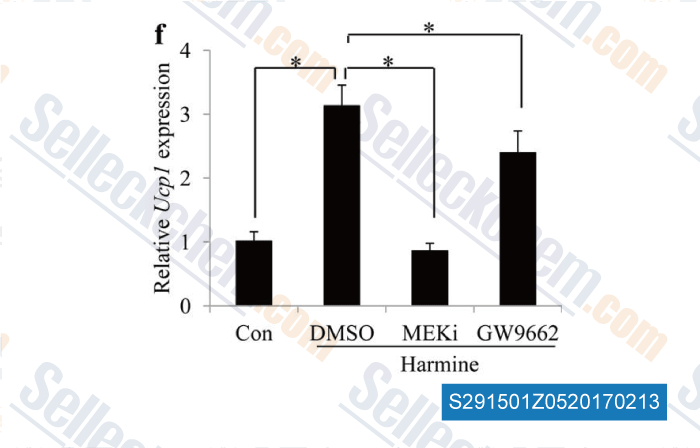
Data from [Data independently produced by , , Sci Rep, 2016, 6:36382.]
-
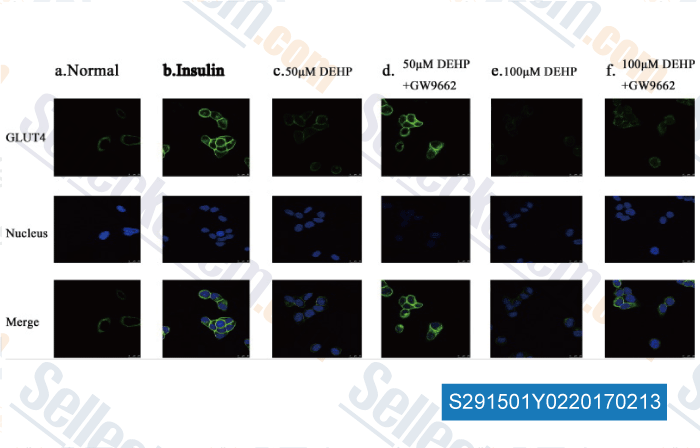
Data from [Data independently produced by , , Toxicol Appl Pharmacol, 2016, 316:17-26.]
Selleckの高級品が、幾つかの出版された研究調査結果(以下を含む)で使われた:
| Extracellular Vesicles From Limosilactobacillus johnsonii Enhance Milk Fat Synthesis by Inducing CD36 Dynamic Palmitoylation and Activating PPARγ Signalling [ J Extracell Vesicles, 2025, 14(8):e70143] | PubMed: 40767021 |
| LPS pretreated dental follicle stem cell derived exosomes promote periodontal tissue regeneration via miR-184 and PPARα-Akt-JNK signaling pathway [ Stem Cell Res Ther, 2025, 16(1):347] | PubMed: 40605003 |
| IRF8 aggravates nonalcoholic fatty liver disease via BMAL1/PPARγ axis [ Genes Dis, 2025, 12(3):101333] | PubMed: 40083324 |
| Epigenetic reprogramming via EZH2 inhibition rescues fibroadipose pathogenesis in secondary lymphedema through activating PPARγ signaling [ J Orthop Translat, 2025, 55:309-322] | PubMed: 41079990 |
| Compromised Peroxisome Proliferator-Activated Receptor γ-Mediated Impaired Placental Glucose Transport Via the Phosphatidylinositol 3-Kinase/Protein Kinase B Signaling Pathway Is Associated With Fetal Growth Restriction [ Lab Invest, 2025, 105(4):104103] | PubMed: 39909142 |
| TFPI2 hypermethylation promotes diabetic atherosclerosis progression through the Ap2α/PPARγ axis [ J Mol Cell Cardiol, 2025, 198:45-59] | PubMed: 39631358 |
| Naringin mitigates experimental autoimmune prostatitis by modulating oxidative stress and the NLRP3 inflammasome via the PPAR-γ/NF-κB pathway [ Sci Rep, 2025, 15(1):20843] | PubMed: 40594232 |
| FFAR2 expressing myeloid-derived suppressor cells drive cancer immunoevasion [ J Hematol Oncol, 2024, 17(1):9] | PubMed: 38402237 |
| Brain Short-Chain Fatty Acids Induce ACSS2 to Ameliorate Depressive-Like Behavior via PPARγ-TPH2 Axis [ Research (Wash D C), 2024, 7:0400] | PubMed: 38939042 |
| IL-33 Accelerates Chronic Atrophic Gastritis through AMPK-ULK1 Axis Mediated Autolysosomal Degradation of GKN1 [ Int J Biol Sci, 2024, 20(6):2323-2338] | PubMed: 38617533 |
長期の保管のために-20°Cの下で製品を保ってください。
人間や獣医の診断であるか治療的な使用のためにでない。
各々の製品のための特定の保管と取扱い情報は、製品データシートの上で示されます。大部分のSelleck製品は、推薦された状況の下で安定です。製品は、推薦された保管温度と異なる温度で、時々出荷されます。長期の保管のために必要とされてそれと異なる温度で、多くの製品は、短期もので安定です。品質を維持するが、夜通しの積荷のために最も経済的な貯蔵状況を用いてあなたの送料を保存する状況の下に、製品が出荷されることを、我々は確実とします。製品の受領と同時に、製品データシートの上で貯蔵推薦に従ってください。