
|
受注:045-509-1970 |
技術サポート:tech@selleck.co.jp 平日9:00〜18:00 1営業日以内にご連絡を差し上げます |
生物学的記述
| Specificity | Haptoglobin Antibody [B3H20] detects endogenous levels of total Haptoglobin protein. |
|---|---|
| Background | Haptoglobin (Hp) is an acute phase glycoprotein produced mainly in hepatocytes that functions as a key extracellular scavenger of hemoglobin released during intravascular hemolysis, thereby limiting iron driven oxidative damage and protecting renal and vascular tissues. It circulates as dimeric and multimeric assemblies whose structural organization supports high affinity binding to free hemoglobin, forming a stable haptoglobin–hemoglobin (Hp–Hb) complex that masks the pro oxidant heme moiety and prevents its dissociation into ferric iron and globin radicals. This complex is recognized by the hemoglobin–haptoglobin scavenger receptor CD163, which is expressed on monocytes and tissue macrophages in the liver, spleen, and bone marrow, mediating clathrin dependent endocytosis and subsequent lysosomal degradation of Hp–Hb, while the heme component is catabolized and iron is recycled or stored via ferritin. In parallel, haptoglobin modulates inflammatory signaling by regulating the availability of free hemoglobin for CD163 dependent anti inflammatory pathways, since ligation of CD163 promotes secretion of interleukin 10 and suppresses pro inflammatory cytokine production, thus positioning haptoglobin as a molecular interface between hemolysis, oxidative stress, and macrophage polarization. By sequestering toxic hemoglobin and facilitating its receptor mediated clearance, haptoglobin constrains lipid peroxidation, endothelial activation, and renal tubular injury in settings of hemolytic anemia, ischemia–reperfusion, and severe infection, so that its depletion or overload is associated with accentuated oxidative damage and microvascular dysfunction. Polymorphisms in the haptoglobin gene generate distinct isoforms that differ in polymerization state and hemoglobin binding capacity, influencing the efficiency of Hp–Hb complex formation and clearance, and these allelic variants are linked to altered susceptibility to ischemic cardiovascular events and chronic inflammatory states, yet haptoglobin dependent signaling remains dysregulated when hemolytic or inflammatory loads overwhelm the scavenger system and exhaust the CD163 mediated clearance machinery. |
使用情報
| Application | WB, IHC, IF, ELISA | Dilution |
|
||||||
|---|---|---|---|---|---|---|---|---|---|
| Reactivity | Human | ||||||||
| Source | Mouse Monoclonal Antibody | MW | 242 kDa | ||||||
| Storage Buffer | PBS, pH 7.2+50% Glycerol+0.05% BSA+0.01% NaN3 | Storage (from the date of receipt) |
-20°C (avoid freeze-thaw cycles), 2 years | ||||||
References
|
Application Data
WB
Validated by Selleck
-
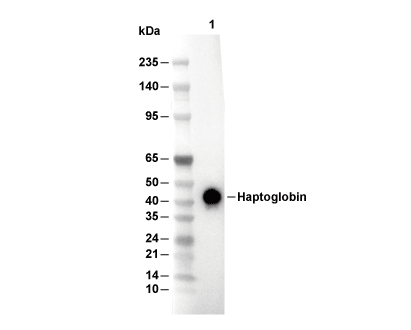 Lane 1: Human plasma