
|
受注:045-509-1970 |
技術サポート:tech@selleck.co.jp 平日9:00〜18:00 1営業日以内にご連絡を差し上げます |
生物学的記述
| Specificity | Histone H3 (di/tri methyl K4) Antibody [A19H7] detects endogenous levels of histone H3 only when it is di- or tri-methylated at lysine 4 (K4). |
|---|---|
| Background | Histone H3 (di/tri methyl K4) refers to histone H3 whose lysine 4 side chain carries two or three methyl groups, a covalent tail modification that functions as a key chromatin signal for transcriptional competence and active promoter architecture. Lys4 lies within the N‑terminal tail of H3 that protrudes from the nucleosome core, where it is accessible to SET1/MLL‑family methyltransferases and KDM‑family demethylases that dynamically install and remove mono‑, di‑, and tri‑methyl states, generating distinct docking surfaces for effector proteins. Dimethylation at H3K4 (H3K4me2) associates broadly with active and poised genes, extending across promoter‑proximal and early gene body regions and marking chromatin that is transcriptionally engaged or readily activatable, whereas trimethylation (H3K4me3) is sharply enriched at transcription start sites of actively transcribed genes and forms a narrow peak that defines active promoter nucleosomes. These methyl marks do not significantly alter nucleosome structure directly but create binding platforms for chromatin readers containing PHD fingers, chromodomains, Tudor domains, and WD40 repeats, including BPTF, ING family proteins, WDR5, and other components of nucleosome remodeling and histone acetyltransferase complexes, which then promote an open chromatin environment and recruitment or stabilization of the transcriptional machinery. H3K4me3 interacts functionally with H3/H4 acetylation and RNA polymerase II pre‑initiation complex assembly, and its presence at promoters correlates with transcription start site nucleosome depletion and high levels of paused and elongating polymerase, integrating it into core promoter logic in development and cell identity. H3K4me2 and H3K4me3 patterns change dynamically during differentiation and in disease, and altered distribution or global levels of these marks are linked to mis‑regulated gene expression programs in cancer, developmental syndromes, and metabolic and inflammatory disorders driven by mutations or aberrant activity of H3K4 methyltransferases and demethylases. |
使用情報
| Application | WB, IF, FCM | Dilution |
|
||||||
|---|---|---|---|---|---|---|---|---|---|
| Reactivity | Cow, Human, Rice | ||||||||
| Source | Mouse Monoclonal Antibody | MW | 15 kDa | ||||||
| Storage Buffer | PBS, pH 7.2+50% Glycerol+0.05% BSA+0.01% NaN3 | Storage (from the date of receipt) |
-20°C (avoid freeze-thaw cycles), 2 years | ||||||
References
|
Application Data
WB
Validated by Selleck
-
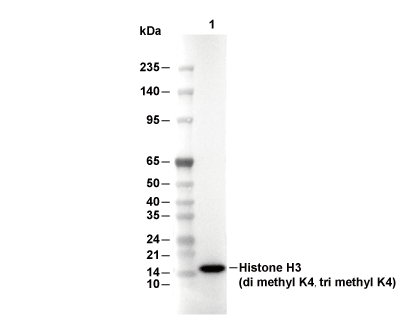 Lane 1: Recombinant Histone H3 Protein