
|
受注:045-509-1970 |
技術サポート:tech@selleck.co.jp 平日9:00〜18:00 1営業日以内にご連絡を差し上げます |
生物学的記述
| Specificity | Histone H3 (mono methyl K9) Antibody [G13B9] detects endogenous levels of total Histone H3 protein only when it is mono‑methylated at K9. |
|---|---|
| Background | Histone H3 lysine 9 monomethylation (H3K9me1) is a covalent post-translational modification occurring on the N-terminal tail of the core histone H3, a key component of the canonical nucleosome that organizes genomic DNA into chromatin. H3K9me1 is established by SET-domain-containing lysine methyltransferases, which can modify newly synthesized H3 during or immediately after translation to generate a pool of primed histones for chromatin incorporation. These monomethylated histones can serve as substrates for further methylation to H3K9me2 and H3K9me3, marks associated with heterochromatin formation, transcriptional repression, and the creation of silent chromatin domains. H3K9 methylation states modulate the recruitment of chromatin-associated factors, including reader proteins with aromatic-cage domains that discriminate between mono-, di-, and tri-methylated lysine. In certain plant species, a SAWADEE-like reader domain preferentially recognizes H3K9me1, indicating that this mark can act as a distinct docking site for effector complexes. H3K9 methylation can also antagonize local histone acetylation by restricting histone acetyltransferase access or activity, thereby reinforcing chromatin repression. Altered H3K9 methylation patterns, such as loss or redistribution of H3K9me1, have been linked to compromised heterochromatin maintenance, impaired transposon silencing, and gene regulation defects, contributing to developmental disorders and cancer. Positioned at the crossroads of histone turnover, hierarchical methylation, and reader recruitment, H3K9me1 serves as a key marker and functional probe for studying early heterochromatin assembly, RNA-directed DNA methylation, and the epigenetic regulation of genome stability. |
使用情報
| Application | WB, IHC, IF, ChIP | Dilution |
|
||||||||
|---|---|---|---|---|---|---|---|---|---|---|---|
| Reactivity | Mouse, Rat, Human | ||||||||||
| Source | Rabbit Monoclonal Antibody | MW | 15 kDa | ||||||||
| Storage Buffer | PBS, pH 7.2+50% Glycerol+0.05% BSA+0.01% NaN3 | Storage (from the date of receipt) |
-20°C (avoid freeze-thaw cycles), 2 years | ||||||||
References
|
Application Data
WB
Validated by Selleck
-
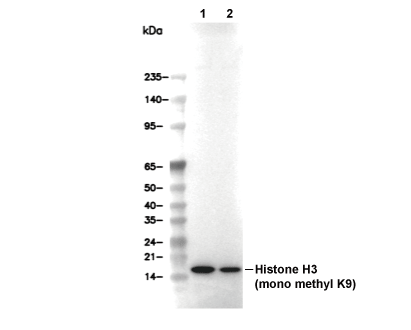 Lane 1: Hela, Lane 2: NIH/3T3