
|
受注:045-509-1970 |
技術サポート:tech@selleck.co.jp 平日9:00〜18:00 1営業日以内にご連絡を差し上げます |
生物学的記述
| Specificity | HuR/ELAVL1 Antibody [G18B5] detects endogenous levels of total HuR/ELAVL1 protein. |
|---|---|
| Background | HuR (ELAVL1), the ubiquitously expressed founding member of the ELAV RNA-binding protein family alongside neuron-restricted HuB/C/D, orchestrates post-transcriptional control of mRNA stability and translation through high-affinity binding to AU- and U-rich elements (AREs) predominantly in 3' untranslated regions of proliferation, survival, and inflammatory transcripts. Its three tandem RNA recognition motifs (RRMs) form a compact clamp that engages adenine-rich stems with subnanomolar affinity, while nuclear localization/importin signals enable continuous nucleocytoplasmic shuttling that accelerates upon transcriptional stress when HuR relocates to cytoplasmic stress granules. Upon binding, HuR recruits poly(A)-binding protein to circularize mRNAs and excludes decay factors like TTP/BRF1 while promoting cap-dependent translation via eIF4A/eIF4G interactions; concurrently, HuR antagonizes miR-16 and let-7 repression by sterically occluding RISC loading sites on VEGF, c-Myc, and COX-2 transcripts. Phosphorylation by p38 MAPK, PKC, or Chk2 at S202/S220/S318 shifts HuR from nuclear retention to cytoplasmic export, coupling genotoxic stress or inflammatory cues to rapid proteome reprogramming. Physiologically, HuR sustains intestinal epithelial barrier integrity through sustained Mcl-1 expression, coordinates T cell activation via CD154 stabilization, and buffers oncogenic stress in fibroblasts, positioning it as the master regulator of immediate-early gene expression that researchers target with RRM-competitive quinazolines or antisense morpholinos to dissect translational buffering in tumorspheres. Cytoplasmic sequestration via 14-3-3 binding provides feedback inhibition, while HuR auto-regulates its own decay through intronic ARE binding. Overexpression drives chemoresistance through MDR1 stabilization while deficiency impairs wound healing through VEGF deficits. |
使用情報
| Application | WB, IP, IF, FCM | Dilution |
|
||||||||
|---|---|---|---|---|---|---|---|---|---|---|---|
| Reactivity | Human, Mouse, Rat, Monkey | ||||||||||
| Source | Rabbit Monoclonal Antibody | MW | 30 kDa | ||||||||
| Storage Buffer | PBS, pH 7.2+50% Glycerol+0.05% BSA+0.01% NaN3 | Storage (from the date of receipt) |
-20°C (avoid freeze-thaw cycles), 2 years | ||||||||
References
|
Application Data
WB
Validated by Selleck
-
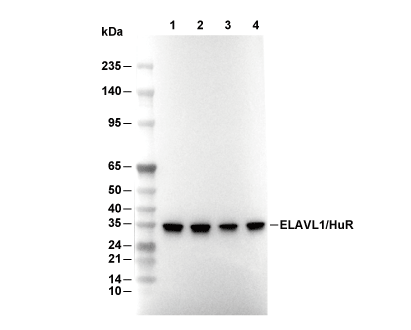 Lane 1: 293T, Lane 2: HCT116, Lane 3: 3T3, Lane 4: RAW264.7