
|
受注:045-509-1970 |
技術サポート:tech@selleck.co.jp 平日9:00〜18:00 1営業日以内にご連絡を差し上げます |
生物学的記述
| Specificity | MLLT1/ENL Antibody [N21N24] detects endogenous levels of total MLLT1/ENL protein. |
|---|---|
| Background | MLLT1, commonly known as ENL, belongs to the family of yeast eleven-nineteen leukemia (ENL) proteins and serves as a chromatin reader within the super elongation complex (SEC), a multiprotein assembly that drives RNA polymerase II (RNAPII) transcriptional elongation by counteracting promoter-proximal pausing. The protein contains an N-terminal YEATS domain that selectively binds acetylated and crotonylated histone tails, particularly H3K9ac, facilitating SEC recruitment to active gene loci, alongside an integrated YEATS-YeATS dimerization interface and association with P-TEFb kinase for phosphorylation of RNAPII CTD at Ser2. Within the SEC, ENL coordinates with AFF4, MLLT3/AF9, and ELL proteins to accelerate RNAPII processivity, releasing negative elongation factors DSIF and NELF to enable productive elongation on developmental genes like HOX clusters. ENL also integrates into the Dot1L histone H3K79 methyltransferase complex, where it recruits DOT1L to elongation sites, depositing H3K79me2/3 marks that stabilize open chromatin and amplify transcription of proto-oncogenes such as MYC alongside MLL-fusion targets. Phosphorylation by ATM kinase modulates ENL function, enabling binding to Polycomb Repressive Complex 1 (PRC1) components BMI1 and RING1B, which deposit H2AK119ub and switches active elongation to repression at DNA damage-responsive loci. The YEATS domain adopts a rigid pocket for rigid histone engagement, while fusion breakpoints in MLL-ENL retain this domain to aberrantly tether SEC and Dot1L to MLL genomic targets. Dysregulated MLLT1 fusions drive mixed-lineage leukemia through sustained HOX/MYC overexpression, while somatic mutations in solid tumors like Wilms tumor enhance Wnt/β-catenin signaling via PITX2 and MYC upregulation. |
使用情報
| Application | WB, ChIP | Dilution |
|
||||
|---|---|---|---|---|---|---|---|
| Reactivity | Human | ||||||
| Source | Rabbit Monoclonal Antibody | MW | 80 kDa | ||||
| Storage Buffer | PBS, pH 7.2+50% Glycerol+0.05% BSA+0.01% NaN3 | Storage (from the date of receipt) |
-20°C (avoid freeze-thaw cycles), 2 years | ||||
References
|
Application Data
WB
Validated by Selleck
-
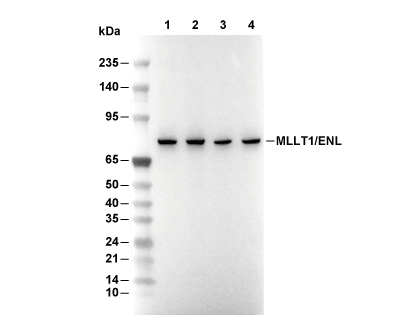 Lane 1: Jurkat, Lane 2: K562, Lane 3: MDA-MB-453, Lane 4: SK-N-MC