
|
受注:045-509-1970 |
技術サポート:tech@selleck.co.jp 平日9:00〜18:00 1営業日以内にご連絡を差し上げます |
化学情報
|
Synonyms | N/A | Storage (From the date of receipt) |
3 years -20°C powder 1 years -80°C in solvent |
|||
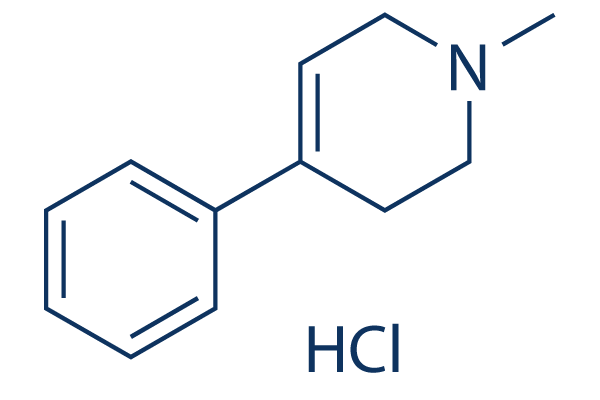
| 化学式 | C12H15N·HCl |
||||||
| 分子量 | 209.72 | CAS No. | 23007-85-4 | ||||
| Solubility (25°C)* | 体外 | Water | 41 mg/mL (195.49 mM) | ||||
| DMSO | 30 mg/mL (143.04 mM) | ||||||
| Ethanol | 23 mg/mL (109.67 mM) | ||||||
| 体内 (毎回新しく調製した物を用意してください) |
|
||||||
|
* <1 mg/ml means slightly soluble or insoluble. * Please note that Selleck tests the solubility of all compounds in-house, and the actual solubility may differ slightly from published values. This is normal and is due to slight batch-to-batch variations. |
|||||||
溶剤液(一定の濃度)を調合する
生物活性
| 製品説明 | MPTP hydrochloride is a dopaminergic neurotoxin and cause selective destruction of dopaminergic neurons in animal models of parkinsonism. MPTP hydrochloride induces apoptosis.=""&B5&" can be used to induce animal models of "&H5&"." |
|---|---|
| in vitro | The morphology of N2AB-1 and glioma cells was unaltered when these cells were exposed to all doses of MPTP hydrochloride. And, C6 glioma cell proliferation was also unaffected by this compound treatment[3]. MPTP Promotes Apoptosis and Tau Phosphorylation in Human Neuroblastoma M17 Cells. This compound significantly promotes Tau phosphorylation at Ser262 in human neuroblastoma M17 cells. It caused a dose-dependent increase in the intracellular α-synuclein level in our M17 human neuroblastoma cells. This chemical appears to promote Tau phosphorylation in the brain by activating both PKA and GSK3β[4]. |
| in vivo | The number of tyrosine hydroxylase-positive neurons was decreased in the substantia nigra pars compacta of MPTP-treated mice. This compound decreased thioredoxin reductase 1 expression and thioredoxin reductase activity in the mouse midbrain, reduced the number of thioredoxin reductase 1-positive cells in the substantia nigra pars compacta of mice. Administration of this toxin can cause neurochemical, behavioral and histopathological alterations in human and nonhuman primates that are similar to those observed in Parkinsonian patients. Compared with primates, rodents are insensitive to MPTP. This chemical can be administered by various routes, such as gavage and stereotactic injection, but the most common and reproducible route is systemic administration, including subcutaneous, intravenous, intraperitoneal and intramuscular injection. It is a lipophilic protoxin that can rapidly cross the blood-brain barrier following systemic injection. Once it enters the brain, MPTP is converted to 1-methyl-4-phenylpyridine by monoamine oxidase B[1]. It has been shown to be toxic to dopaminergic neurons of the nigrostriatal system in humans, monkeys, and mice and to produce long-lasting depletion of DA and its metabolites in the striatum[2]. |
プロトコル(参考用のみ)
| 細胞アッセイ | 細胞株 | N2AB-1 neural cell line and the C6 glioma cell line |
|---|---|---|
| 濃度 | 47.7, 4.77 and 0.477 μM | |
| 反応時間 | 1, 2, 3 days | |
| 実験の流れ | N2AB-1 and C6 glioma cells were plated in 24-well costar dishes (16 mm diameter) at 50,000 cells per well with the culture medium described above. After 24 h medium was removed and medium with varying concentrations of MPTP hydrochloride or MPP+ was added in duplicate. Control and treated cells were then trypsinized and counted with a hemocytometer every day for 3 days following treatment. |
|
| 動物実験 | 動物モデル | C57BL/6 mice |
| 投薬量 | 20 mg/kg | |
| 投与方法 | i.p. |
参考
|
Selleckの高級品が、幾つかの出版された研究調査結果(以下を含む)で使われた:
| Integrated Analysis of Single-Cell and Transcriptome Data Reveals the Role and Regulatory Mechanisms of Neuroinflammation in Parkinson's Disease [ Inflammation, 2025, 10.1007/s10753-025-02306-4] | PubMed: 40285838 |
| The mechanism of electroacupuncture-mediated improvement in Parkinson's disease by inhibiting ferroptosis through activating the Nrf2/GPX4 signal pathway [ Front Aging Neurosci, 2025, 17:1551404] | PubMed: 40400910 |
| URB597 downregulates DJ-1 expression in the mouse striatum and induces neurodegeneration [ Exp Cell Res, 2025, 449(2):114602] | PubMed: 40373851 |
| Down-regulation of HSPA9 reduces tyrosine hydroxylase-positive neurons in mouse substantia nigra and induces Parkinson's disease-like motor impairments [ Anim Cells Syst (Seoul), 2025, 29(1):615-627] | PubMed: 41104322 |
| Disulfide bridge-targeted metabolome mining unravels an antiparkinsonian peptide [ Acta Pharm Sin B, 2024, 14(2):881-892] | PubMed: 38322339 |
| Echinacoside exerts neuroprotection via suppressing microglial α-synuclein/TLR2/NF-κB/NLRP3 axis in parkinsonian models [ Phytomedicine, 2024, 123:155230] | PubMed: 38000105 |
| Intravitreal MPTP drives retinal ganglion cell loss with oral nicotinamide treatment providing robust neuroprotection [ Acta Neuropathol Commun, 2024, 12(1):79] | PubMed: 38773545 |
| Phosphorylated α-synuclein deposited in Schwann cells interacting with TLR2 mediates cell damage and induces Parkinson's disease autonomic dysfunction [ Cell Death Discov, 2024, 10(1):52] | PubMed: 38278799 |
| CDK5-USP30 signaling pathway regulates MAVS-mediated inflammation via suppressing mitophagy in MPTP/MPP+ PD model [ Ecotoxicol Environ Saf, 2024, 279:116446] | PubMed: 38772138 |
| GSK-3β inhibitor amplifies autophagy-lysosomal pathways by regulating TFEB in Parkinson's disease models [ Exp Neurol, 2024, S0014-4886(24)00359-5] | PubMed: 39490621 |
長期の保管のために-20°Cの下で製品を保ってください。
人間や獣医の診断であるか治療的な使用のためにでない。
各々の製品のための特定の保管と取扱い情報は、製品データシートの上で示されます。大部分のSelleck製品は、推薦された状況の下で安定です。製品は、推薦された保管温度と異なる温度で、時々出荷されます。長期の保管のために必要とされてそれと異なる温度で、多くの製品は、短期もので安定です。品質を維持するが、夜通しの積荷のために最も経済的な貯蔵状況を用いてあなたの送料を保存する状況の下に、製品が出荷されることを、我々は確実とします。製品の受領と同時に、製品データシートの上で貯蔵推薦に従ってください。