
|
受注:045-509-1970 |
技術サポート:tech@selleck.co.jp 平日9:00〜18:00 1営業日以内にご連絡を差し上げます |
生物学的記述
| Specificity | MyoD1 Antibody [M18A7] detects endogenous levels of total MyoD1 protein. |
|---|---|
| Background | MyoD1 (myogenic differentiation 1, also called MyoD or Myf3) is a skeletal muscle–specific basic helix–loop–helix transcription factor of the myogenic regulatory factor family that functions as a master determinant of the myogenic lineage by converting multipotent mesenchymal and other non‑muscle cells to committed myoblasts and orchestrating the activation of muscle structural and metabolic gene programs. The protein contains an N‑terminal transactivation region, a central bHLH domain that mediates heterodimerization with E‑proteins and sequence‑specific binding to E‑box motifs (CANNTG), and C‑terminal regions that contribute to chromatin interaction and recruitment of transcriptional co‑regulators, allowing MyoD1 to act as both a DNA‑binding factor and a chromatin remodeling organizer at myogenic loci. MyoD1 binding to E‑box elements on muscle gene promoters and enhancers recruits SWI/SNF chromatin‑remodeling complexes, histone acetyltransferases, and other coactivators, promotes nucleosome repositioning and increased histone acetylation, and activates transcription of genes encoding myofibrillar proteins, muscle‑specific enzymes, and regulators of sarcomere assembly and excitation–contraction coupling, while also inducing expression of other MRFs and MEF2 family members to establish feed‑forward networks that stabilize myogenic identity. MyoD1 expression is induced and modulated by multiple signaling pathways, including p38 MAPK, PI3K–Akt, myostatin/Smad, NF‑κB, and mTOR, which influence MyoD1 phosphorylation status, interaction with co‑regulators, and promoter selectivity, enabling extracellular cues such as growth factors, inflammatory mediators, and nutrient availability to shape the timing and extent of myoblast proliferation, withdrawal from the cell cycle, and terminal differentiation into multinucleated myotubes. Circadian clock components also regulate MyoD1, with CLOCK–BMAL1 driving rhythmic MyoD transcription in skeletal muscle and MyoD1 in turn amplifying circadian gene expression programs that affect muscle structure, metabolism, and contractile function, linking systemic timekeeping mechanisms to daily remodeling of the muscle transcriptome. MyoD1 remains expressed in satellite cell–derived myoblasts during postnatal muscle regeneration and contributes to reactivation of myogenic gene networks after injury, while inappropriate or absent MyoD1 expression in non‑muscle contexts is associated with tumorigenesis and serves as a diagnostic marker in rhabdomyosarcoma and related soft‑tissue malignancies where myogenic differentiation programs are activated or disrupted. |
使用情報
| Application | WB, IHC, IF | Dilution |
|
||||||
|---|---|---|---|---|---|---|---|---|---|
| Reactivity | Human | ||||||||
| Source | Rabbit Monoclonal Antibody | MW | 34 kDa | ||||||
| Storage Buffer | PBS, pH 7.2+50% Glycerol+0.05% BSA+0.01% NaN3 | Storage (from the date of receipt) |
-20°C (avoid freeze-thaw cycles), 2 years | ||||||
References
|
Application Data
WB
Validated by Selleck
-
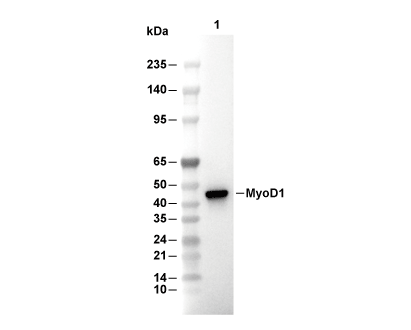 Lane 1: RD