
|
受注:045-509-1970 |
技術サポート:tech@selleck.co.jp 平日9:00〜18:00 1営業日以内にご連絡を差し上げます |
生物学的記述
| Specificity | Neuropilin-1 Antibody [C24N3] detects endogenous levels of total Neuropilin-1 protein. |
|---|---|
| Background | Neuropilin-1, or NRP1, is a single-pass transmembrane glycoprotein of 923 amino acids and a co-receptor in the neuropilin family that includes NRP1 and NRP2. It lacks intrinsic enzymatic activity but enhances signaling specificity for semaphorin-3A in axon guidance and VEGF-A165 in angiogenesis by forming holoreceptor complexes with Plexin-As and VEGFR2, respectively. The extracellular region of NRP1 contains two CUB domains, a1 and a2, for Sema3A binding, two coagulation factor VIII homology domains, b1 and b2, which serve as the primary docking site for VEGF-A165 at the exon 7-8 region through an Arg/Arg/Lys triad, and a MAM globular domain, c, for Plexin and VEGFR dimerization. This is followed by a single transmembrane helix, d, and a short cytoplasmic tail of 44 amino acids with an SEA or PDS motif that binds GIPC1 and Syndecan for PDZ-mediated trafficking. The dimeric b1b1 platform selectively accommodates the C-terminal helix of VEGF-A165 and excludes PlGF and TGFβ. NRP1 acts as axon repulsion, where the Sema3A-NRP1-PlexinA1 tetramer recruits R-Ras GAP1 and collapsin response mediator protein, leading to F-actin depolymerization and integrin internalization for growth cone collapse, repelling about 90 percent of sympathetic axons; angiogenic tip cell guidance, where NRP1 localizes to filopodia, enhancing VEGF-A165-VEGFR2 signaling via PI3K, Akt, and FAK, promoting directional migration and sprouting, with NRP1 knockout embryos displaying vascular branching defects similar to VEGF haploinsufficiency; and integrin α5β1 recycling via GIPC1 endosomes for fibronectin-mediated adhesion and invasion. NRP1 is crucial for cardiovascular and neuronal development, including optic chiasm decussation and lymphatic valve formation, synaptic plasticity through regulation of dendritic spine density via Sema3A, and immune tolerance by supporting regulatory T cell migration. NRP1 is overexpressed in gliomas and breast cancer, where it drives metastasis through VEGFR-independent Rac1 activation and perineural invasion. |
使用情報
| Application | WB, IP, FCM | Dilution |
|
||||||
|---|---|---|---|---|---|---|---|---|---|
| Reactivity | Human | ||||||||
| Source | Rabbit Monoclonal Antibody | MW | 120-140 kDa | ||||||
| Storage Buffer | PBS, pH 7.2+50% Glycerol+0.05% BSA+0.01% NaN3 | Storage (from the date of receipt) |
-20°C (avoid freeze-thaw cycles), 2 years | ||||||
| WB |
Experimental Protocol:
Sample preparation
1. Tissue: Lyse the tissue sample by adding an appropriate volume of ice-cold RIPA/NP-40 Lysis Buffer (containing Protease Inhibitor Cocktail),and homogenize the tissue at a low temperature. 2. Adherent cell: Aspirate the culture medium and wash the cells with ice-cold PBS twice. Lyse the cells by adding an appropriate volume of RIPA/NP-40 Lysis Buffer (containing Protease Inhibitor Cocktail) and put the sample on ice for 5 min. 3. Suspension cell: Transfer the culture medium to a pre-cooled centrifuge tube. Centrifuge and aspirate the supernatant. Wash the cells with ice-cold PBS twice. Lyse the cells by adding an appropriate volume of RIPA/NP-40 Lysis Buffer (containing Protease Inhibitor Cocktail) and put the sample on ice for 5 min. 4. Place the lysate into a pre-cooled microcentrifuge tube. Centrifuge at 4°C for 15 min. Collect the supernatant;
5. Remove a small volume of lysate to determine the protein concentration;
6. Combine the lysate with protein loading buffer. Boil 20 µL sample under 95-100°C for 5 min. Centrifuge for 5 min after cool down on ice.
2. Power up 80V for 30 minutes. Then the power supply is adjusted (110 V~150 V), the Marker is observed, and the electrophoresis can be stopped when the indicator band of the predyed protein Marker where the protein is located is properly separated. (Note that the current should not be too large when electrophoresis, too large current (more than 150 mA) will cause the temperature to rise, affecting the result of running glue. If high currents cannot be avoided, an ice bath can be used to cool the bath.)
Transfer membrane
1. Take out the converter, soak the clip and consumables in the pre-cooled converter;
2. Activate PVDF membrane with methanol for 1 min and rinse with transfer buffer;
3. Install it in the order of "black edge of clip - sponge - filter paper - filter paper - glue -PVDF membrane - filter paper - filter paper - sponge - white edge of clip"; 4. The protein was electrotransferred to PVDF membrane. ( 0.45 µm PVDF membrane is recommended ) Reference Table for Selecting PVDF Membrane Pore Size Specifications Recommended conditions for wet transfer: 200 mA, 120 min. ( Note that the transfer conditions can be adjusted according to the protein size. For high-molecular-weight proteins, a higher current and longer transfer time are recommended. However, ensure that the transfer tank remains at a low temperature to prevent gel melting.)
Block
1. After electrotransfer, wash the film with TBST at room temperature for 5 minutes;
2. Incubate the film in the blocking solution for 1 hour at room temperature;
3. Wash the film with TBST for 3 times, 5 minutes each time.
Antibody incubation
1. Use 5% skim milk powder to prepare the primary antibody working liquid (recommended dilution ratio for primary antibody 1:1000), gently shake and incubate with the film at 4°C overnight; 2. Wash the film with TBST 3 times, 5 minutes each time;
3. Add the secondary antibody to the blocking solution and incubate with the film gently at room temperature for 1 hour;
4. After incubation, wash the film with TBST 3 times for 5 minutes each time.
Antibody staining
1. Add the prepared ECL luminescent substrate (or select other color developing substrate according to the second antibody) and mix evenly;
2. Incubate with the film for 1 minute, remove excess substrate (keep the film moist), wrap with plastic film, and expose in the imaging system.
|
References
|
Application Data
WB
Validated by Selleck
-
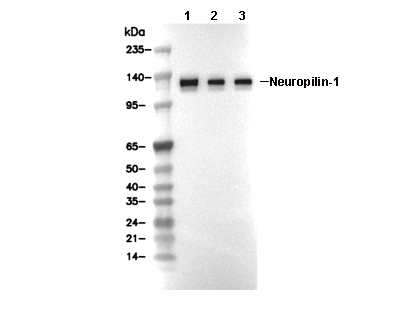 Lane 1: PC-3, Lane 2: HT1080, Lane 3: MDA-MB-231