
|
受注:045-509-1970 |
技術サポート:tech@selleck.co.jp 平日9:00〜18:00 1営業日以内にご連絡を差し上げます |
生物学的記述
| Specificity | OS9 Antibody [M17H4] detects endogenous levels of total OS9 protein. |
|---|---|
| Background | OS9 functions as an endoplasmic reticulum resident lectin within the mannose-6-phosphate receptor homology domain family, recognizing monoglucosylated N-glycans on misfolded glycoproteins to facilitate ER-associated degradation. The protein contains an N-terminal signal sequence, a central MRH domain with mannose-binding sites flanked by conserved charged residues, and C-terminal transmembrane and cytoplasmic tail regions that anchor it to ER membranes while enabling interactions with dislocation machinery. OS9 binds high-mannose oligosaccharides on terminally misfolded proteins through its MRH lectin domain, recruiting them to the Hrd1-SEL1L E3 ubiquitin ligase complex via direct SEL1L interaction, which delivers substrates to the dislocation channel for retrotranslocation into the cytosol followed by proteasomal degradation. Binding specificity arises from calcium coordination within the MRH domain that positions mannose residues for recognition, distinguishing misfolded conformers from properly folded glycoproteins during calnexin/calreticulin cycle reglucosylation events. OS9 forms a stable complex with XTP3-B to enhance recognition of nonglycosylated substrates through hydrophobic patch exposure, while IRE1/XBP1 pathway activation transcriptionally upregulates both OS9 isoforms during acute ER stress to amplify degradation capacity. The protein colocalizes with ERGIC-53 and VIP36 cargo receptors to prevent anterograde transport of terminally misfolded α1-antitrypsin variants and the null Hong Kong variant. OS9 deficiency impairs the degradation of destabilized CFTR folding mutants and ricin toxin A chain, leading to cytosolic accumulation. Isoform-specific expression patterns emerge through alternative splicing, with OS9.1 predominant in fibroblasts and OS9.2 enriched in professional secretory cells. Dysregulation of OS9 is linked to congenital disorders of glycosylation and protein folding diseases, including α1-antitrypsin deficiency. |
使用情報
| Application | WB, IP | Dilution |
|
||||
|---|---|---|---|---|---|---|---|
| Reactivity | Human, Mouse, Rat, Monkey | ||||||
| Source | Rabbit Monoclonal Antibody | MW | 83 kDa,97 kDa | ||||
| Storage Buffer | PBS, pH 7.2+50% Glycerol+0.05% BSA+0.01% NaN3 | Storage (from the date of receipt) |
-20°C (avoid freeze-thaw cycles), 2 years | ||||
References
|
Application Data
WB
Validated by Selleck
-
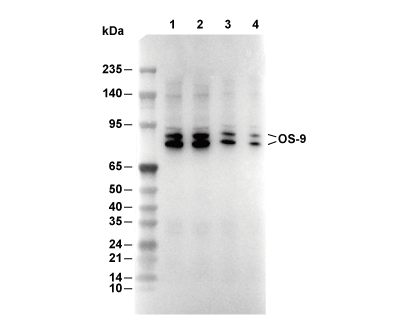 Lane 1: HL60, Lane 2: MCF7, Lane 3: PANC1, Lane 4: COS-7