
|
受注:045-509-1970 |
技術サポート:tech@selleck.co.jp 平日9:00〜18:00 1営業日以内にご連絡を差し上げます |
化学情報
|
Synonyms | Storage (From the date of receipt) |
3 years -20°C powder 1 years -80°C in solvent |
||||||||||||
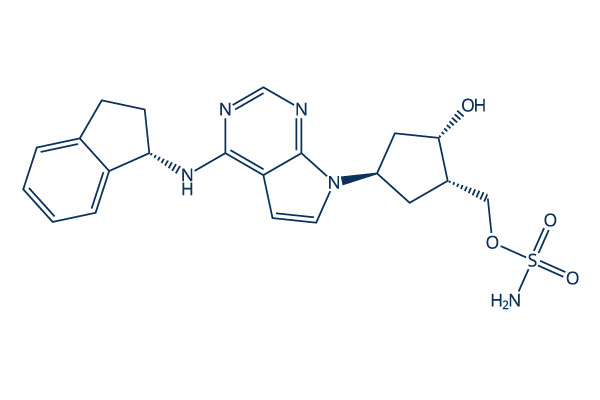
| 化学式 | C21H25N5O4S |
||||||||||||||
| 分子量 | 443.52 | CAS No. | 905579-51-3 | ||||||||||||
| Solubility (25°C)* | 体外 | DMSO | 88 mg/mL (198.41 mM) | ||||||||||||
| Ethanol | 88 mg/mL (198.41 mM) | ||||||||||||||
| Water | Insoluble | ||||||||||||||
| 体内 (毎回新しく調製した物を用意してください) |
|
||||||||||||||
|
* <1 mg/ml means slightly soluble or insoluble. * Please note that Selleck tests the solubility of all compounds in-house, and the actual solubility may differ slightly from published values. This is normal and is due to slight batch-to-batch variations. |
|||||||||||||||
溶剤液(一定の濃度)を調合する
生物活性
| 製品説明 | MLN4924 is a small molecule inhibitor of Nedd8 activating enzyme (NAE) with IC50 of 4 nM. |
|---|---|
| in vitro | Pevonedistat (MLN4924) is structurally related to adenosine 59-monophosphate (AMP)—a tight binding product of the NAE reaction. It (3 μM) selectively inhibits NAE in HCT-116 cell lysates and inhibits overall protein turnover by <9% in HCT-116 cells. This compound results in a dose-dependent decrease of Ubc12–NEDD8 thioester and NEDD8–cullin conjugates with an IC50 < 0.1 μM in HCT-116 cells, resulting in a reciprocal increase in the abundance of the known CRL substrates CDT1, p27 and NRF2, but not non-CRL substrates. It (3 μM) leads cells to accumulate in S-phase as early as 8 hours and results in a significant fraction of cells contained 4N DNA content by 24 hours in HCT-116 cells. [1] It (3 μM) results in rapid accumulation of pIkappaBalpha, decrease in nuclear p65 content, reduction of nuclear factor-kappaB (NF-kappaB) transcriptional activity, and G(1) arrest, ultimately resulting in apoptosis induction, events consistent with potent NF-kappaB pathway inhibition in ABC DLBCL cells. [2] This compound (1 μM) triggers DNA replication and inhibit cell proliferation by stabilizing the DNA replication factor Cdt1, a substrate of cullins 1 and 4. It (1 μM) , which is sufficient to elevate Cdt1 for 4-5 hours, is found to be sufficient to induce DNA replication and to activate apoptosis and senescence pathways. [3] Its treatment induces the characteristics of senescence phenotypes as evidenced by enlarged and flattened cellular morphology and positive staining of senescence-associated β-Gal. MLN4924-induced senescence is associated with cellular response to DNA damage, triggered by accumulation of DNA-licensing proteins CDT1 and ORC1, as a result of inactivation of CRL/SCF E3s. This senescence is irreversible and coupled with persistent accumulation of p21 and sustained activation of DNA damage response. [4] |
| in vivo | Pevonedistat (MLN4924) (60 mg/kg) results in a dose- and time-dependent decrease of NEDD8–cullin levels as early as 30 min after administration in HCT-116 tumour-bearing mice, with maximal effect 1–2 hours post-dose. It also leads to a dose- and time-dependent increase in the steady state levels of NRF2 and CDT1 in HCT-116 tumour-bearing mice. This compound leads to DNA damage in the tumour indicated by the increased levels of phosphorylated CHK1 in HCT-116 tumour-bearing mice. When administered on a BID schedule at 30 mg/kg and 60 mg/kg, it inhibits tumour growth with T/C values of 0.36 and 0.15, respectively, in mice bearing HCT-116 xenografts. [1] It (60 mg/kg) blocks NAE pathway biomarkers and results in complete tumor growth inhibition in mice bearing human xenograft tumors of ABC- and GCB-DLBCL. This compound (60 mg/kg) results in NF-kappaB pathway inhibition accompanied by tumor regressions in primary human tumor mice models of ABC-DLBCL. [2] |
| 特徴 | A mechanism-based inhibitor of NAE, and creates a covalent NEDD8-MLN4924 adduct catalyzed by the enzyme. |
プロトコル(参考用のみ)
| キナーゼアッセイ | In vitro E1-activating enzyme assays | |
|---|---|---|
| A time-resolved fluorescence energy transfer assay format is used to measure the in vitro activity of NAE. The enzymatic reaction, containing 50 μL 50 mM HEPES, pH 7.5, 0.05% BSA, 5 mM MgCl2, 20 μM ATP, 250 μM glutathione, 10 nM Ubc12–GST, 75 nM NEDD8–Flag and 0.3 nM recombinant human NAE enzyme, is incubated at 24 ℃ for 90 min in a 384-well plate, before termination with 25 μL of stop/detection buffer (0.1 M HEPES, pH 7.5, 0.05% Tween20, 20 mM EDTA, 410 mM KF, 0.53 nM Europium-Cryptate-labelled monoclonal Flag-M2-specific antibody and 8.125 μg/mL PHYCOLINK allophycocyanin (XL-APC)-labelled GST-specific antibody. After incubation for 2 hours at 24 ℃, the plate is read on the LJL Analyst HT Multi-Mode instrument using a time-resolved fluorescence method. A similar assay protocol is used to measure other E1 enzymes. | ||
| 細胞アッセイ | 細胞株 | HCT-116 cells |
| 濃度 | 3 μM | |
| 反応時間 | 72 hours | |
| 実験の流れ | Cell suspensions are seeded at 3,000–8,000 cells per well in 96-well culture plates and incubated overnight at 37 ℃. Pevonedistat (MLN4924) is added to the cells in complete growth media and incubated for 72 hours at 37 ℃, after which cell number is quantified using the ATPlite assay. | |
| 動物実験 | 動物モデル | mice bearing HCT-116 xenografts |
| 投薬量 | 60 mg/kg | |
| 投与方法 | Subcutaneously injection | |
参考
|
カスタマーフィードバック
-
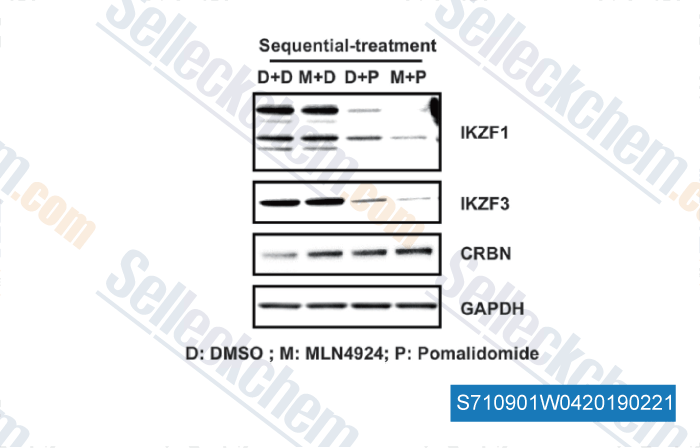
Data from [Data independently produced by , , Leukemia, 2019, 33(1):171-180]
-
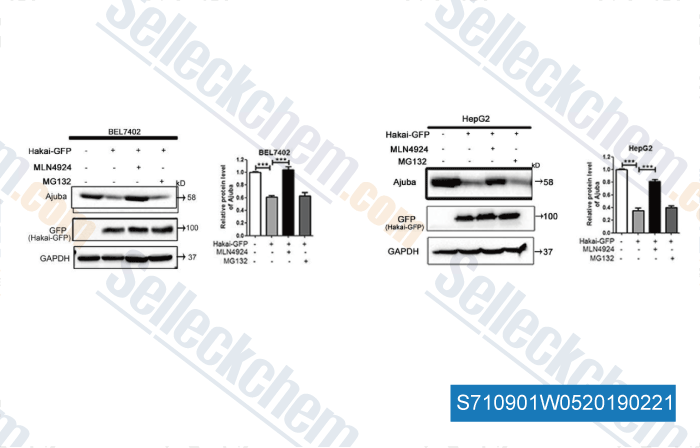
Data from [Data independently produced by , , J Exp Clin Cancer Res, 2018, 37(1):165]
-
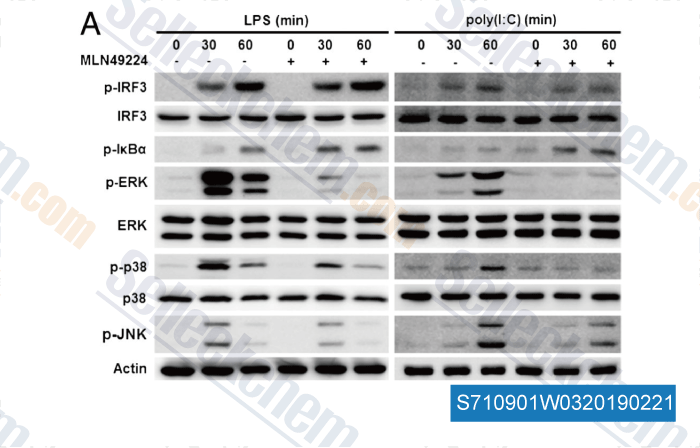
Data from [Data independently produced by , , J Immunol, 2016, 196(7):3117-23]
Selleckの高級品が、幾つかの出版された研究調査結果(以下を含む)で使われた:
| Multigenerational cell tracking of DNA replication and heritable DNA damage [ Nature, 2025, 642(8068):785-795] | PubMed: 40399682 |
| USP7 V517F mutation as a mechanism of inhibitor resistance [ Nat Commun, 2025, 16(1):2526] | PubMed: 40087304 |
| SAMD9 senses cytosolic double-stranded nucleic acids in epithelial and mesenchymal cells to induce antiviral immunity [ Nat Commun, 2025, 16(1):3756] | PubMed: 40263291 |
| Disrupting AGR2/IGF1 paracrine and reciprocal signaling for pancreatic cancer therapy [ Cell Rep Med, 2025, 6(2):101927] | PubMed: 39914384 |
| Functional landscape of ubiquitin linkages couples K29-linked ubiquitylation to epigenome integrity [ EMBO J, 2025, 10.1038/s44318-025-00599-7] | PubMed: 41125851 |
| Identification of a BACH1 lung cancer signature: A novel tool for understanding BACH1 biology and identifying new inhibitors [ Redox Biol, 2025, 85:103789] | PubMed: 40716152 |
| A genome-wide, CRISPR-based screen reveals new requirements for translation initiation and ubiquitination in driving adipogenic fate change [ Genes Dev, 2025, 10.1101/gad.352779.125] | PubMed: 40675820 |
| DTL dose-dependent control of sex-dimorphic ferroptosis in liver ischemia reperfusion injury [ Cell Rep, 2025, 44(7):115920] | PubMed: 40560731 |
| Prominin-2/FBXO22/BACH1 axis protects bone marrow mesenchymal stem cells against TBHP-induced ferroptosis and ameliorates intervertebral disc degeneration [ Stem Cell Res Ther, 2025, 16(1):340] | PubMed: 40598356 |
| Pharmacological Modulation of the Unfolded Protein Response as a Therapeutic Approach in Cutaneous T-Cell Lymphoma [ Biomolecules, 2025, 15(1)76] | PubMed: 39858470 |
長期の保管のために-20°Cの下で製品を保ってください。
人間や獣医の診断であるか治療的な使用のためにでない。
各々の製品のための特定の保管と取扱い情報は、製品データシートの上で示されます。大部分のSelleck製品は、推薦された状況の下で安定です。製品は、推薦された保管温度と異なる温度で、時々出荷されます。長期の保管のために必要とされてそれと異なる温度で、多くの製品は、短期もので安定です。品質を維持するが、夜通しの積荷のために最も経済的な貯蔵状況を用いてあなたの送料を保存する状況の下に、製品が出荷されることを、我々は確実とします。製品の受領と同時に、製品データシートの上で貯蔵推薦に従ってください。