
|
受注:045-509-1970 |
技術サポート:tech@selleck.co.jp 平日9:00〜18:00 1営業日以内にご連絡を差し上げます |
生物学的記述
| Specificity | Phospho-BTK (Tyr551) Antibody [D4E1] detects endogenous levels of total BTK protein only when it is phosphorylated at Tyr551. |
|---|---|
| Background | Phospho‑BTK (Tyr551) denotes Bruton's tyrosine kinase phosphorylated on the activation‑loop tyrosine within its C‑terminal kinase domain, a modification that marks catalytic activation downstream of antigen and innate immune receptors and positions BTK as a central signaling node in B cells and other hematopoietic lineages. BTK belongs to the Tec family and carries an N‑terminal pleckstrin homology domain that binds phosphatidylinositol‑3,4,5‑trisphosphate, followed by a Tec homology region, SH3 and SH2 domains that mediate protein–protein interactions, and a C‑terminal kinase lobe whose activation loop contains Tyr551 as the key regulatory residue. Engagement of the B‑cell receptor or other immunoreceptors leads to PI3K‑dependent generation of PIP3, membrane recruitment of BTK via its PH domain, and exposure of Tyr551 to Src‑family kinase Lyn and Syk, which transphosphorylate Tyr551 and thereby induce the conformational rearrangement characteristic of active tyrosine kinases. Phosphorylation at Tyr551 increases BTK catalytic activity and permits efficient autophosphorylation of Tyr223 in the SH3 domain, stabilizing an open, fully active enzyme configuration that propagates B‑cell receptor signaling by phosphorylating substrates such as PLCγ2 and contributing to downstream Ca²⁺ mobilization, PKC activation, NF‑κB and MAPK pathway engagement, and transcriptional programs for B‑cell activation, survival, and differentiation. Mutation of Tyr551 abolishes BCR‑induced calcium flux while mutation of Tyr223 does not, indicating that Tyr551 phosphorylation is the primary determinant for functional BCR signaling, and biochemical analyses show that activation‑loop phosphorylation directly tunes kinase kinetics and substrate recognition. Phospho‑specific antibodies that recognize BTK only when Tyr551 is phosphorylated demonstrate that Tyr551 phosphorylation increases rapidly upon BCR cross‑linking or TLR4 stimulation and correlates with membrane‑localized, signaling‑competent BTK, while PKCβ‑mediated phosphorylation of Ser180 reduces PH‑domain‑dependent membrane recruitment and thereby limits Tyr551 transphosphorylation, setting a negative feedback threshold for BTK activation. BTK activity regulated at Tyr551 is essential for normal B‑cell development; germline loss‑of‑function of BTK causes X‑linked agammaglobulinemia with a block in pre‑B‑cell maturation, and aberrant or constitutive BTK activation contributes to survival and proliferation of malignant B cells in disorders such as chronic lymphocytic leukemia and mantle cell lymphoma, where Tyr551 phosphorylation provides a mechanistic readout of pathway activation and of pharmacodynamic response to covalent and non‑covalent BTK inhibitors. |
使用情報
| Application | WB, IF | Dilution |
|
||||
|---|---|---|---|---|---|---|---|
| Reactivity | Human | ||||||
| Source | Rabbit Monoclonal Antibody | MW | 76 kDa | ||||
| Storage Buffer | PBS, pH 7.2+50% Glycerol+0.05% BSA+0.01% NaN3 | Storage (from the date of receipt) |
-20°C (avoid freeze-thaw cycles), 2 years | ||||
References
|
Application Data
WB
Validated by Selleck
-
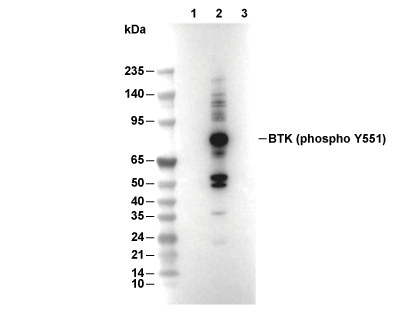 Lane 1: Ramos (pervanadate, 1mM, 30 min), Lane 2: K-562 (pervanadate, 1mM, 30 min), Lane 3: Ramos (pervanadate, 1mM, 30 min; Alkaline Phosphatase, 1 h)