
|
受注:045-509-1970 |
技術サポート:tech@selleck.co.jp 平日9:00〜18:00 1営業日以内にご連絡を差し上げます |
生物学的記述
| Specificity | Phospho-c-Myc (Thr58) Antibody [G15N9] detects endogenous levels of total c-Myc protein only when it is phosphorylated at Thr58. |
|---|---|
| Background | Phosphorylation of c-Myc at threonine 58 (Thr58) represents a critical regulatory modification governing the stability, subnuclear localization, and oncogenic activity of this transcription factor belonging to the basic-helix-loop-helix leucine zipper (bHLH-ZIP) family that heterodimerizes with Max to regulate genes controlling cell growth, proliferation, differentiation, and apoptosis. Thr58 resides within the N-terminal transactivation domain and constitutes a mutational hotspot in Burkitt's lymphoma and other aggressive human lymphomas, with mutations at this site abolishing phosphorylation-dependent proteolysis and enhancing oncogenic transformation. Glycogen synthase kinase-3 (GSK-3) functions as the principal kinase mediating Thr58 phosphorylation through direct binding to c-Myc within the nucleus, with both GSK-3α and GSK-3β isoforms capable of phosphorylating Thr58 and promoting c-Myc ubiquitination and proteasomal degradation. The phosphorylation process operates through a sequential mechanism wherein mitogenic signals, mitotic progression, or cellular stress initially induce phosphorylation at serine 62 (Ser62) by kinases including ERK, CDK, or JNK, with Ser62 phosphorylation serving as a priming modification that enables subsequent GSK-3-mediated Thr58 phosphorylation, although GSK-3 binding to c-Myc remains independent of Ser62 phosphorylation status. Thr58 phosphorylation triggers recruitment of the E3 ubiquitin ligase SCF^Fbw7^, which recognizes the phosphorylated degron motif and mediates polyubiquitination and proteasomal degradation, thereby limiting c-Myc protein stability and restricting its oncogenic potential. The modification alters c-Myc subnuclear distribution, enhancing localization to discrete nuclear bodies together with GSK-3, which may represent sites of active proteolysis or sequestration away from chromatin-associated transcriptional complexes. Lithium treatment inhibits GSK-3 activity, specifically preventing Thr58 phosphorylation and increasing c-Myc protein stability without affecting Ser62 phosphorylation, demonstrating selective regulation of the Thr58 site by GSK-3. The T58A phosphorylation-deficient mutant exhibits dramatically increased protein stability compared to wild-type c-Myc, with transgenic expression of c-Myc(T58A) producing enhanced mammary gland density, hyperplastic foci, cellular dysplasia, and mammary carcinomas associated with increased genomic instability and suppressed apoptosis relative to wild-type c-Myc, whereas the S62A mutant reduces mammary gland density and exhibits normal apoptotic function, illustrating differential regulatory roles for these phosphorylation sites. Altered ratios of Thr58 to Ser62 phosphorylation occur in human cancers, with reduced Thr58 phosphorylation observed in immortalized cells compared to primary cells, contributing to elevated c-Myc protein levels that drive proliferative signaling and bypass normal growth constraints. The phosphorylation state at Thr58 integrates signals from growth factor pathways including Ras/MAPK cascades that induce priming Ser62 phosphorylation and from GSK-3, which itself responds to PI3K/AKT signaling wherein AKT-mediated GSK-3 inhibition stabilizes c-Myc by preventing Thr58 phosphorylation, creating a regulatory circuit linking growth factor receptor activation to c-Myc protein abundance. The c-MycS isoform lacking the N-terminal domain containing Thr58 cannot bind GSK-3 and escapes phosphorylation-dependent degradation, illustrating structural requirements for kinase recognition. Thr58 phosphorylation coordinates c-Myc degradation with cell cycle progression, enabling transient c-Myc accumulation during G1-S transition to promote proliferation while ensuring subsequent degradation to permit mitotic exit and prevent excessive genomic instability. |
使用情報
| Application | WB | Dilution |
|
||
|---|---|---|---|---|---|
| Reactivity | Human, Mouse | ||||
| Source | Rabbit Monoclonal Antibody | MW | 50 kDa | ||
| Storage Buffer | PBS, pH 7.2+50% Glycerol+0.05% BSA+0.01% NaN3 | Storage (from the date of receipt) |
-20°C (avoid freeze-thaw cycles), 2 years | ||
References
|
Application Data
WB
Validated by Selleck
-
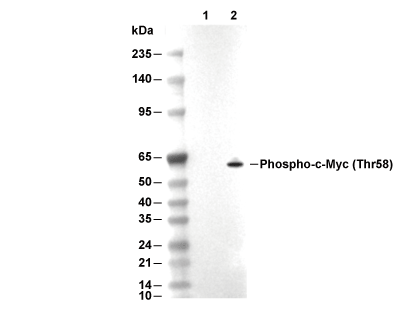 Lane 1: EL4, Lane 2: EL4 (MG-132, 10 μM, 18 h)