
|
受注:045-509-1970 |
技術サポート:tech@selleck.co.jp 平日9:00〜18:00 1営業日以内にご連絡を差し上げます |
生物学的記述
| Specificity | Phospho-eIF4B (Ser406) Antibody [E13A7]detects endogenous levels of total eIF4B protein only when it is phosphorylated at Ser406. |
|---|---|
| Background | Eukaryotic translation initiation factor 4B (eIF4B) belongs to the eIF4 family of RNA‑binding initiation factors and acts as a positive regulator of cap‑dependent translation, with phosphorylation at Ser406 defining a mitogen‑sensitive activation state that links growth factor signaling to protein synthesis. The protein contains an N‑terminal RNA‑recognition region, an internal arginine‑rich basic segment, and C‑terminal low‑complexity and helical regions that cooperate to bind mRNA and ribosomal subunits and to interface with the eIF4F complex and the RNA helicase eIF4A, supporting efficient recruitment of structured mRNAs to the 43S preinitiation complex. Ser406 lies within a regulatory C‑terminal portion that serves as a substrate for AGC family kinases, including protein kinase B and downstream effectors in the mTOR and MEK‑dependent cascades, and phosphorylation at this residue increases with insulin and mitogen stimulation in a manner dependent on these pathways. Phosphorylated Ser406 cooperates with other phospho‑acceptor sites such as Ser422 to maintain an active conformation of eIF4B that promotes its association with the initiation machinery, enhances its capacity to stimulate eIF4A‑driven RNA unwinding, and strengthens the assembly of translation initiation complexes on capped mRNAs that contain structured 5′ untranslated regions. The Ser406‑phosphorylated form of eIF4B supports global protein synthesis and selectively favors translation of mRNAs encoding survival and growth regulators, including factors that influence cell cycle progression and resistance to apoptotic stimuli, aligning eIF4B phosphorylation with control of cell proliferation. Growth factor and oncogenic kinase signaling maintain Ser406 phosphorylation through coordinated input from mTORC1 and MEK‑ERK pathways, connecting extracellular cues and oncogenic AGC kinases with translational outputs at the level of eIF4B activity. Elevated eIF4B phosphorylation, including at Ser406, accompanies enhanced cap‑dependent translation in transformed cells, associates with increased expression of anti‑apoptotic proteins and cyclins, and aligns with survival and proliferative advantages that characterize malignant phenotypes. Repression of eIF4B function reduces translation of these growth‑linked messages and diminishes cell survival and expansion, indicating that the Ser406‑regulated pool of eIF4B holds a central position in the translation network that integrates mitogenic and oncogenic signaling. |
使用情報
| Application | WB, IHC | Dilution |
|
||||
|---|---|---|---|---|---|---|---|
| Reactivity | Human | ||||||
| Source | Rabbit Monoclonal Antibody | MW | 69 kDa | ||||
| Storage Buffer | PBS, pH 7.2+50% Glycerol+0.05% BSA+0.01% NaN3 | Storage (from the date of receipt) |
-20°C (avoid freeze-thaw cycles), 2 years | ||||
References
|
Application Data
WB
Validated by Selleck
-
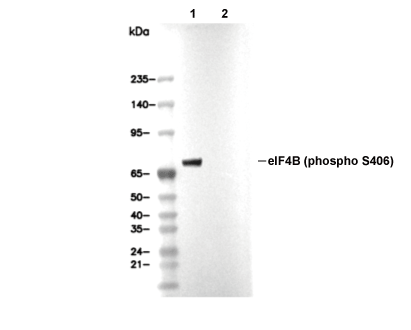 Lane 1: HeLa, Lane 2: HeLa (Alkaline Phosphatase treated)