
|
受注:045-509-1970 |
技術サポート:tech@selleck.co.jp 平日9:00〜18:00 1営業日以内にご連絡を差し上げます |
生物学的記述
| Specificity | Phospho-Histone H2A (Ser129) Antibody [A4N9] detects endogenous levels of total Histone H2A protein only when it is phosphorylated at Ser129. |
|---|---|
| Background | Phospho Histone H2A at Ser129 (H2A S129ph) is a conserved, DNA damage–induced histone mark that plays a central role in the chromatin based signaling cascade coordinating double strand break (DSB) repair and genome integrity, particularly in yeast and mammalian systems where it functions as part of the broader H2A.X family of variant histones. The modification occurs at a C terminal SQ motif that is phosphorylated by phosphoinositide 3 kinase related kinases such as ATM and ATR in response to DNA breaks, generating a localized phospho epitope that spreads over kilobase scale chromatin regions flanking the lesion and thereby serving as a nucleation platform for downstream repair factors. H2A S129ph directly recruits chromatin modifying complexes such as the NuA4 histone acetyltransferase and Ino80/Swr1 type ATP dependent remodeling complexes, which are anchored through specific subunits that recognize the phosphorylated tail, thus promoting acetylation and restructuring of nearby nucleosomes to enhance accessibility of damaged DNA to repair enzymes. This phospho H2A–dependent recruitment supports efficient homologous recombination and non homologous end joining by facilitating the assembly and retention of DSB sensing and processing factors at the break site, while also interfacing with cell cycle checkpoints to delay progression until repair is complete. H2A S129ph is widely used as a sensitive, high resolution readout for DSB generation and repair efficiency, and dysregulation of its phosphorylation or recognition machinery contributes to defective repair responses, increased genomic instability, and hypersensitivity to genotoxic agents, so that H2A S129ph dependent signaling is ultimately dysregulated in DNA repair deficient and cancer prone backgrounds. |
使用情報
| Application | WB, ChIP, ELISA | Dilution |
|
||||
|---|---|---|---|---|---|---|---|
| Reactivity | Human, Saccharomyces cerevisiae | ||||||
| Source | Rabbit Monoclonal Antibody | MW | 14 kDa | ||||
| Storage Buffer | PBS, pH 7.2+50% Glycerol+0.05% BSA+0.01% NaN3 | Storage (from the date of receipt) |
-20°C (avoid freeze-thaw cycles), 2 years | ||||
References
|
Application Data
WB
Validated by Selleck
-
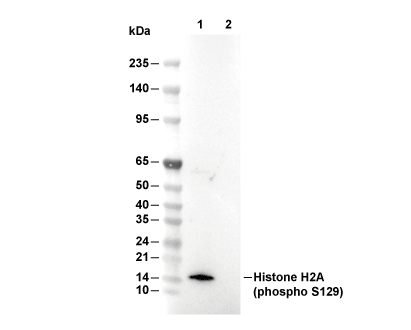 Lane 1: Saccharomyces cerevisiae (0.2% Methyl methanesulfonate, 1 h), Lane 2: Saccharomyces cerevisiae