
|
受注:045-509-1970 |
技術サポート:tech@selleck.co.jp 平日9:00〜18:00 1営業日以内にご連絡を差し上げます |
生物学的記述
| Specificity | Phospho-MBP (Thr98) Antibody [A3B1] detects endogenous levels of total MBP protein only when it is phosphorylated at Thr98. |
|---|---|
| Background | Phospho-MBP designates post-translationally modified myelin basic protein isoforms within the central nervous system myelin sheath, where MAPK-mediated phosphorylation at conserved threonine residues like Thr95 and Thr125 dynamically modulates compact multilayer stability and cytoskeletal interactions. MBP organizes intrinsically disordered regions flanking amphipathic alpha-helical segments and proline-rich polyproline II helices that compact apposed cytoplasmic leaflets through multivalent cationic interactions with phospholipid headgroups and actin microfilaments. Phosphorylation introduces negative charge that electrostatically disrupts MBP-lipid adhesion, loosening sheath compaction while altering the central molecular switch region where Thr92/Thr95 phosphorylation impedes alpha-helical folding stability and reduces reversibility upon thermal perturbation through altered electrostatics that propagate globally via repulsions in the proline-rich domain. This modification attenuates MBP-actin polymerization and bundling capacity alongside a dramatic reduction in actin-MBP-lipid ternary complex formation at negatively charged bilayers, with sequential MAPK action at both sites compounding inhibition beyond net charge reduction alone. High-frequency neuronal stimulation triggers alveus MBP hyperphosphorylation via MAPK activation that propagates action potentials, while tetrodotoxin blockade prevents this regulated loosening essential for myelin plasticity during synaptic remodeling. All four major MBP charge isomers exhibit coordinated dephosphorylation responses, reflecting isoform-nonspecific pathway control. Phospho-MBP calibrates conduction velocity adaptation and oligodendroglial process dynamics during CNS development and activity-dependent myelination. |
使用情報
| Application | WB | Dilution |
|
||
|---|---|---|---|---|---|
| Reactivity | vertebrates | ||||
| Source | Mouse Monoclonal Antibody | MW | 33 kDa | ||
| Storage Buffer | PBS, pH 7.2+50% Glycerol+0.05% BSA+0.01% NaN3 | Storage (from the date of receipt) |
-20°C (avoid freeze-thaw cycles), 2 years | ||
References
|
Application Data
WB
Validated by Selleck
-
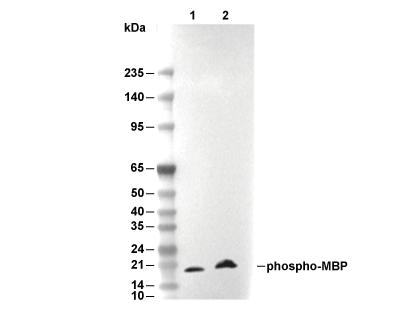 Lane 1: Mouse brain, Lane 2: Rat brain