
|
受注:045-509-1970 |
技術サポート:tech@selleck.co.jp 平日9:00〜18:00 1営業日以内にご連絡を差し上げます |
生物学的記述
| Specificity | Phospho-Tau (Ser262+Thr263) Antibody [D14G14] detects endogenous levels of total Tau protein only when it is phosphorylated at Ser262 and Thr263. |
|---|---|
| Background | Phospho‑Tau (Ser262+Thr263) refers to tau protein phosphorylated within the KXGS motif of its first microtubule‑binding repeat, a regulatory hotspot that controls tau affinity for microtubules, its subcellular distribution, and its propensity to participate in pathological aggregation in tauopathies. Tau is a microtubule‑associated protein with an N‑terminal projection region, a proline‑rich segment harboring multiple serine/threonine–proline motifs, and a C‑terminal repeat domain that contains several KXGS motifs; Ser262 and Thr263 lie in the first repeat and phosphorylation at these residues disrupts the electrostatic interactions that stabilize tau–microtubule binding and markedly reduces the ability of tau to promote microtubule assembly and stability. Kinases that target the KXGS motif, including MARK family enzymes and related microtubule affinity‑regulating kinases, generate phospho‑Ser262 and phospho‑Thr263 tau species that detach from microtubules, increase the pool of soluble tau, and facilitate redistribution of tau into compartments where it can misfold and assemble into oligomers and fibrils, particularly when additional phosphorylation occurs at other epitopes such as Thr212 and Thr231. Phospho‑Tau Ser262 immunoreactivity is present in fetal tau and in adult diseased tau, and antibodies specific for this epitope detect hyperphosphorylated tau in neurofibrillary tangles, pre‑tangles, dystrophic neurites, neuropil threads, and other abnormal deposits in Alzheimer’s disease, Pick’s disease, progressive supranuclear palsy, corticobasal degeneration, and argyrophilic grain disease, indicating that modification at Ser262 and the adjacent Thr263 region is a shared feature of multiple tauopathy lesions and accumulates particularly in more advanced tangles. Comparative analyses of tau phosphorylation patterns show that Ser262 phosphorylation is less frequent in early pre‑tangles than epitopes such as Ser199/202 or Ser396/404, while it is enriched in intracellular and extracellular tangles, consistent with a role for phosphorylation at this site in destabilizing microtubules and favoring later stages of tangle maturation and tau filament pathology. Phosphorylation at Ser262 also contributes to Aβ‑associated tau toxicity in experimental models, where Ser262‑modified tau exhibits increased toxicity and aggregation in the presence of Aβ42 and promotes disruption of neuronal structure and function, linking this modification to amyloid‑driven neurodegenerative cascades. |
使用情報
| Application | WB | Dilution |
|
||
|---|---|---|---|---|---|
| Reactivity | Human | ||||
| Source | Rabbit Monoclonal Antibody | MW | 79 kDa | ||
| Storage Buffer | PBS, pH 7.2+50% Glycerol+0.05% BSA+0.01% NaN3 | Storage (from the date of receipt) |
-20°C (avoid freeze-thaw cycles), 2 years | ||
References
|
Application Data
WB
Validated by Selleck
-
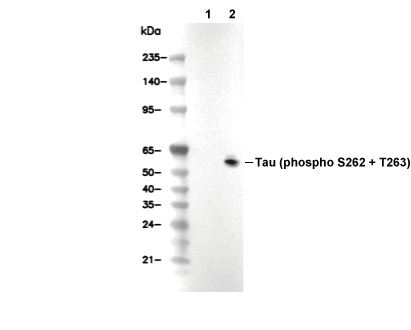 Lane 1: SH-SY5Y, Lane 2: SH-SY5Y (Olcadaic acid and Calyculin A treated)