
|
受注:045-509-1970 |
技術サポート:tech@selleck.co.jp 平日9:00〜18:00 1営業日以内にご連絡を差し上げます |
生物学的記述
| Specificity | PME-1 Antibody [L6L14] detects endogenous levels of total PME-1 protein. |
|---|---|
| Background | Protein phosphatase methylesterase-1 (PME-1, also known as PP2A methylesterase 1) is a conserved serine hydrolase that regulates protein phosphatase 2A (PP2A), a central Ser/Thr phosphatase complex controlling cell growth, survival, and stress signaling, by reversing C-terminal methylation of the PP2A catalytic subunit and directly inhibiting the phosphatase active site. PME-1 has an α/β-hydrolase fold with a catalytic Ser-Asp-His triad typical of serine hydrolases, and N‑terminal low-complexity regions that contain short linear motifs used for docking to PP2A holoenzymes, including motifs that mimic PP2A substrates and engage specific regulatory B subunits. PME-1 demethylates PP2A by hydrolyzing the ester bond at the C-terminal leucine of the catalytic subunit, which removes the methyl group required for efficient association with a subset of regulatory B subunits and alters the composition and activity profile of PP2A holoenzymes, thereby shifting signaling output across pathways such as MAPK/ERK and AKT. PME-1 also binds directly to assembled PP2A core and B56-containing holoenzymes, occupies the catalytic groove, and blocks access of phospho-substrates, so that a single PME-1 molecule can both demethylate the catalytic tail and inhibit PP2A catalytic activity toward bound substrates in the same complex. PME-1 disordered N-terminal regions tether to multiple remote sites on the B56 regulatory subunit, including a substrate-mimicking motif that inserts into the canonical substrate-binding groove, while large conformational shifts in both PME-1 and the holoenzyme bring the PME-1 catalytic core into position to access the methylated PP2A tail and enforce active-site inhibition, defining a multipartite interaction mechanism that couples holoenzyme recognition to methylesterase activation. These binding modes enable PME-1 to demethylate different families of PP2A holoenzymes and to broadly suppress PP2A holoenzyme functions, with B56 interface mutations selectively blocking PME-1 activity toward PP2A-B56 complexes and altering methylation of a defined fraction of cellular PP2A, including pools involved in p53 signaling. In cancer models such as glioma and endometrial carcinoma, PME-1 overexpression reduces PP2A tumor suppressor activity, sustains ERK and AKT pathway signaling, and supports malignant phenotypes including increased proliferation, invasion, and resistance to kinase inhibitors, and PME-1 levels are elevated in clinical tumor specimens where they correlate with progression. |
使用情報
| Application | WB, IP, IF, FCM, ELISA | Dilution |
|
||||||||
|---|---|---|---|---|---|---|---|---|---|---|---|
| Reactivity | Human, Mouse, Rat | ||||||||||
| Source | Mouse Monoclonal Antibody | MW | 44 kDa | ||||||||
| Storage Buffer | PBS, pH 7.2+50% Glycerol+0.05% BSA+0.01% NaN3 | Storage (from the date of receipt) |
-20°C (avoid freeze-thaw cycles), 2 years | ||||||||
References
|
Application Data
WB
Validated by Selleck
-
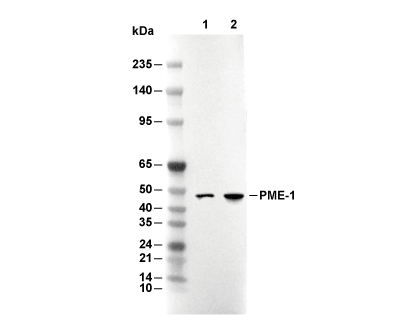 Lane 1: K-562, Lane 2: Neuro-2A