
|
受注:045-509-1970 |
技術サポート:tech@selleck.co.jp 平日9:00〜18:00 1営業日以内にご連絡を差し上げます |
生物学的記述
| Specificity | PREX1 Antibody [B1D11] detects endogenous levels of total PREX1 protein. |
|---|---|
| Background | PREX1 (phosphatidylinositol‑3,4,5‑trisphosphate‑dependent Rac exchanger 1; P‑Rex1) is a Rac‑selective guanine nucleotide exchange factor that integrates phosphoinositide 3‑kinase and G protein‑coupled receptor signaling to control actin remodeling, motility, and oncogenic behavior through localized Rac activation at the plasma membrane. The protein contains an N‑terminal Dbl homology (DH) domain that catalyzes GDP–GTP exchange on Rac1 and Rac2, an adjacent pleckstrin homology (PH) domain that binds PtdIns(3,4,5)P3, two tandem DEP domains that sense heterotrimeric G‑protein Gβγ subunits, and a C‑terminal PDZ‑like region plus multiple regulatory elements that scaffold upstream receptors and downstream effectors into spatially organized signaling complexes. PREX1 activity is synergistically stimulated when PtdIns(3,4,5)P3 and Gβγ are present together, providing coincidence detection of PI3K‑ and GPCR‑derived signals, and is negatively regulated downstream by PAK family kinases that phosphorylate defined serine residues within the DH/PH region, creating a feedback loop in which Rac‑PAK signaling dampens further Rac activation by PREX1. The GEF promotes Rac‑dependent lamellipodia formation, actin polymerization, and directional migration, functions first defined in neutrophils responding to chemotactic cues and subsequently extended to endothelial barrier regulation, platelet production, and diverse tumor cell types. In cancer, PREX1 and its paralog PREX2 are frequently altered via overexpression, amplification, or mutation, and PREX1 overexpression in breast, prostate, and melanoma correlates with increased invasion and metastasis, with PREX1 acting downstream of ErbB receptors (EGFR, ErbB2, ErbB3) and chemokine receptor CXCR4 to couple receptor‑driven PI3K activation to Rac‑PAK and MEK–ERK cascades that sustain motility, proliferation, and survival. PREX1 integrates G protein‑coupled receptor and phosphoinositide signals by responding to SDF‑1/CXCL12, S1P, and other GPCR ligands, and by engaging PtdIns(3,4,5)P3 generated by class I PI3Ks, thereby functioning as a central hub that converts extracellular chemokine and growth factor gradients into intracellular Rac activity gradients that guide migration and invasion in both physiological and pathological contexts. PREX1‑driven Rac activation connects to downstream kinase networks including PAK, JNK, p38, and LIMK, modulating cytoskeletal organization, transcription factor activity, and cell‑cycle regulators, while feedback phosphorylation by PAKs attenuates PREX1 catalytic function and contributes to temporal shaping of Rac signaling bursts. |
使用情報
| Application | WB, IF | Dilution |
|
||||
|---|---|---|---|---|---|---|---|
| Reactivity | Human, Monkey | ||||||
| Source | Rabbit Monoclonal Antibody | MW | 186 kDa | ||||
| Storage Buffer | PBS, pH 7.2+50% Glycerol+0.05% BSA+0.01% NaN3 | Storage (from the date of receipt) |
-20°C (avoid freeze-thaw cycles), 2 years | ||||
References
|
Application Data
WB
Validated by Selleck
-
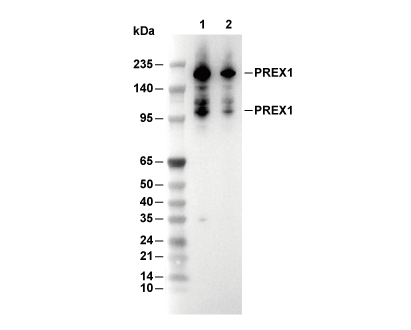 Lane 1: MCF7, Lane 2: T-47D