
|
受注:045-509-1970 |
技術サポート:tech@selleck.co.jp 平日9:00〜18:00 1営業日以内にご連絡を差し上げます |
化学情報
|
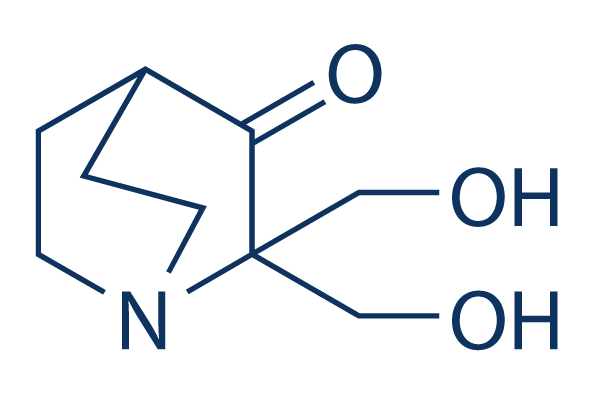
Synonyms | 2,2-Bis(hydroxymethyl)-3-quinuclidinone | Storage (From the date of receipt) |
3 years -20°C powder 1 years -80°C in solvent |
|||||||||||
| 化学式 | C9H15NO3 |
||||||||||||||
| 分子量 | 185.22 | CAS No. | 5608-24-2 | ||||||||||||
| Solubility (25°C)* | 体外 | DMSO | 37 mg/mL (199.76 mM) | ||||||||||||
| Water | 37 mg/mL (199.76 mM) | ||||||||||||||
| Ethanol | 37 mg/mL (199.76 mM) | ||||||||||||||
| 体内 (毎回新しく調製した物を用意してください) |
|
||||||||||||||
|
* <1 mg/ml means slightly soluble or insoluble. * Please note that Selleck tests the solubility of all compounds in-house, and the actual solubility may differ slightly from published values. This is normal and is due to slight batch-to-batch variations. |
|||||||||||||||
溶剤液(一定の濃度)を調合する
生物活性
| 製品説明 | PRIMA-1 (2,2-Bis(hydroxymethyl)-3-quinuclidinone) is a mutant p53 reactivator. It induces apoptosis and inhibits growth of human tumors with mutant p53. |
|---|---|
| in vitro | PRIMA-1 is converted to compounds that form adducts with thiols in mutant p53. Modification of thiol groups in mutant p53 by this compound's conversion products is sufficient to restore its tumor suppressor activity.[2]. It inhibits the growth of pancreatic cancer cell lines and induces cell cycle arrest and decreases DNA synthesis. This compound selectively induces apoptosis and cell death in mutant p53-expressing pancreatic cancer cells and also leads to activation of p53-dependent apoptotic pathways. It enhances the cytotoxicity of chemotherapeutic agents active against mutant p53 pancreatic cancer cells[1]. This chemical has antileukemic properties in acute promyelocytic leukemia-derived NB4 cells. PRIMA-1-triggered apoptosis is in a dose-dependent and time-dependent manner as indicated by the MTT assay and annexin-V staining. Apoptosis induction by this agent is associated with caspase-9, caspase-7 activation and PARP cleavage. It does not show any significant apoptotic effect in normal human peripheral blood mononuclear cells[4]. |
| in vivo | Intravenous (i.v.) injections of PRIMA-1 in mice does not cause any obvious changes in weight or behavior compared with untreated animals. This compound has in vivo antitumor activity in this animal tumor model. It suppresses in vivo tumor growth in a mutant p53-dependent manner[3]. |
プロトコル(参考用のみ)
| 細胞アッセイ | 細胞株 | mutant p53 expressing pancreatic cancer cell lines PANC-1 (p.R273H) and BxPC-3 (p.Y220C) and the wild type p53-expressing Capan-2 cells (wtp53) |
|---|---|---|
| 濃度 | 25-100 μM | |
| 反応時間 | 12-48 h | |
| 実験の流れ | Cells are kept at a temperature of 37 °C, a minimum relative humidity of 95 %, and an atmosphere of 5 % CO2 in air. Cell viability is measured by MTT assay after treatment with PRIMA-1. Briefly, cells are seeded in each well of 96-well plates in 100 μl culture medium and incubated overnight at 37 °C in an atmosphere of 5 % CO2. The plates are further incubated at 37 °C under 5 % CO2 for 4 h and then left at room temperature until completely dry. DMSO was then added and the absorbance is read at 492 nm using a microplate enzyme-linked immunoassay reader (ELISA). The relative growth activity is determined as the percentage absorbance of treated cells compared to that of vehicle treated cells (control). |
|
| 動物実験 | 動物モデル | SCID mice |
| 投薬量 | 1, 10, 20 and 100 mg/kg | |
| 投与方法 | i.v. |
参考
|
Selleckの高級品が、幾つかの出版された研究調査結果(以下を含む)で使われた:
| Thermosensitive gel-nano system against esophageal cancer via restoring p53 activity and boosting T-cell immunity [ J Control Release, 2024, 371:111-125] | PubMed: 38782064 |
| Systematic identification of biomarker-driven drug combinations to overcome resistance [ Nat Chem Biol, 2022, 10.1038/s41589-022-00996-7] | PubMed: 35332332 |
| Establishment and Characterization of NCC-PMP1-C1: A Novel Patient-Derived Cell Line of Metastatic Pseudomyxoma Peritonei [ J Pers Med, 2022, 12(2)258] | PubMed: 35207746 |
| Establishment and characterization of NCC-UPS4-C1: a novel cell line of undifferentiated pleomorphic sarcoma from a patient with Li-Fraumeni syndrome [ Hum Cell, 2022, 10.1007/s13577-022-00671-y] | PubMed: 35118583 |
| Establishment and characterization of the NCC-GCTB4-C1 cell line: a novel patient-derived cell line from giant cell tumor of bone [ Hum Cell, 2021, 10.1007/s13577-021-00639-4] | PubMed: 34731453 |
| Establishment and characterization of NCC-MFS4-C1: a novel patient-derived cell line of myxofibrosarcoma [ Hum Cell, 2021, 34(6):1911-1918] | PubMed: 34383271 |
| Establishment and characterization of novel patient-derived cell lines from giant cell tumor of bone [ Hum Cell, 2021, 10.1007/s13577-021-00579-z] | PubMed: 34304386 |
| Arsenic Trioxide Rescues Structural p53 Mutations through a Cryptic Allosteric Site [ Cancer Cell, 2020, S1535-6108(20)30605-X] | PubMed: 33357454 |
長期の保管のために-20°Cの下で製品を保ってください。
人間や獣医の診断であるか治療的な使用のためにでない。
各々の製品のための特定の保管と取扱い情報は、製品データシートの上で示されます。大部分のSelleck製品は、推薦された状況の下で安定です。製品は、推薦された保管温度と異なる温度で、時々出荷されます。長期の保管のために必要とされてそれと異なる温度で、多くの製品は、短期もので安定です。品質を維持するが、夜通しの積荷のために最も経済的な貯蔵状況を用いてあなたの送料を保存する状況の下に、製品が出荷されることを、我々は確実とします。製品の受領と同時に、製品データシートの上で貯蔵推薦に従ってください。