
|
受注:045-509-1970 |
技術サポート:tech@selleck.co.jp 平日9:00〜18:00 1営業日以内にご連絡を差し上げます |
生物学的記述
| Specificity | pro Caspase-1+p10+p12 Antibody [H3L1] detects endogenous levels of total pro Caspase-1, p10, p12 protein. |
|---|---|
| Background | Pro caspase‑1 is the inactive zymogen of the inflammatory caspase‑1 that contains an N‑terminal caspase recruitment domain (CARD) followed by a large catalytic subunit (p20) and a small subunit (p10/p12 region), and the term “pro caspase‑1 + p10 + p12” refers to detection of both the full‑length precursor and its processed small subunits that together define the activation status of caspase‑1 within inflammasome pathways. The zymogen resides in the cytosol of myeloid and other cells and is recruited via CARD–CARD interactions to inflammasome platforms built by pattern‑recognition receptors such as NLRP3, NLRC4, AIM2, or other NLRs and adaptor ASC, which bring multiple pro caspase‑1 molecules into proximity and promote autoproteolytic processing at defined internal aspartate residues to generate p20 and p10/p12 fragments that assemble into an active heterotetramer. The active enzyme cleaves the pro‑forms of IL‑1β and IL‑18 to their mature secreted cytokines and also processes gasdermin D to release its N‑terminal pore‑forming domain, so caspase‑1 activation via its p20/p10 complex couples pathogen‑ or damage‑associated molecular pattern sensing to secretion of key pro‑inflammatory cytokines and to pyroptotic lytic cell death that facilitates pathogen clearance and inflammatory signaling. Beyond canonical inflammasomes, caspase‑1 participates in alternative activation routes, interacts with RIP2 and NF‑κB signaling components, and can influence glycolytic enzymes, caspase‑7 activation, and unconventional protein secretion, indicating broader roles in metabolic adaptation, cell survival, and non‑classical secretion in a context‑dependent manner. The balance between the unprocessed pro form and the p10/p12‑containing active subunits therefore provides a direct biochemical readout of inflammasome engagement and caspase‑1 activation state in tissues and experimental systems, and antibodies that recognize epitopes present in pro caspase‑1 and in the p10/p12 region allow detection of both pools to monitor zymogen availability and activation‑associated cleavage within a single assay. Dysregulated caspase‑1 activity contributes to autoinflammatory and inflammatory diseases, including cryopyrin‑associated periodic syndromes, gout, rheumatoid arthritis, inflammatory bowel disease, obesity‑associated metabolic disorders, cardiovascular disease, and some cancers, through excessive IL‑1β/IL‑18 production and pyroptosis, while insufficient activation impairs host defense against bacterial and viral infections. |
使用情報
| Application | WB, IP | Dilution |
|
||||
|---|---|---|---|---|---|---|---|
| Reactivity | Mouse, Rat, Human | ||||||
| Source | Rabbit Monoclonal Antibody | MW | 45 kDa | ||||
| Storage Buffer | PBS, pH 7.2+50% Glycerol+0.05% BSA+0.01% NaN3 | Storage (from the date of receipt) |
-20°C (avoid freeze-thaw cycles), 2 years | ||||
References
|
Application Data
WB
Validated by Selleck
-
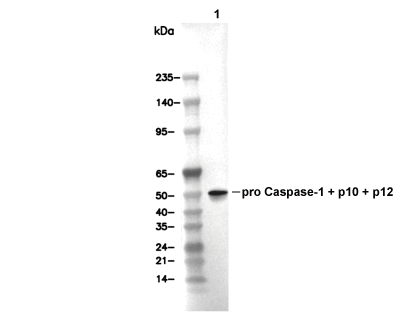 Lane 1: THP-1 (LPS, 0.1 µg/mL, 3 h; ATP, 5 mM, 15 min)