
|
受注:045-509-1970 |
技術サポート:tech@selleck.co.jp 平日9:00〜18:00 1営業日以内にご連絡を差し上げます |
生物学的記述
| Specificity | Puromycin Antibody [H12G14] detects exogenous levels of total Puromycin. |
|---|---|
| Background | Puromycin is a naturally occurring aminonucleoside antibiotic derived from Streptomyces alboniger that functions as a small‑molecule mimic of the 3′ end of aminoacyl‑tRNA and acts as a potent, universal inhibitor of translation by directly engaging the ribosomal elongation machinery in both prokaryotic and eukaryotic cells. The molecule consists of an adenosine‑like nucleoside covalently linked through its ribose 3′ position to a tyrosine‑like amino acid moiety, creating a structural analog of the 3′‑CCA terminus of charged tRNA in which the natural ester linkage between tRNA and amino acid is replaced with a non‑hydrolyzable amide bond that resists peptidyl‑tRNA hydrolysis and underlies its chain‑terminating activity. Puromycin enters the ribosomal A site in competition with aminoacyl‑tRNA, aligns its amino group in the peptidyl transferase center, and accepts the growing polypeptide from the P‑site peptidyl‑tRNA to form a peptidyl‑puromycin conjugate; the resulting product lacks a tRNA moiety and fails to remain stably anchored in the ribosome, leading to dissociation of the truncated peptidyl‑puromycin from the P‑site and premature termination of protein synthesis while leaving the ribosome as an intact 70S (or 80S) monosome that can fall off mRNA as a single particle rather than dissociating into subunits as in normal termination. This mechanism places puromycin as an elongation‑stage inhibitor that does not require specific initiation context, allowing incorporation into nascent chains on any actively translating ribosome and generating a population of puromycylated nascent chains that carry the antibiotic covalently at their C‑terminus, a property exploited extensively in molecular biology to label and quantify nascent protein synthesis in approaches such as SUnSET and ribosome profiling–derived puromycylation assays. Puromycin’s ribosome‑catalyzed incorporation follows the same chemistry as peptidyl transfer between two tRNAs, and its effectiveness arises from the conserved architecture of the peptidyl transferase center and A‑site across bacteria and eukaryotes, which permits broad‑spectrum inhibition despite differences in ribosomal protein composition. The antibiotic blocks further elongation cycles by occupying the A site and by removing the growing chain from its tRNA carrier, so subsequent EF‑Tu/eEF1A‑dependent aminoacyl‑tRNA delivery is futile, global translation drops rapidly, and cells experience proteostasis stress that activates integrated stress responses, unfolded protein responses, and, at higher concentrations or prolonged exposure, apoptotic and necrotic pathways. Puromycin is also used as a powerful selection reagent in mammalian cell culture, where co‑expression of the bacterial puromycin N‑acetyl‑transferase (pac) gene confers resistance by enzymatic acetylation of the amino group on puromycin, preventing its participation in peptidyl transfer and allowing survival of transfected cells under continuous antibiotic pressure. |
使用情報
| Application | WB, IP, IHC, IF, FCM | Dilution |
|
||||||||||
|---|---|---|---|---|---|---|---|---|---|---|---|---|---|
| Reactivity | Chemical | ||||||||||||
| Source | Rabbit Monoclonal Antibody | MW | |||||||||||
| Storage Buffer | PBS, pH 7.2+50% Glycerol+0.05% BSA+0.01% NaN3 | Storage (from the date of receipt) |
-20°C (avoid freeze-thaw cycles), 2 years | ||||||||||
References
|
Application Data
WB
Validated by Selleck
-
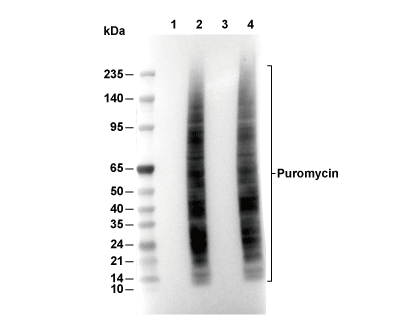 Lane 1: Hela, Lane 2: Hela (Puromycin, 1uM, 30 min), Lane 3: NIH/3T3, Lane 4: NIH/3T3 Hela (Puromycin, 1uM, 30 min)