
|
受注:045-509-1970 |
技術サポート:tech@selleck.co.jp 平日9:00〜18:00 1営業日以内にご連絡を差し上げます |
生物学的記述
| Specificity | SARM1 Antibody [H21M23] detects endogenous levels of total SARM1 protein. |
|---|---|
| Background | Sterile alpha and TIR motif–containing protein 1 (SARM1) is a multidomain adaptor and enzyme of the Toll/IL‑1 receptor (TIR) superfamily that functions as a central executioner of axon degeneration and as a regulatory component of innate immune signaling. The protein contains an N‑terminal region with HEAT/armadillo repeats that mediates autoinhibition and organelle association, tandem sterile alpha motif (SAM) domains that drive oligomerization into an octameric assembly, and a C‑terminal TIR domain that carries intrinsic NAD‑cleaving catalytic activity. This architecture allows SARM1 to act as a metabolic sensor in axons, where the ARM region binds nicotinamide adenine dinucleotide and maintains a closed, inactive conformation under basal conditions characterized by high NAD and low nicotinamide mononucleotide levels, while changes in the NMN:NAD ratio and upstream kinases such as MAPK modules promote conformational rearrangement and activation. Activation of SARM1 disrupts ARM‑mediated inhibition, permits SAM‑driven multimerization of the TIR domains, and unleashes robust NAD hydrolase and cyclase activity that converts NAD into nicotinamide, ADP‑ribose, and cyclic ADP‑ribose, triggering rapid depletion of axonal NAD, collapse of ATP production, ionic imbalance, and fragmentation characteristic of Wallerian and related forms of programmed axon degeneration. The SARM1 pathway thus integrates metabolic stress signals, such as loss of the axon survival factor NMNAT2 and associated drops in NAD, with rises in NMN, with structural rearrangements in the SARM1 complex, providing a direct molecular link between altered nucleotide metabolism and execution of axonal self‑destruction. SARM1 functions as a TIR‑domain adaptor in innate immunity where it participates in Toll‑like receptor signaling networks, acting as a negative regulator of TRIF‑dependent type I interferon and NF‑κB pathways and modulating production of pro‑inflammatory cytokines and interferon responses in selected cellular contexts. Expression in central nervous system neurons, glia, and immune cells connects SARM1 to neuroinflammatory environments, where its enzymatic and adaptor roles intersect and influence the balance between axon loss, tissue damage, and innate immune activation. Genetic, biochemical, and structural characterization places SARM1 at the core of an evolutionarily conserved NAD‑cleaving cell‑death axis, aligning its TIR‑domain NADase with plant and microbial TIR proteins involved in programmed cell death and host defense and establishing a mechanistic framework for targeting SARM1 in neurodegenerative diseases and axonopathies. |
使用情報
| Application | WB, IP, IHC, IF | Dilution |
|
||||||||
|---|---|---|---|---|---|---|---|---|---|---|---|
| Reactivity | Rat, Human, Mouse | ||||||||||
| Source | Rabbit Monoclonal Antibody | MW | 79 kDa | ||||||||
| Storage Buffer | PBS, pH 7.2+50% Glycerol+0.05% BSA+0.01% NaN3 | Storage (from the date of receipt) |
-20°C (avoid freeze-thaw cycles), 2 years | ||||||||
References
|
Application Data
WB
Validated by Selleck
-
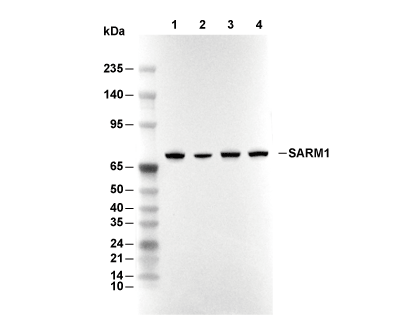 Lane 1: SH-SY5Y, Lane 2: Neuro-2a, Lane 3: Mouse brain, Lane 4: Rat brain