
|
受注:045-509-1970 |
技術サポート:tech@selleck.co.jp 平日9:00〜18:00 1営業日以内にご連絡を差し上げます |
生物学的記述
| Specificity | SARS-CoV-2 Spike Protein (S1) Antibody [N11L5] detects exogenous levels of total SARS-CoV-2 Spike Protein (S1) protein. |
|---|---|
| Background | SARS‑CoV‑2 Spike Protein (S1) is the N‑terminal subunit of the trimeric class I fusion glycoprotein that projects from the viral envelope and governs host‑cell recognition by engaging angiotensin‑converting enzyme 2 (ACE2) and auxiliary attachment factors, thereby initiating viral entry and tropism at the level of receptor binding and S‑protein priming. The S1 subunit comprises the N‑terminal domain, the receptor‑binding domain with its receptor‑binding motif, and two subdomains (SD1 and SD2) arranged around a central β‑sheet scaffold and heavily decorated with N‑linked glycans that shape epitope exposure, stabilize the prefusion trimer, and modulate interactions with host receptors and neutralizing antibodies. The receptor‑binding domain alternates between “down” and “up” conformations, with the up state exposing the ACE2‑binding surface; binding of S1 to ACE2 on target cells stabilizes this conformation and promotes subsequent S2′ cleavage and large‑scale structural rearrangements in the S2 subunit that drive membrane fusion, while shedding of S1 after ACE2 engagement or antibody binding triggers the fusogenic refolding cascade in S2. A multibasic furin site at the S1/S2 junction is cleaved during virus production, generating noncovalently associated S1 and S2 fragments and increasing the proportion of pre‑primed spikes on virions; S1 retains the polybasic C‑terminal region that, once exposed, can bind attachment receptors such as neuropilin‑1 and thereby enhance viral attachment and infectivity in tissues with high neuropilin expression. ACE2 binding through the S1 receptor‑binding motif determines primary tissue tropism to ACE2‑positive epithelia in the respiratory and gastrointestinal tracts and endothelium, and S1 contacts with ACE2, together with local protease availability (TMPRSS2, cathepsins, other serine proteases), direct the balance between plasma‑membrane fusion and endocytic entry routes that vary between viral variants and cell types. Sequence changes in S1, including substitutions and insertions in the receptor‑binding motif and N‑terminal domain, tune ACE2 affinity, modulate dependence on specific host proteases, remodel glycan shields, and alter sensitivity to neutralizing antibodies, thereby contributing to variant‑specific differences in transmissibility, immune escape, and cell‑type preference while preserving the core function of ACE2 engagement and attachment‑factor binding. |
使用情報
| Application | WB, IHC, IF | Dilution |
|
||||||
|---|---|---|---|---|---|---|---|---|---|
| Reactivity | Virus | ||||||||
| Source | Rabbit Monoclonal Antibody | MW | 141 kDa | ||||||
| Storage Buffer | PBS, pH 7.2+50% Glycerol+0.05% BSA+0.01% NaN3 | Storage (from the date of receipt) |
-20°C (avoid freeze-thaw cycles), 2 years | ||||||
References
|
Application Data
WB
Validated by Selleck
-
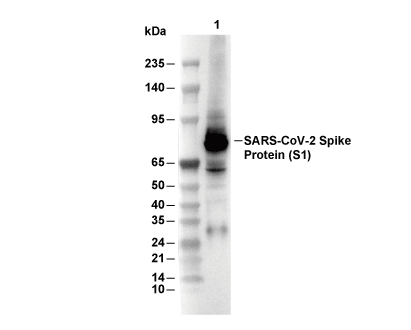 Lane 1: SARS-CoV-2 Spike S1(330-530)Recombinant Protein