
|
受注:045-509-1970 |
技術サポート:tech@selleck.co.jp 平日9:00〜18:00 1営業日以内にご連絡を差し上げます |
生物学的記述
| Specificity | SPARC Antibody [A10J5] detects endogenous levels of total SPARC protein. |
|---|---|
| Background | SPARC (secreted protein acidic and rich in cysteine, also known as osteonectin) is a matricellular extracellular matrix glycoprotein that localizes to mineralized and soft connective tissues and modulates interactions between structural matrix components, growth factors, and resident or infiltrating cells rather than serving as a purely structural element. The protein displays a modular organization with an N‑terminal acidic domain that binds multiple divalent cations, a central follistatin‑like region containing a cationic, disulfide‑bonded segment with growth factor–modulating activity, and a C‑terminal EF‑hand calcium‑binding domain that associates with collagens and other matrix ligands, allowing SPARC to engage both matrix and signaling partners through distinct surfaces. Binding to fibrillar and basement‑membrane collagens, thrombospondin, and albumin, together with high‑affinity calcium and copper binding, positions SPARC at sites of active matrix remodeling where it can disrupt stable focal adhesions, reduce cell–matrix anchorage, and induce changes in cell shape and adhesion that facilitate migration, tissue morphogenesis, and remodeling during development and repair. Association with growth factors such as platelet‑derived growth factor links SPARC to direct modulation of cytokine responsiveness, as interaction with PDGF alters growth factor signaling and contributes to its capacity to inhibit or fine‑tune cell cycle progression and proliferation in selected cell types, including endothelial and mesenchymal cells. Anti‑adhesive and proliferation‑modulating properties place SPARC at the center of signaling networks that balance matrix deposition with cellular differentiation, where its presence favors transitions from proliferative to more differentiated phenotypes and supports acquisition of specialized functions in osteogenic and other mesenchymal lineages. Roles in tissue injury responses arise from induction of SPARC in wound environments, where secretion by fibroblasts, macrophages, and other stromal cells correlates with reorganization of extracellular matrix, regulation of endothelial and inflammatory cell behavior, and coordination of collagen fibrillogenesis during scar formation and tissue repair. In pulmonary and other organs, SPARC influences matrix stiffness, fibroblast activity, and angiogenesis, and altered expression associates with lung cancer and pulmonary fibrosis, where changes in its levels accompany aberrant matrix deposition, invasion, and remodeling. Expression patterns and functional effects in diverse tumors link SPARC to both tumor‑suppressive and tumor‑promoting roles in a context‑dependent manner, reflecting its dual capacity to limit proliferation and adhesion on one hand and to promote matrix turnover, migration, and neovascularization on the other. |
使用情報
| Application | WB, IHC, IF, FCM | Dilution |
|
||||||||
|---|---|---|---|---|---|---|---|---|---|---|---|
| Reactivity | Human | ||||||||||
| Source | Rabbit Monoclonal Antibody | MW | 35 kDa | ||||||||
| Storage Buffer | PBS, pH 7.2+50% Glycerol+0.05% BSA+0.01% NaN3 | Storage (from the date of receipt) |
-20°C (avoid freeze-thaw cycles), 2 years | ||||||||
References
|
Application Data
WB
Validated by Selleck
-
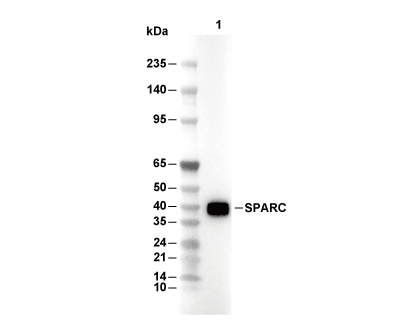 Lane 1: HUVEC