
|
受注:045-509-1970 |
技術サポート:tech@selleck.co.jp 平日9:00〜18:00 1営業日以内にご連絡を差し上げます |
生物学的記述
| Specificity | Stathmin Antibody [M5B10] detects endogenous levels of total Stathmin protein. |
|---|---|
| Background | Stathmin (STMN1, Op18) is a ubiquitously expressed cytosolic phosphoprotein of the stathmin family that regulates the microtubule cytoskeleton and integrates mitogenic and stress signals with control of cell proliferation, motility, and differentiation. The protein contains a conserved C terminal stathmin-like domain and an N terminal regulatory region rich in serine residues that undergo reversible phosphorylation by cell cycle and signaling kinases, and these two regions cooperate to couple upstream pathways to the state of the microtubule network. The stathmin-like domain binds soluble αβ tubulin heterodimers, maintains them in a nonpolymerizable curved conformation, and prevents their incorporation into growing microtubules, while also promoting transitions from growth to shrinkage at microtubule ends, which decreases microtubule polymer mass and increases microtubule turnover. The N terminal serine residues act as a graded regulatory switch; the unphosphorylated form shows strong tubulin binding and high microtubule destabilizing activity, and progressive phosphorylation at these sites reduces tubulin binding and weakens microtubule destabilization, so the phosphorylation pattern of Stathmin sets the balance between available tubulin dimers and polymerized microtubules at any time in the cell cycle. During G2/M transition, Stathmin exhibits high phosphorylation and low destabilizing activity, and spindle microtubules become stable enough to support chromosome alignment and segregation, whereas during G1 and early S phase the protein is more dephosphorylated and microtubule destabilization is stronger, which contributes to dynamic remodeling of the interphase microtubule network. Stathmin protein abundance remains relatively constant through the cycle, so control occurs mainly at the level of phosphorylation and dephosphorylation rather than protein synthesis or degradation, and this places Stathmin as a central element in timing microtubule behavior with checkpoint transitions at G1/S and G2/M. In many solid tumors and hematologic malignancies, Stathmin expression is elevated and the protein often shows altered phosphorylation patterns, and these changes associate with high proliferative capacity, increased cell motility, and modified sensitivity to microtubule targeting chemotherapeutic agents. |
使用情報
| Application | WB, IHC, IF | Dilution |
|
||||||
|---|---|---|---|---|---|---|---|---|---|
| Reactivity | Human, Mouse, Rat | ||||||||
| Source | Rabbit Monoclonal Antibody | MW | 19 kDa | ||||||
| Storage Buffer | PBS, pH 7.2+50% Glycerol+0.05% BSA+0.01% NaN3 | Storage (from the date of receipt) |
-20°C (avoid freeze-thaw cycles), 2 years | ||||||
References
|
Application Data
WB
Validated by Selleck
-
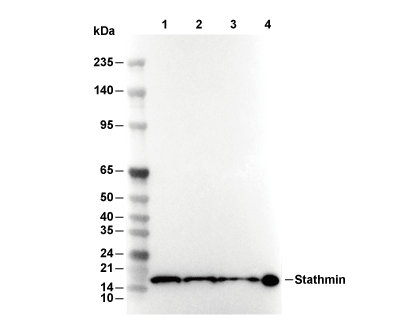 Lane 1: MCF7, Lane 2: Hela, Lane 3: C6, Lane 4: 3T3