
|
受注:045-509-1970 |
技術サポート:tech@selleck.co.jp 平日9:00〜18:00 1営業日以内にご連絡を差し上げます |
化学情報
|
Synonyms | E7438 | Storage (From the date of receipt) |
3 years -20°C powder 1 years -80°C in solvent |
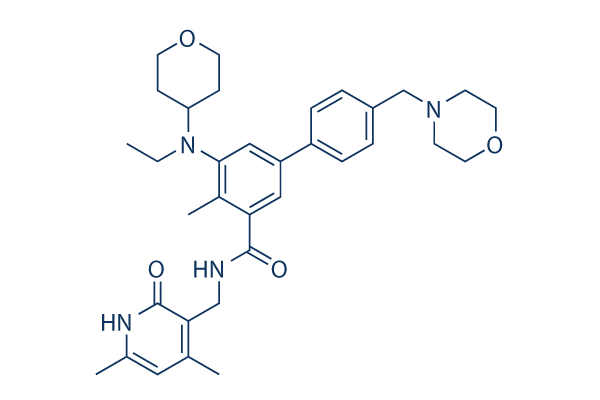
| 化学式 | C34H44N4O4 |
|||
| 分子量 | 572.74 | CAS No. | 1403254-99-8 | |
| Solubility (25°C)* | 体外 | DMSO | 100 mg/mL (174.59 mM) | |
| Water | Insoluble | |||
| Ethanol | Insoluble | |||
|
* <1 mg/ml means slightly soluble or insoluble. * Please note that Selleck tests the solubility of all compounds in-house, and the actual solubility may differ slightly from published values. This is normal and is due to slight batch-to-batch variations. |
||||
溶剤液(一定の濃度)を調合する
生物活性
| 製品説明 | Tazemetostat (EPZ-6438, E7438) is a potent, and selective EZH2 inhibitor with Ki and IC50 of 2.5 nM and 11 nM in cell-free assays, exhibiting a 35-fold selectivity versus EZH1 and >4,500-fold selectivity relative to 14 other HMTs. |
|---|---|
| in vitro | Tazemetostat (EPZ-6438) concentration-dependently reduces global H3K27Me3 levels in wild-type or SMARCB1 mutant cells, and induces strong antiproliferative effects with IC50 ranging from 32 nM to 1000 nM in SMARCB1-deleted MRT cell lines. It induces gene expression of neuronal differentiation and cell cycle inhibition, while inhibtis expression of Hedgehog pathway genes, MYC and EZH2. [1] The antiproliferative effect of this compound is enhanced by either NSC-9900 or Hexadecadrol in several EZH2 mutant lymphoma cell lines. [2] |
| in vivo | In SCID mice bearing s.c. G401 xenografts, Tazemetostat (EPZ-6438) induces tumor stasis during the administration period and produces a significant tumor growth delay with minimal effect on body weight. [1] |
| 特徴 | Orally bioavailable EZH2-selective inhibitor for both wild-type and mutant. Currently being tested in Phase II clinical trials for treatment of Diffuse Large B Cell Lymphoma. |
プロトコル(参考用のみ)
| キナーゼアッセイ | Biochemical Methods | |
|---|---|---|
| Tazemetostat (EPZ-6438) is incubated for 30 min with 40 μL per well of 5 nM PRC2 (final assay concentration in 50 μL is 4 nM ) in 1X assay buffer (20 mM Bicine [pH 7.6], 0.002% Tween-20, 0.005% Bovine Skin Gelatin and 0.5 mM DTT). 10 μL per well of substrate mix comprising assay buffer 3 H-SAM, unlabeled SAM, and peptide representing histone H3 residues 21-44 containing C-terminal biotin (appended to a C-terminal amide-capped lysine) are added to initiate the reaction (both substrates are present in the final reaction mixture at their respective Km values, an assay format referred to as ‘‘balanced conditions’’. The final concentrations of substrates and methylation state of the substrate peptide are indicated for each enzyme Reactions are incubated for 90 min at room temperature and quenched with 10 μL per well of 600 μM unlabeled SAM, Then transferred to a 384-well flashplate and washed after 30 min. | ||
| 細胞アッセイ | 細胞株 | Mutant cell lines (G401, A204, G402, KYM-1), Wild type cell line (RD, 293, SJCRH30) |
| 濃度 | ~10 μM | |
| 反応時間 | 7 days | |
| 実験の流れ | For the adherent cell line proliferation assays, plating densities for each cell line are determined based on growth curves (measured by ATP content) and density over a 7-d time course. On the day before compound treatment, cells are plated in either 96-well plates in triplicate (for the day 0–7 time course) or 6-well plates (for replating on day 7 for the remainder of the time course). On day 0, cells are either untreated, DMSO-treated, or treated with Tazemetostat (EPZ-6438) starting at 10 µM and decreasing in either threefold or fourfold dilutions. Plates are read on day 0, day 4, and day 7 using Cell Titer Glo, with compound/media being replenished on day 4. On day 7, the six-well plates are trypsinized, centrifuged, and resuspended in fresh media for counting by Vi-Cell. Cells from each treatment are replated at the original density in 96-well plates in triplicate. Cells are allowed to adhere to the plate overnight, and cells are treated as on day 0. On days 7, 11, and 14, plates are read using Cell Titer Glo, with compound/media being replenished on day 11. Averages of triplicates are used to plot proliferation over the time course, and calculate IC50 values. For cell cycle and apoptosis, G401 and RD cells are plated in 15-cm dishes in duplicate at a density of 1 × 10⁶ cells per plate. Cells are incubated with this compound at 1 µM, in a total of 25 mL, over a course of 14 d, with cells being split back to original plating density on day 4, 7, and 11. Cell cycle analysis and TUNEL assay are performed using a Guava flow cytometer, following the manufacturer’s protocol. |
|
| 動物実験 | 動物モデル | SCID mice bearing s.c. G401 xenografts. |
| 投薬量 | ~500 mg/kg | |
| 投与方法 | Oral administration | |
参考
|
カスタマーフィードバック
-
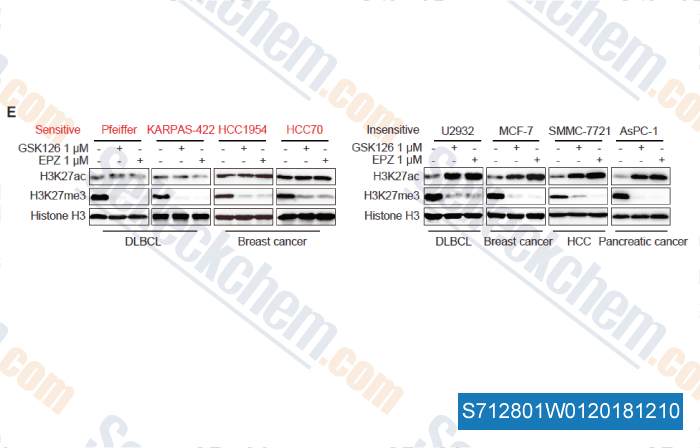
Data from [Data independently produced by , , Cell, 2018, 175(1):186-199]
-
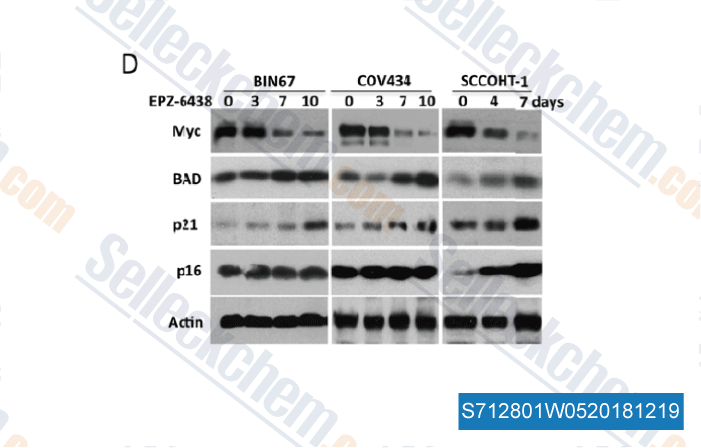
Data from [Data independently produced by , , J Pathol, 2017, 242(3):371-383]
-
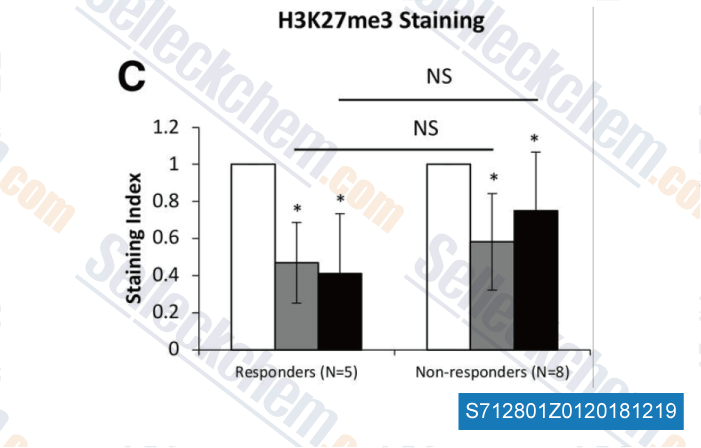
Data from [Data independently produced by , , Clin Epigenetics, 2018, 10(1):121]
Selleckの高級品が、幾つかの出版された研究調査結果(以下を含む)で使われた:
| Whole-exome tumor-agnostic ctDNA analysis enhances minimal residual disease detection and reveals relapse mechanisms in localized colon cancer [ Nat Cancer, 2025, 10.1038/s43018-025-00960-z] | PubMed: 40301653 |
| Genome-wide CRISPR screen identifies Menin and SUZ12 as regulators of human developmental timing [ Nat Cell Biol, 2025, 27(9):1411-1421] | PubMed: 40897805 |
| Constitutive expression of the transcriptional co-activator IκBζ promotes melanoma growth and immunotherapy resistance [ Nat Commun, 2025, 16(1):5387] | PubMed: 40562773 |
| Single cell suppression profiling of human regulatory T cells [ Nat Commun, 2025, 16(1):1325] | PubMed: 39900891 |
| A specific form of cPRC1 containing CBX4 is co-opted to mediate oncogenic gene repression in diffuse midline glioma [ Mol Cell, 2025, 85(11):2110-2127.e7] | PubMed: 40403727 |
| HIF-independent oxygen sensing via KDM6A regulates ferroptosis [ Mol Cell, 2025, 85(15):2973-2987.e6] | PubMed: 40712585 |
| The NEXT complex regulates H3K27me3 levels to affect cancer progression by degrading G4/U-rich lncRNAs [ Nucleic Acids Res, 2025, 53(4)gkaf107] | PubMed: 39988317 |
| Differential regulation of FADS2 by EZH2 reveals a metabolic vulnerability in ovarian cancer treatment [ EBioMedicine, 2025, 119:105879] | PubMed: 40818202 |
| EZH2 inhibition mitigates HIV immune evasion, reduces reservoir formation, and promotes skewing of CD8+ T cells toward less-exhausted phenotypes [ Cell Rep, 2025, 44(5):115652] | PubMed: 40333189 |
| EZH2 inhibition sensitizes MYC-high medulloblastoma cancers to PARP inhibition by regulating NUPR1-mediated DNA repair [ Oncogene, 2025, 44(6):391-405] | PubMed: 39562655 |
長期の保管のために-20°Cの下で製品を保ってください。
人間や獣医の診断であるか治療的な使用のためにでない。
各々の製品のための特定の保管と取扱い情報は、製品データシートの上で示されます。大部分のSelleck製品は、推薦された状況の下で安定です。製品は、推薦された保管温度と異なる温度で、時々出荷されます。長期の保管のために必要とされてそれと異なる温度で、多くの製品は、短期もので安定です。品質を維持するが、夜通しの積荷のために最も経済的な貯蔵状況を用いてあなたの送料を保存する状況の下に、製品が出荷されることを、我々は確実とします。製品の受領と同時に、製品データシートの上で貯蔵推薦に従ってください。